
Deep Domain Expertise Weighs In to Reinvent a Broken Business
Introduction
Have photographs lost their economic value? One might make that case by connecting the dots, from photo agency consolidation and the transition from film to digital image capture, the conjunction of crowd-sourcing with the World Wide Web and social media, to underserved publishers and the sorry circumstances that challenge photographers who try to earn a living.
The good news is that photography (both still & video) remains vital to every aspect of commerce. Business needs photography. Its demand is both enduring and universal. Living, breathing photographers are in no danger of being replaced by artificial intelligence. The value of original photography, including the value of the people who produce it, is unequivocal for commercial brands and media companies that publish pictures to inform and connect with their own customers. However, it is increasingly hard for them to find commercially useful pictures. It should therefore be clear that the economic issues confronting photographers are directly related to issues of utility facing publishers. (Wedding & Portrait photography, incidentally, is a separate and unrelated industry.) The question should be, Is photography underpriced?
Shutterstock and Adobe, the two publicly-traded companies engaged in photo distribution, agree it’s underpriced. So do their privately-held competitors; mostly startups but including giant Getty Images. Public records uphold that assertion. And, to their dismay, they have all been unable to raise prices. Revenue throughout the industry has been flat for a decade.
You Get What You Pay For
It’s not an inclination of market forces that keeps prices down. It’s because the most sought-after imagemakers in the world deliberately withhold their premium content from online sales. That fact was confirmed firsthand, to me, by the topmost AdobeStock executives. It is further evidenced by empirical observation, stemming from my own four decades in this industry, plus a recent poll of 9,500 working pro photographers which yielded 1,087 responses (11.4%) and astonishing detail about their photography practices.
The withholding of premium content and a correlation between low prices and poor quality notwithstanding, additional causes of marketplace dysfunction are less than obvious if you’re not either 1) a practicing art director or graphic designer — a buyer, or 2) shooting pictures for commercial publication — a seller. For everyone else, despite the universal presence of cameras and photographs, the business of photography is about as well understood as a cocker spaniel understands how dog food gets in a can.
Taking pictures is effortless.
The BUSINESS of taking pictures is NOT effortless.
Missing from discussions about the business side of photography — and how to price it — is the importance of data. More to the point, the data are missing. Not one company collects or analyzes individual transactions between commercial photographers and the publishers they shoot pictures for, despite the fact that they generate $14 billion in revenue each year doing business with each other.
Without the availability of data, that $14B figure will remain flat. Moreover, the incumbent middlemen are incapable of building an online infrastructure to capture these data, without pivoting to such an extent that they would cannibalize their existing revenue. Not even Adobe, which touches the work of practically every imagemaker on the planet, can see transactions between pro photographers and their clients. (More about that will be explained later.)
But, first, from a privacy perspective, what difference is there — any wary photographer may ask — between a Facebook or a Google surreptitiously collecting private information and monetizing it with third parties versus a company that collects data about photographers and their economic relationships with publishers? The difference is that ONLY the photographers and publishers who create the data can use the data. The data give them interactive and actionable market intelligence to make doing business with each other more productive. There is no pernicious effect on privacy.
Photographers and publishers are equally aware of how back-office innovation has languished throughout years of indifference while technology continued its advance on the creative side, particularly the sexier science of digital image capture. That led to neglect of both administrative infrastructure and best practices; so that today, in the 21st century, the business side of photography, including payments, limps along with 1995 technology. Industry protocol still relies on paper transactions; e.g., “your check is in the mail.”
This treatise will get you inside the heads of real photographers and real photo buyers. And it offers a solution to the problems they face doing business.
Who Am I to Say?
Having packed in a career as a USC-educated classical musician to become a photojournalist, I’ve covered hundreds of historical and breaking news events for major periodicals worldwide. I’ve shot many hundreds of portraits, including magazine covers from John Lennon to Steve Jobs, plus two sitting American presidents (Carter and Reagan) for the covers of Time and Fortune. I’ve also shot advertising campaigns for Fortune 500 companies, Hollywood movie studios, and the US Navy.
My career-long body of work, shot on film, was acquired for conservation and academic research by the Briscoe Center for American History at the University of Texas at Austin. My portrait prints are collected by museums, including the Los Angeles County Museum of Art and the National Portrait Gallery in London.
I created PhotoByte®, the first successful CRM/licensing-and-billing software for commercial photographers. And I wrote the book, if you will, about the business of photography: Photography: Focus on Profit (Allworth Press, 2002). It has been used to teach at colleges across the country.
I founded a venture-funded startup during the “dotcom bubble” and, more recently, matriculated the StartX collaborative community of startups affiliated with Stanford University.
I was also represented (consecutively) by two preeminent international photo agencies, Sygma and Gamma-Liaison, until they were acquired in the 1990s by Corbis and Getty Images respectively. I went to great lengths to remove all of my physical film and all digital traces of my work from these two online exchanges. Despite my having forbidden them to further license my work, I discovered they were still doing so — for insulting and paltry fees. In years past, I’ve received several very small checks in the mail from Getty Images for photographs I did not shoot.
A Break with Tradition Put the Brakes on Revenue
Photo agencies once represented accomplished and carefully vetted photographers on an exclusive basis. They ensured that major brands and media companies could find the best pictures publishers could use, to inform and communicate with their own customers. The price of a publication license, for any given picture, varied in accordance with its commercial value to the publisher. But the role of the photo agency was usurped years ago by private equity investors — today’s middlemen. They had no prior experience in photography. They deliberately sidestepped organic growth to exploit an obviously lucrative consumer-facing opportunity — obvious as in low-hanging fruit, easy to do. They didn’t so much disrupt the photo marketplace asbuy it.
The upshot was to set in motion a creeping institutional memory loss (a photographic memory loss, if you will) about the larger, multibillion-dollar enterprise market segment: the brands and media companies.
In other words, some unwelcome interlopers frittered away the capacity to serve institutional publishing clients by focusing, instead, on an emerging retail-consumer base. This new consumer segment consisted of freelancers, shopkeepers, startups, and very small businesses with little money to spend on photo or video production, but with a need to fill an exponentially increasing number of websites and blogs with pictures. They simply forgot about the already established and more lucrative business associated with enterprise photo publishing.
The displacement of the photo agency business model has been likened to a hostile takeover with two insidious consequences:
1) Photographers lost control over pricing their own work.
2) Publishers were flooded with lesser-quality content.
These outcomes are underscored by the spreading mediocrity of stock photos, their burgeoning overabundance yet frustrating lack of exclusivity, a sore relationship between creatives and middlemen, and the fragmentation of billions of dollars in commissioned jobs revenue. These are not separate issues.

A New Kind of Marketplace for Photography
Publishers are unhappy with stock photos in particular becausephotographers — who are business owners but artists temperamentally — have a hard time trying to navigate the world of commerce and shoot pictures at the same time. And because so many are one-man bands, taking care of business is even more problematical. They spend too much time looking at their laptops and not enough time looking through their lenses. Online workflow automation is nonexistent.
A holistic approach is required to create a dynamic source of pre-shot stockphotos that satisfies publishers by, first, making it easier for them to do business with the photographers they trust to shoot made-to-order jobs.
The online integration of stock photo workflow with commissioned job workflow is a new idea: one proprietary platform where creators and publishers want to be, directly connected — together — within a B2B marketplace network. It need not support retail-consumer transactions or even try to compete on that front.
Is the picture getting clearer?
Consumers are a class, an audience targeted by Enterprise brands and media to see and be influenced by commercially produced, published photographs. It is vital to understand that consumers do not create photographs for commercial publication. What photos they do create are for their own personal satisfaction and use. What photos they download are created by amateurs. And because downloads are dirt cheap and used without discretion, they are limited to trivial publication purposes.
Mediocrity is baked-in to the Consumer segment of the Commercial Photo market, particularly stock photo sales, because buyers can only afford to pay trifling prices. They get trifling quality in kind. When trifling with the quality of content, middlemen can only make money on a high-volume of sales. This business model is enabled by how cheap and easy it is to collect staggering numbers of photos through crowd-sourcing, and because consumers are infinitely less picky about quality and exclusivity than higher-paying enterprise publishers who cannot abide mediocrity.
Photographs, whether shot on assignments or chosen from pre-shot stock, acquire tremendous commercial value when they become associated with brand identities. Corporations will protect these assets at any cost. Such photographs are created by an elite class of photographers.
Elite Photographers
Photographers are elite, not because they say they are but because the clients who pay them — handsomely — say they are. Their clients have already vetted them to shoot made-to-order pictures for publication. But the same clients also want access to unpublished and rights-reverted photographs — they’re called residuals — that have already been shot (and continue to be shot) by these photographers.
Residuals is an industry term of art for pre-shot commercial photography. Residuals are intellectual property belonging to the photographers who created them. But they are practically unavailable for publication because they’re fragmented into tens of thousands of separate pools. Because residuals are not online, they are effectively not on the market. So, how does a publisher tap into this scattered but continuously recharged trove of premium content? (Hint: A “distributed database” with blockchain provenance is not the answer.)
There cannot be three Facebooks or six Googles. Those companies became institutions because, ultimately, there remained only one of each in its class. Right now, there is no “go-to” platform, no home for the worldwide community of commercial photographers and their enterprise publishing clients to congregate. If there were, it would be possible to intercept symmetrical information flowing back and forth between them. In addition to their commercial transactions, it would capture the photographs themselves, passively, seamlessly, and cooperatively during routine electronic file transfers (job delivery/fulfillment) — part of the workflow.
Why is the passive capture of digital image files important? The commercial class of pro photographers categorically refuses to contribute their valuable assets to the stock photo pipeline, let alone to do so proactively.
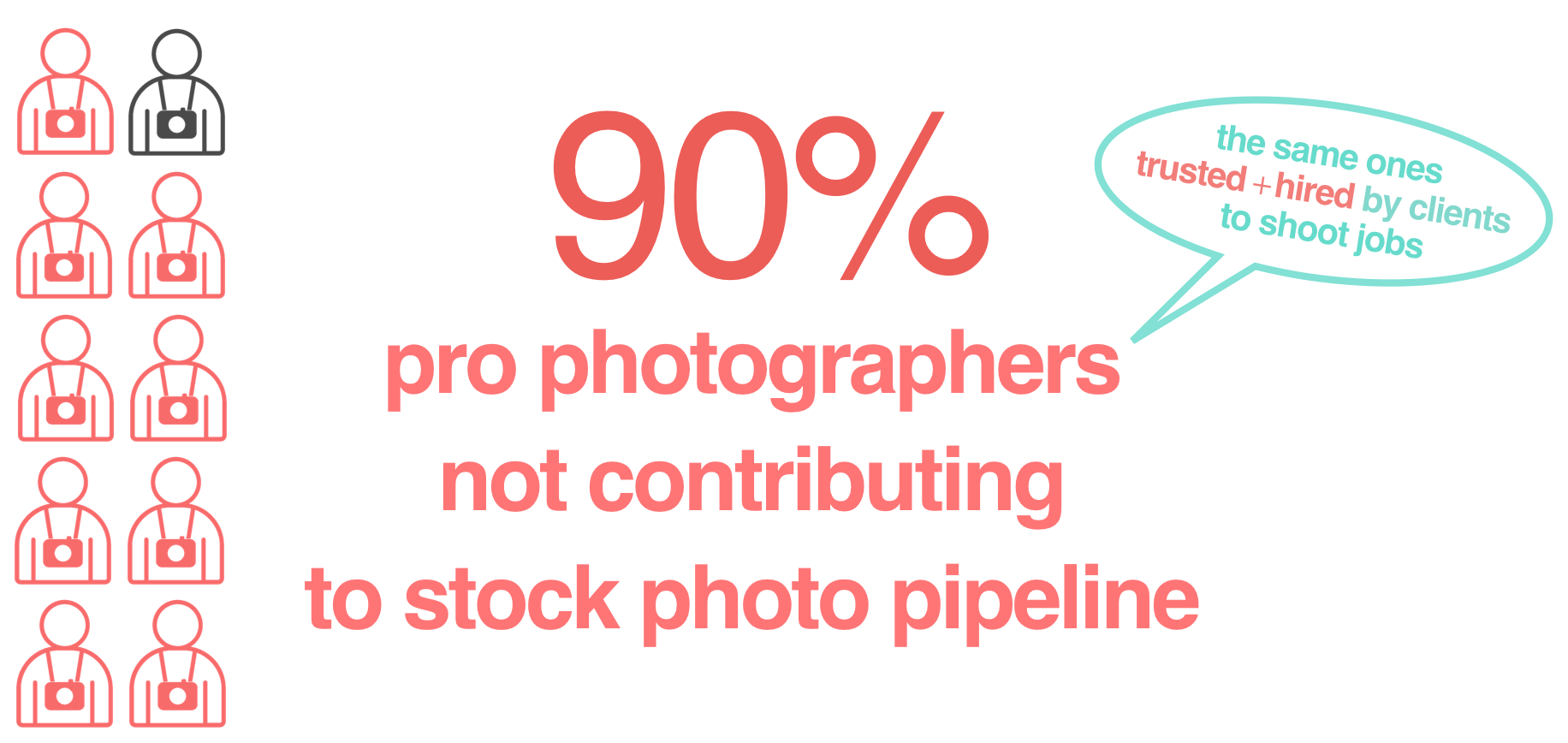
It should be clear that better stock is NOT about better search. Very simply put, ninety percent (90%) of professional photographers do not contribute to the stock photo pipeline. Why is that?
Photography lives at the intersection of art and commerce. But that intersection is not in the cloud, where intellectual property and data mingle, where they can be captured and analyzed to generate a continuously updated inventory in tandem with actionable market intelligence about how photos and videos are actually used. These data can be fed through a rights-managed AI pricing matrix — a pricing engine — and be integrated with a photo-industry-specific electronic payments system.
With such a pricing engine in place (an algorithm), the price of any given photo (i.e., a fee collected in exchange for granting publication rights) is tied to the actual commercial value a publisher derives from each and every specific use, calculated in real time, transaction by transaction, and paid for in real time too. The data, collected by dint of automating this kind of rights-managed pricing for commissioned jobs, has an extraordinarily beneficial knock-on effect. It undoes the prevailing and problematical “one-price-fits-all” model for residuals, for all but the most trivial publications.
Publishers want stock imagery created by the same artists they hire to shoot commercial jobs. They do not want pre-shot crowd-sourced photos. They are aware that the most talented and self-respecting commercial photographers will not “join the crowd” of camera enthusiasts who contribute pictures to online vendors who pile ’em high and sell ’em cheap.
Elite photographers continue to be entrusted with big budgets and even bigger creative responsibilities. They are themselves businesses, each one a discrete entity. They each have operational overhead, often including a studio and many tens of thousands or hundreds of thousands of dollars worth of specialized camera, lighting, and grip equipment to maintain. They employ photo assistants and often direct larger crews of freelance stylists, designers, technicians, location scouts, and producers. Commercial photographers are not interchangeable links in a commodified supply chain, as conventional lay wisdom would have them.
As far as any middleman should be concerned, photographers have equal standing with publishers — as customers. But the vendors who imposed themselves in the middle, who encroached on the role previously played by photo agents, don’t treat photographers as customers at all.
Absent equal respect for the economic concerns of publishers andphotographers, it is categorically impossible to obtain marketing rights to a dynamically replenished source of premium stock photos. The only way publishers can gain access, to pick and choose from such a source is through a broker who can consolidate commmercial pro photographers worldwide under one virtual roof.
It is the responsibility of any third-party broker, or agent, to create an infrastructure that attracts elite commercial photographers like a magnet. By consolidating them, it’s easier for them to do business with their existing clientele — and vice versa.
Do not forget that these photographers come with their content. It is theirintellectual property. According to US federal law, they own it, lock, stock, and copyright, no matter who paid to produce it. It is no supposition that publishers are attracted to the quality and exclusivity of this content. Publishers follow the content. Full stop.
The role of a marketplace broker-cum-agent — indeed the proprietor of a platform — is different than the role played by middlemen in a consumer-facing retail marketplace. That’s because sellers and buyers, in the B2B Enterprise segment of Commercial Photo, have already cultivated direct relationships with each other. There is no role for a third party to create those relationships. The thing is, those relationships are off-line. That means their content and revenue are off-line too — fragmented. Rewards are aplenty for the broker who can facilitate transactions between them, optimizing economic outcomes for both.
If the most tried-and-true investment thesis is to take an essential industry that’s not digital, and make it digital, it’s not hard to see how connecting photographers online with their existing clients will do the following:
• Consolidate photographers on one proprietary platform: a virtual content cartel
• Consolidate Digital Asset Management for publishers
• Automate complex B2B licensing transactions
• Protect intellectual property rights for photographers
• Foster exclusivity in the stock photo pipeline for enterprise publishers
• Institutionalize electronic billings & payments industry-wide
Economic and creative outcomes for photographers and publishers are radically transformed by building a marketplace network where photo industry participants want to be. Such a marketplace prevents inventory bloat and the overuse of individual photographs, thus protecting every buyer’s unique brand identity, so different companies don’t get screwed using the same picture. It makes prices sustainable for photographers and affordable for publishers by leveling the economic playing field, then tilting both sides toward the proprietor of this marketplace, facilitating transactions in the middle of the revenue stream.
I wrote a book alluding to this issue many years ago: Photography: Focus on Profit (Allworth Press, 2002). It is timelier today because the technology to do this is available today. By the end of this in-depth article, summarized at the end, it should be clear that photography is indeed underpriced; why it is underpriced; and how underpricing adversely affects industry-wide productivity and growth. And I’ll explain how to fix it.
Sidebar
To have an intelligent discussion about the future of photography, three misconceptions must be dispelled. Here are your noise-canceling headphones:
1) Blockchain addresses issues that keep photographers up at night.
NOT TRUE. In the Commercial Photo industry, blockchain is hardly necessary to establish intellectual property ownership and provenance.
Blockchain is categorically incapable of “protecting” either the legal or economic prerogatives of copyright holders. Straightforward ways to do that already exist, although they can and should be automated. Moreover, relying on a “distributed” or “decentralized” inventory of pre-shot stock photos would only create new problems, not solutions, for publishers.
……………………………
2) Image curation and post-production image processing pose grand problems for artificial intelligence to solve.
NOT TRUE. This is routine stuff. Creatives have bigger fish to fry.
……………………………
3) There are millions of photographers.
NOT TRUE. In fact, there are only about 125,000 working pros shooting commercially worldwide (earning billions of dollars in fees). Many more people claim to be photographers, implying a professional standing. It’s mostly wishful thinking. Some are indeed pros, who earn their livings shooting weddings, head-shots, and “grip-and-grin” events. But theirs is an unrelated industry, not even a segment of Commercial Photo. Their business is aimed at ordinary retail consumers. Despite their use of cameras, in common with commercial photographers, they are not hired by major corporate brands and editorial media companies to shoot pictures for publication. They have no enterprise clientele.
Many more claimants are camera enthusiasts who enjoy the concept of “sharing” photos. Less concerned about making money but proud of their work, they’ve found an outlet to show-off online. A lot of them are quite good — better than good. Sometimes they earn a few dollars for pictures in a retail, consumer-commodity context. It’s not enough to buy a new lens.
<<End of Introduction>>

First Order of Business:
Understanding the Economic Difference between Stock Photos and Assignment Photos (Jobs)
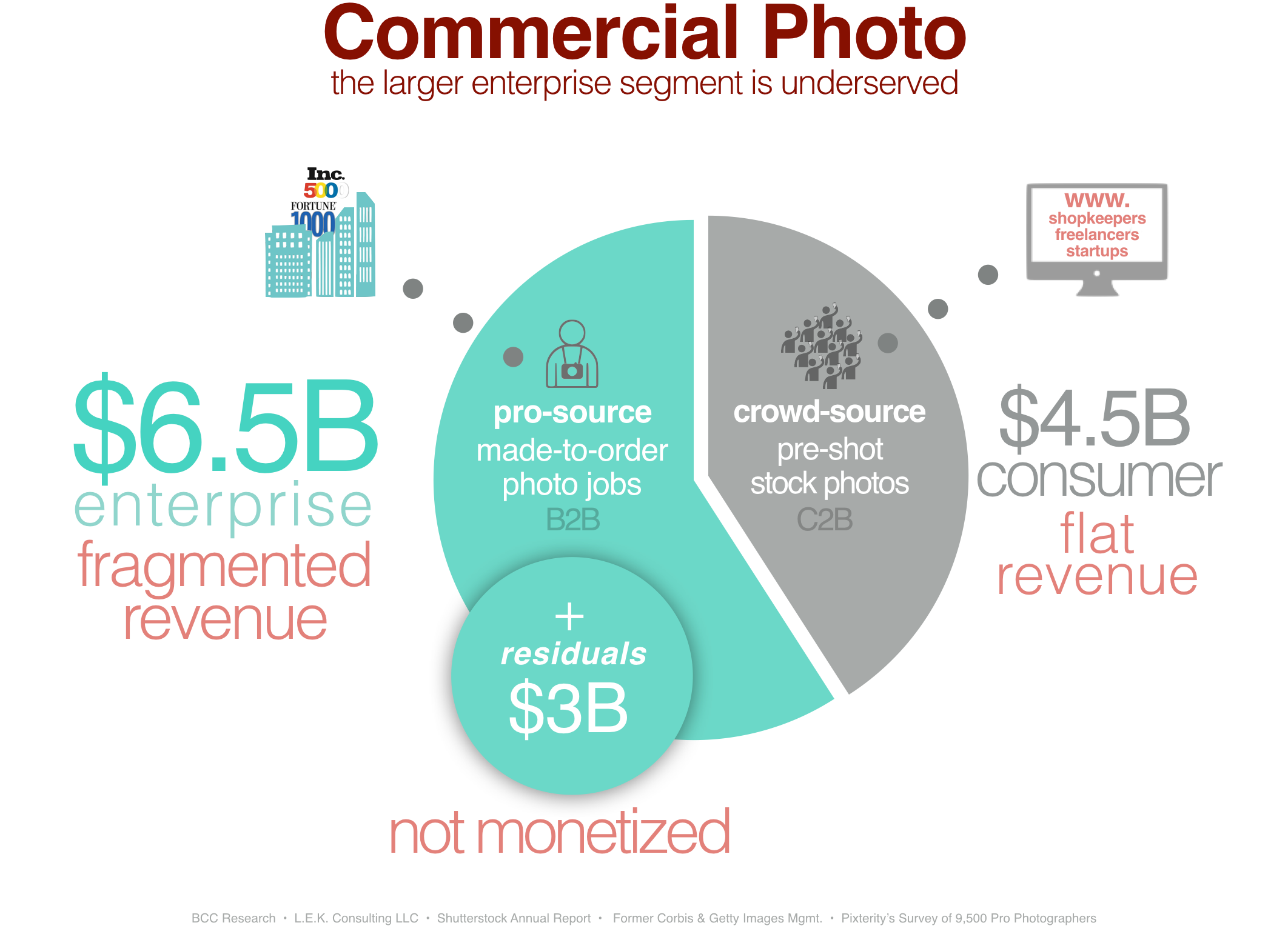
Consumer-retail stock photo sales represent a $4.5 billion segment of the $14 billion photo-publishing industry. It is the business of licensing and re-licensing pre-shot photographs for publication. For commercial and editorial use that is, not art to hang on the wall or to memorialize private events. Stock photographs are used mostly by very small businesses — shopkeepers, startups, freelancers, etc. — to illustrate Web pages, blogs, brochures, and Powerpoint presentations.
Major brands will license stock photos too, often for comprehensive page layouts (“comps” for short). Comps are visual rough drafts presented by graphic designers and art directors to their clients for approval, to show what a finished project will look like when published in print, online, or broadcast.
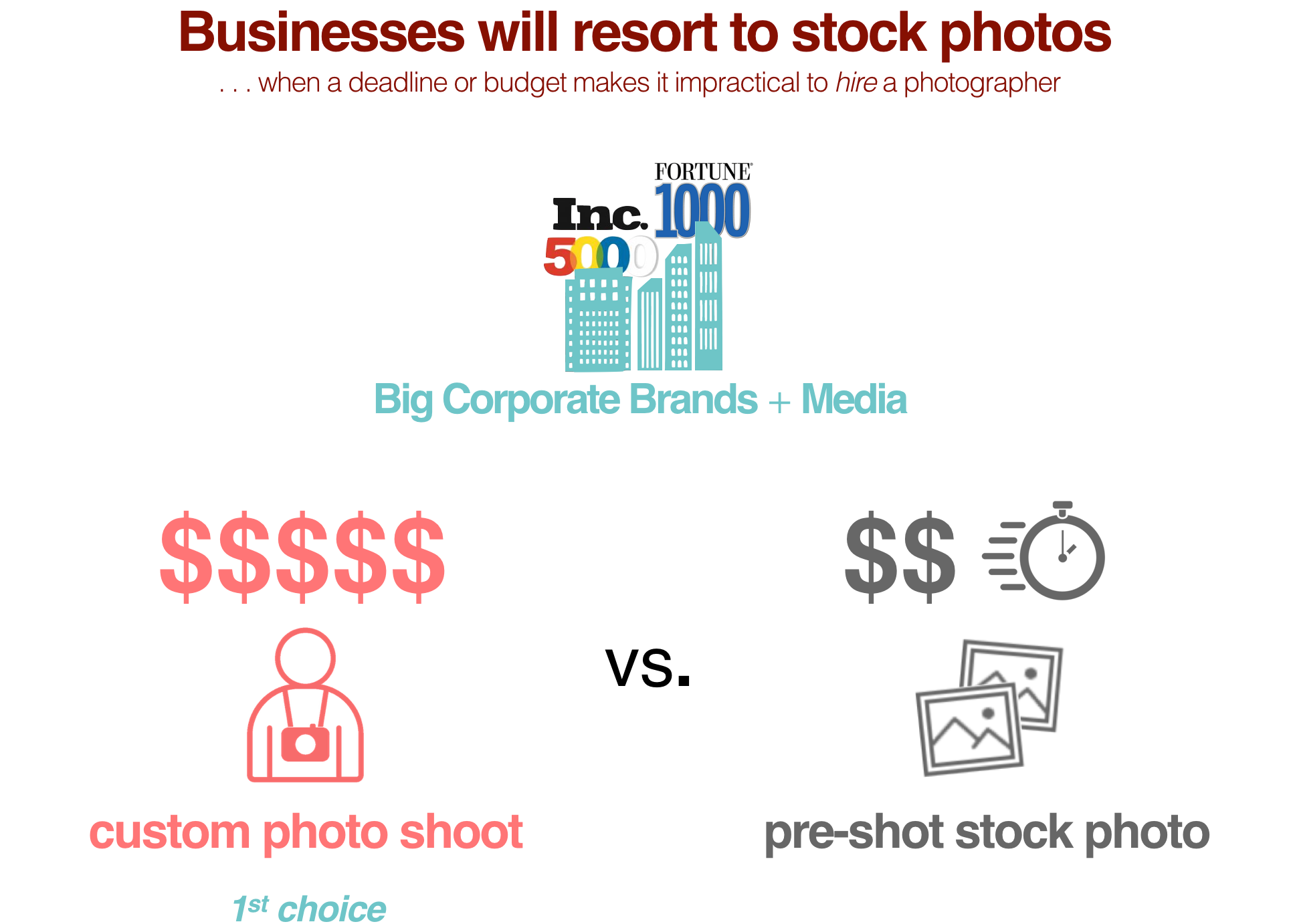
If a stock photo is used in the final version of a publication it will command a higher licensing fee (also called a usage fee) commensurate with the extent of publication rights granted. But, generally, these pictures are available for quick digital downloads on the cheap when a limited budget or a looming deadline makes it impractical to hire a photographer for a made-to-order photo assignment.
Stock photos are sometimes available directly from the photographer who shot them. They are more likely to be licensed from a centralized customer-searchable catalog, an e-commerce exchange owned and operated by a middleman. Stock may include pictures of timeless historical value (all digitized now) including famous people, places, and things. But middlemen, as well as photographers who are dedicated to shooting stock, continuously anticipate abstract themes and specific subject matter that publishers are likely to want illustrated in a rapidly changing commercial and visual environment, news photography notwithstanding.
Most stock photos have a limited shelf-life, just like food — a “use-by date.” They are considered perishable if their subject matter is likely to lose credibility or relevance over time, and look dated. Ergo, stock photos must continually be replenished to reflect what is new in the worlds of fashion, politics, sports, celebrity, cultural ephemera — generally everything imaginable. (There are stock videos too.)
Life’s a Pitch
Many attempts have been made to reinvent the photo business. After all, it is a multibillion-dollar industry with equal relevance to technology, commerce, and culture. Yet it is fraught with severe customer-dissatisfaction issues; and its potential for growth is not clearly understood beyond consolidating existing stock photo inventories: big fish swallowing smaller fish. Nevertheless, entrepreneurs have shown a serial determination to beat Getty Images, the biggest fish, at its own game. But, first, they have to run a gauntlet of investors.
As an “artrepreneur,” I’ve seen a few investor pitches. I’ve made a few investor pitches. It’s a Silicon Valley ritual.
Typically, a successful pitch describes a problem that strikes a chord with everyone in the room. It has immediate relevance, and it offers a solution. Or it addresses a new twist to an established technology that only affects consumers indirectly, but makes immediate sense to investors. That said, no one in the room has ever licensed a stock photo for either commercial or editorial publication. Nor has anyone ever hired a photographer to shoot such a photograph — or shot one themselves. Still, both the ubiquity and demotic appeal of photography predispose everyone to think, “I know all about this.” But what they know is riding the rails of presumption.
After all, everyone has a camera. Many people use Instagram too. SmugMug, Apple Photos, and Google Photos are electronic shoeboxes for storing their snapshots. Lots of people have had the experience of hiring a wedding photographer or someone to take a publicity headshot. You, or someone you know, may have attracted news-media attention and become the subject of a photojournalist. And who hasn’t downloaded a photo to illustrate a Web page, a blog post, or a Powerpoint presentation? But laypeople are totally unfamiliar photography’s greater enterprise role. Again, that means everyone who isn’t either a practicing art director, publisher, or a working pro photographer who shoots pictures for publication.
How many more times must the latest razzle-dazzle team of MBAs and Ph.D. engineers, with zero experience in photography, sing the same old song to credulous investors before they all realize it ends on the wrong note — every time?
Two Separate MARKETS: Commercial Photo + Social Photo
Photography’s commercial value, not to mention its other inherent values, is habitually undermined by businesspeople with no photographic experience and by photographers with no business experience. Both parties are to blame for a persistent arrogation — sadly mistaken — that one business model can serve two totally separate markets:
- Commercial Photo, the business of licensing intellectual property to major brands and media companies
- Social Photo (aka Wedding & Portrait), the retail business of selling (not licensing) memorabilia and tangible goods to consumers for personal use (e.g., photo albums)
Two Separate SEGMENTS of One Commercial Photo Market
Investors and startup founders compound their mistake by further conflating two separate segments of the Commercial Photo market as one and the same:
- Enterprise, the business-to-business segment serving major brands and media companies (B2B/pro-sourced)
- Consumer, the retail segment serving shopkeepers, freelancers, bloggers, and startups (C2B/crowd-sourced)
Only when Enterprise and Consumer are acknowledged as separate segments of one market, with each segment serving a different class of customers, is it evident how one hand washes the other.
Note: There is no B2C segment (business-to-consumer) in Commercial Photo. Considering that “B” would represent sellers, “2” would represent middlemen, and “C” would represent buyers, no seller would do business with ordinary consumers per se because they can’t pay enough. Furthermore, individual sellers, who rely on photographic services to earn a living, categorically refuse to allow middlemen (vendors) to represent their sales because middlemen make money on volume transactions at ultra-low prices; too low for any individual seller to sustain a livable income. A putative B2C segment is merely the mirror image of C2B, In either case, only the “2” makes money. C2B (or B2C, if you will) is predicated on extracting huge quantities of content from amateurs and “wannabe” pros who think that getting their pictures published — even for just pennies or for free — will lead to some vague kind of recognition; or maybe lead to good-paying photo assignments. That’s crowd-sourcing. But, to the chagrin of the middlemen themselves, buyers look at the crowd-sourcing of usable (i.e., publishable) photos like the zany logic of expecting a Shakespeare sonnet to emerge from the random typing of a chimpanzee, nonstop over thousands of years.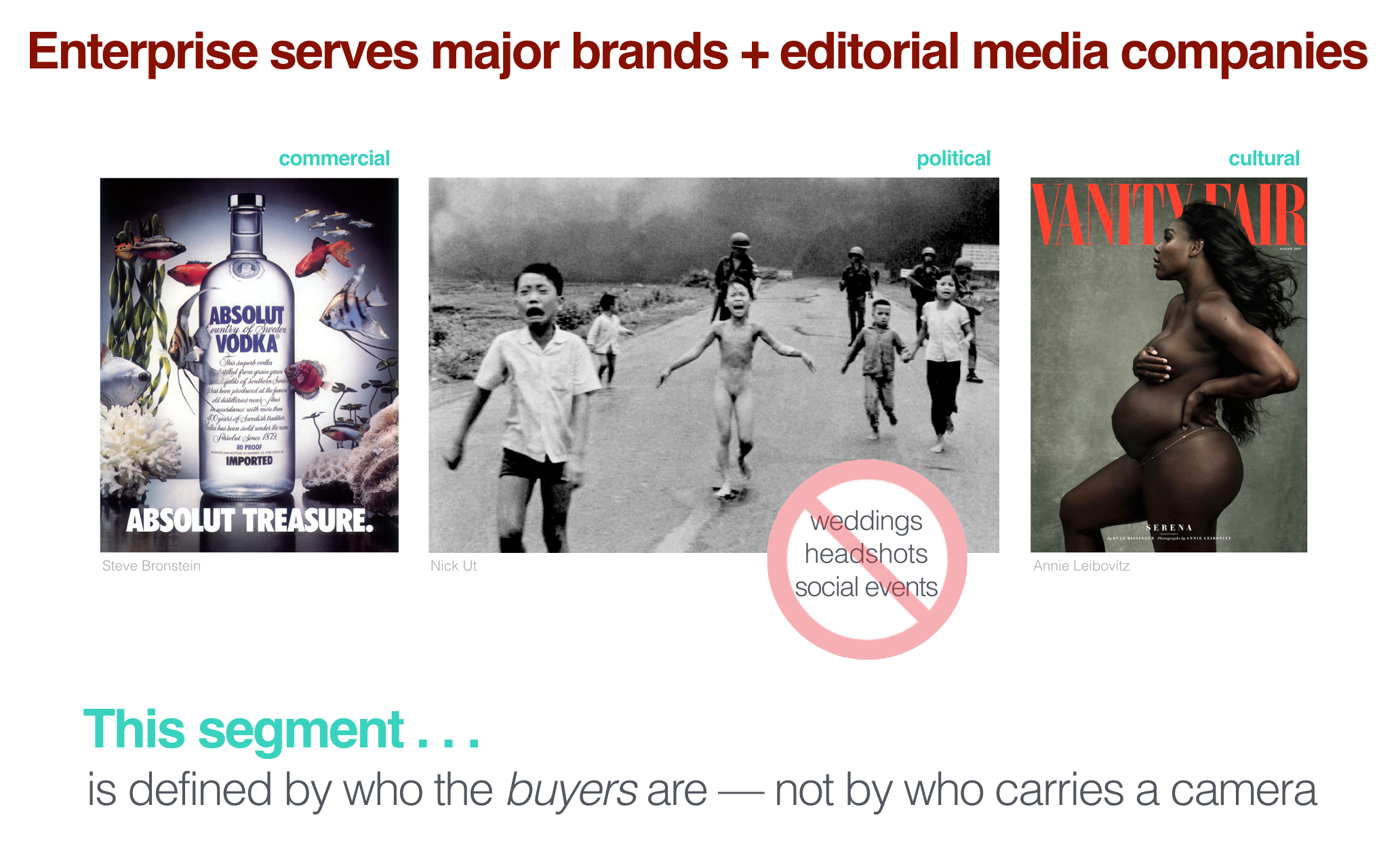
Asboth a seasoned photographer and startup founder, I am bewildered by the fact that investors, time after time, apply the rules of a conventional consumer-facing business to the steeply vertical enterprise of commercial photography. Their failure to appreciate the idiosyncrasies of this marketplace is the very reason an opportunity exists to disrupt it in the first place. And it elicits a rhetorical but unapologetically indignant question: How many more times must the latest razzle-dazzle team of MBAs and Ph.D. engineers, with zero — bupkis, nada — experience in photography, sing the same old song to credulous investors before they all realize it ends on the wrong note — every time?

Investors might be forgiven fortheir confusion, if only becauseboth the Commercial Photo and Social Photo markets use cameras as tools of their respective trades. Less pardonable, however, is the same investors’ inability to differentiate between two segments of one market.
The differences between Commercial B2B and Consumer C2B are as profound as the differences between chess and checkers; two completely different games with completely different rules, whose only similarity begins and ends with a playing board; just as any similarity between two profoundly different business models, Commercial Photo (enterprise publishing) vs. Consumer Photo (retail), begins and ends with a camera.
The public at large is familiar with the Consumer C2B segment. After all, who does not participate in this segment, to one extent or another? Ironically, however, the most lucrative segment of this, the most obvious enterprise in the world — literally obvious, lies hidden in plain sight. Big corporations, along with an aggregation of smaller companies, spend many billions of dollars each year to make sure you see the photographs they produce every day, aiming to influence the financial, cultural, and political decisions you makeevery day.
Texting & Pixting
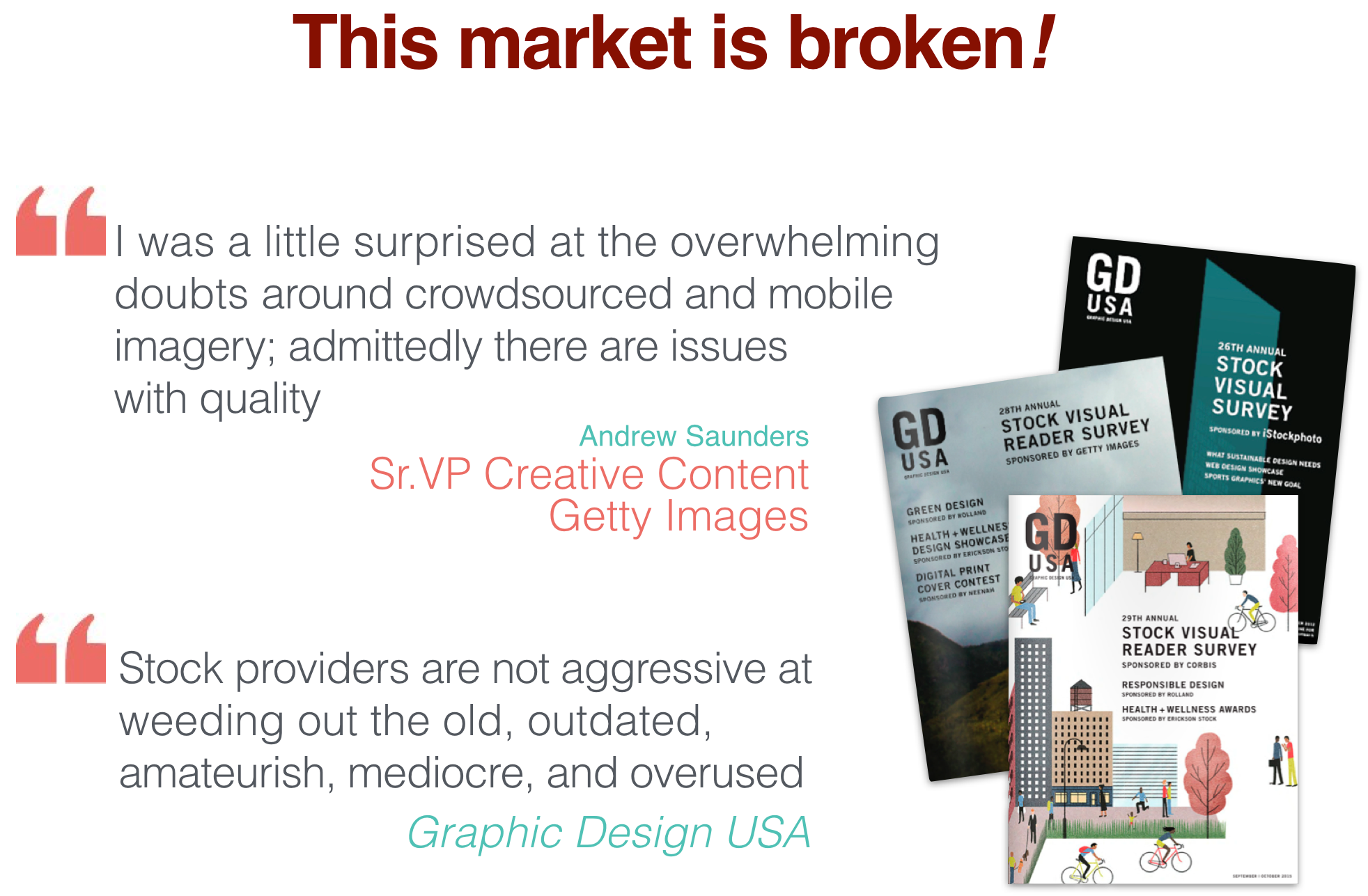
Let me clear up one more widely held misconception. So-called “influencers” on social media platforms like Instagram play no role at all in the photography industry.
Don’t let that surprise you. Influencers are not paid to provide photographic services but for how many “followers” they attract, given their respective talents for garnering “fifteen minutes of fame” (as per Andy Warhol’s timeless dictum). Of course, real celebrities can be influencers too: athletes, musicians, movies stars, etc. They all get paid to guilefully display or deliberately pose with name-brand products, thus making tacit commercial endorsements to their followers.
It’s called “product placement,” of course. It’s a successful way to advertise. You already know that. But it gets more interesting. Influencers with large followings are often financially supported by advertising agencies who employ professional “ringers” to shoot pictures that merely look like user-generated content. But it is not UGC. Pros are hired for their ability to reliably produce an “amateur-looking aesthetic.” Attribution of the resulting pictures is, shall we say, disingenuous. The point is, social media is just another medium for advertisers, who pay pro photographers to create content the good old-fashioned way: they pay them.
The vast preponderance of so-called “content creators,” people who enjoy showing what they ate for breakfast to their online “friends,” are not influencers per se. For real influencers it’s a vocation; it’ their job. They market themselves and earn income. I’m not trying to disparage any porridge paparazzi, but not even millions of social media snapshooters can accomplish what one commercial photographic illustrator can do, just pretending to be an influencer, to get you to buy any given brand of breakfast cereal.
I’ve coined a word for the use of photographic technology on social media: pixting.
Pixting is to photography as texting is to literature. It means engaging in perfunctory conversation by utilizing pictures instead of words across a digital medium. It’s visual smalltalk; the appropriation of a one hundred and seventy-year-old technology called photography for visual chitchat. Anyone can string a few written words together. That doesn’t make them authors. There are a lot of people walking around with cameras. That doesn’t make them photographers.
Do pro photographers use social media? Sure they do. But it’s a means of self-promotion for the most part, to grab the attention of clients who will pay them real money to shoot real jobs—including for publication on social media itself. Can an image published on Instagram be picked up for subsequent use in a commercial ad? Sure, why not?
Defining a Twofold Problem
There are two Bs in B2B, representing two sets of customers. The two sets do business with each other:
- Commercial photographers who create and own intellectual property
- Enterprise publishers who license IP for their own use
The 2 in the middle of B2B represents, of course, the middlemen. Their role is to facilitate transactions between the two Bs. It’s a coveted economic position. But middlemen have failed to acquit themselves comprehensively in that role, in lieu of the photo agents they displaced. Poof! That caused a whole host of problems. Two in particular are voiced loud and clear by sellers and buyers respectively:
- Commercial photographers say, “We’ve lost control over pricing our own work.”
- Enterprise publishers say, “Stock photo inventories offer too many choices, but too few good ones.”
When creators lose control over pricing their own work, publishers get flooded with mediocre content. The two problems act upon each other reciprocally. It is also harder for photographers who shoot commissioned jobs to stay solvent financially and remain available to serve the publishers who rely on their talents for visual problem-solving.
Photobesity
Recently funded photography startups, including Wemark, Photochain, Meero, and EyeEm et al. epitomize “deja vu all over again” or we’ve seen this movie before. Each one boasts about having on-boarded tens of thousands of pro photographers and, by implication, professionally produced content. Balderdash! They say their attraction includes the promised implementation of blockchain technology. They’re kidding themselves.
Many of the ostensibly pro photographers they claim to “on-board” are the same ones already contributing to every other stock photo distributor. Nevertheless, whether they call themselves professionals or not, some terrific photos are bound to turn up in circulation. But terrific photos, too, will get lost in a sea of mediocrity, increasingly diluted by too many millions more not-so-terrific examples. This flood of poorly curated pictures is continuously overtopping an already bloated inventory. Call it photobesity.
Outliers aside, the contributors that startup founders have tried to appeal to are categorically not pro photographers; particularly not just because they say they are, or hope to turn pro one day in the future. In fact, these startups, incumbent photo vendors too, are either delusional or deliberately misleading naive camera enthusiasts to believe they can make money by getting their work seen by lots of buyers. There is a technical term for this gambit: bullshit.
It is misguided to think that any company’s success corresponds with how many proactive content contributors they can recruit. Publishers, the buyers that is, already complain about how hard it is to find the kinds of photos they want amongst so many tens of millions in any given vendor’s inventory. And it’s not because they can’t find any good ones; IT’S BECAUSE THEY ALL FIND THE SAME GOOD ONES, EXACTLY BECAUSE THEY’RE GOOD.
A great photo, once it’s discovered by one buyer, will inevitably be discovered by additional buyers. It will be sold over and over and over again dirt cheap. Thus overused, it is published too many times in too many places by too many different end-users. That’s bad for buyers with brand identities to protect. And it’s bad for photographers trying to make a living.
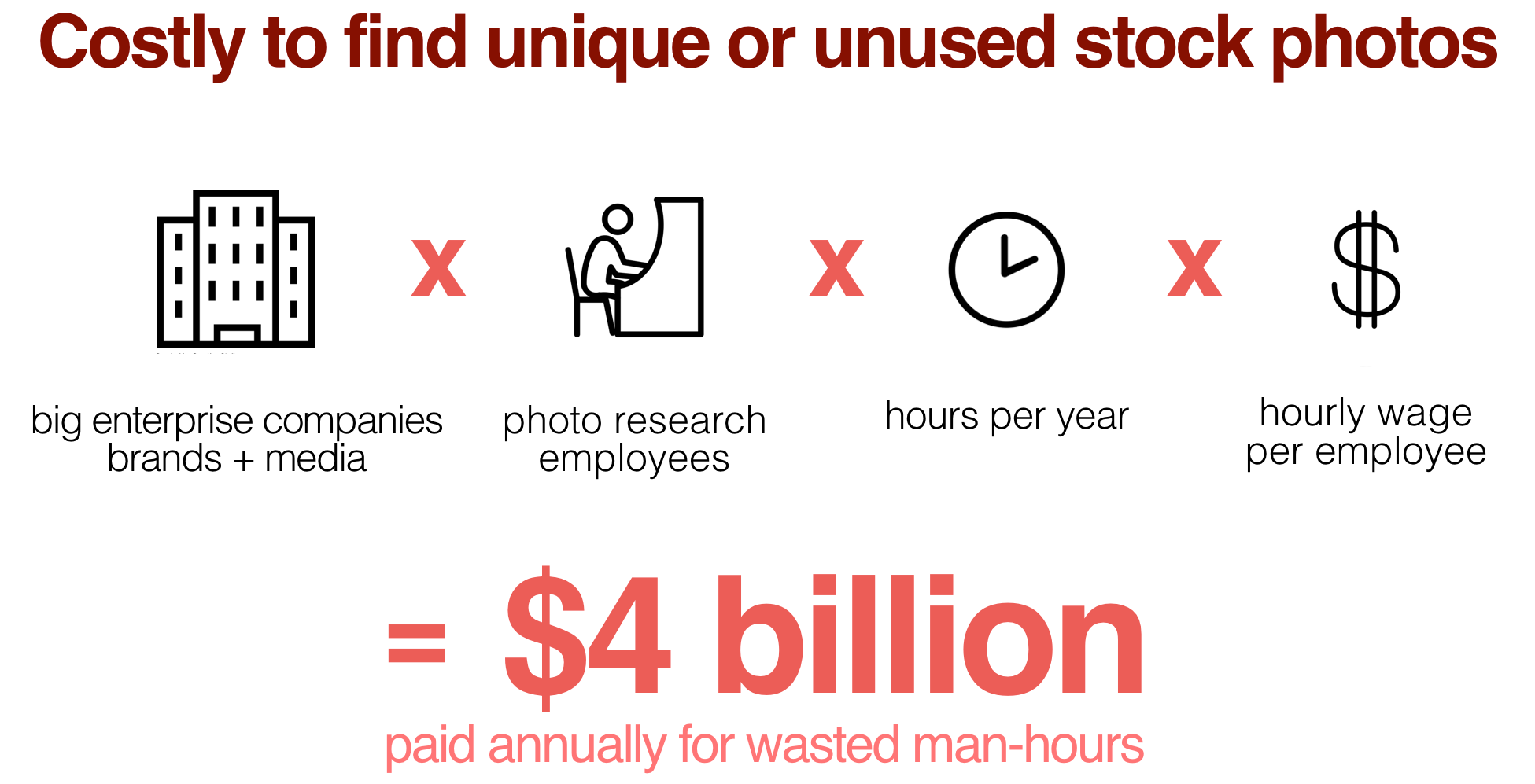
Enterprise publishers are particularly frustrated because they have to comb through inventories that have already been picked clean by tiny businesses and individual consumers who outnumber them exponentially. According to information available on Linkedin.com, it too often costs major brands or media companies more money to find a useable photo than what they might pay for a license to publish it.
According to the 2019 annual survey of commercial image buyers conducted by Visualsteam.com, a distinguished team of marketing professionals, it also takes publishers twices as much time to find an image, today, as it did four years ago.
Eighty-two percent (82%) of stock photos added to the online inventory each year are found and sold on multiple stock photo exchanges. There they sit, gathering digital dust on the virtual shelf for far too long. The incumbent vendors’ business model categorically prevents them from dynamically restocking their inventories with premium content or eliminating what becomes stale and overused because it would mean connecting photographers, sellers, directly with buyers; which contradicts the very idea of being a middleman in a crowd-sourced consumer-facing business.
It’s worth saying again that, just because most stock photos are created by amateur enthusiasts instead of professionals, it doesn’t mean they’re no good. But it does mean the best ones, the most useful ones, are few and far between.
Quality is inconsistent when image inventories are restocked incoherently, by casting a broad net with no effective means of curation. AI cannot do the job. The job is too subjective and idiosyncratic. And if you think the incumbents can employ enough sophisticated humans to eyeball crowd-sourced contributions, I have a bridge in Brooklyn to sell you. Boatloads must be uploaded just to find a few that are worth a publisher’s time and money to download. But poor curation, overuse, and dysfunctional pricing are only symptoms of the root problem. Again, ninety percent (90%) of commercial photographers do not contribute to the stock photo pipeline.
Promises, Promises
Hundreds of millions of dollars have been spent — one could say squandered — by investors on dozens of startup and upstart companies, every one of which has claimed to know how to get pro photographers on board and, hence, better content. They admit it’s their holy grail. But with one risible scheme after another, what they believe will incentivize professionals to contribute content is just putting different shades of lipstick on the same old pig: “We’ll offer them a bigger percentage of royalties.”
No matter how one describes offering a bigger share of revenue to contributors, royalties mean little to professional content producers, almost all of whom earn fees, instead, directly from their own clients for shooting commissioned jobs. That’s how they earn a living; not by dribs and drabs of commodified stock photo income. Pros have given up all expectations of earning income from their residuals in the current market environment. And they’ve all heard that empty “royalty” promise before. It doesn’t jibe with the free in “royalty-free,” the prevailing business model.
Photography has changed radically in the 21st century.
The principles underlying the business of photography haven’t changed one bit.
The incumbents are glued to the idea that one price fits all. That’s what “royalty-free” means. It is that mindset that makes them vulnerable to disruption. They are the proverbial battleship lumbering low in the water, too big and heavy to outmaneuver a fast-attack torpedo boat running circles around it. Still, every trope, every meme, and every buzzword that startup founders pitch to investors is tied to RF consumer-commodified pricing:
- AI image-recognition, to search collections
- Blockchain, to “register” and “enforce” copyrights
- Decentralized, distributed-content
- Initial Coin Offerings (ICOs) and cryptocurrencies
- Networking smartphone cameras to capture breaking news
- “Briefs” . . . i.e., persuading dozens or hundreds of photographers at a time to spend their own money shooting “jobs” on speculation (“on spec”), then submitting pictures to a distributor’s proprietary clients on an approval basis; whereby, if chosen, only one photographer gets paid. And — still — that photographer will have lost control over licensing terms and fees
- “We have more contributors and more photos than anyone else.”
- “We’re pickier about who our contributors are.”
- “Our photos are free.” [Are you frickin’ kidding me!?]
There is nothing inherently wrong with either blockchain or decentralization; and certainly nothing artificial about the promise of artificial intelligence. But not one of the ideas listed above will incentivize professionals to contribute to the stock photo pipeline. Not one of those ideas solves a problem that creatives and publishers experience working together. Not one of them addresses the bigger and underserved Enterprise segment.
Typically, startup founders prescribe competitive solutions for the Commercial Photo marketplace that are either irrelevant or at cross purposes with the business problems they presume to solve, looking right past an obvious fact:pro photographers will reject any company whose business model would exploit them economically. They are, after all, professionals. Professionals do not crowd-source.
Define “Professional”
Professional photographers (and videographers) are trusted and hired to shoot commercial jobs by their own carefully cultivated clientele, to whom they grant publication rights and from whom they receive payments in return, commensurate with the terms of a written copyright-licensing agreement, with different terms negotiated for each and every separate transaction.
Photographers who shoot weddings, bar-mitzvahs, headshots, “grip-and-grin,” school portraits, amateur sports teams, and other social events participate in a totally separate market: Social Photo. It is not related to either one of Commercial Photo’s two segments: Enterprise and Consumer.
It should go without saying that photographers who are full-time employees of a company, other than their own, are excluded from the marketplace.
Startups, upstarts, and investors have a long history of failing to appreciate what separates professionals from mere camera enthusiasts; or, more important, why Enterprise buyers make that distinction themselves. It is generally agreed, however, that on-boarding pros is key to a sustainable competitive advantage in online photo licensing. But expecting commercial photographers to proactively contribute to a vendor like Shutterstock would be like expecting all National Geographic staff photographers to shoot and edit their photo assignments on smartphones, instead of using sophisticated cameras, lenses, lights, and grip equipment along with side-by-side arrays of thirty-inch color-corrected monitors, gobs of RAM, specialized graphic-processing cards, and untold terabytes of hard drive storage space. Ain’t gonna happen.
Investors’ and startup-founders’ familiarity with wedding photographers and camera-toting tyros, who enjoy seeing their personal pictures shared online, cannot offer any insight into the arcane business of licensing commercial photography for publication. So, how does one, first, identify commercialphotographers and, then, secure their cooperation? How is it possible to filterthem out of all the other photographers in the world? Coming up, I’ll demonstrate how to do that.
Throwing the Baby Out with the Bathwater
Why do investors and entrepreneurs keep making the same mistake, conflating two different kinds of photographers representing two different segments using two different business models, resulting in too few professionals contributing to the stock photo pipeline?
First and foremost, it is erroneous to believe that best practices, having once supported a robust analog photography market, are mutually exclusive with online photo sales & licensing. Technology can be used to institutionalize best practices instead of side-stepping them.
Just because it suddenly became free to distribute photographs via the Internet, it doesn’t follow that their commercial value should be trivialized by unimaginative middlemen.
Early on, entrepreneurs and their financial backers were cocksure that creating a new e-commerce channel for digital photos meant sacking all previous pricing models. It was a classic case of throwing the baby out with the bathwater. They operated under a widespread belief that “the Internet changes everything” and that that mantra would usher the “old economy” kicking and screaming into the future.
A lot did change. Technology made taking pictures effortless. But no one used technology to make the business of taking pictures effortless.
There is a greater demand today to publish photographs in both commercial and editorial media than in the heyday of film. If the number of in-print venues has declined, it is more than offset by an exponential increase in online publication opportunities. Demand continues to grow. There are also just as many pro photographers working today throughout the world as there were then, still winning contracts to shoot photo assignments. To say otherwise, we would have to believe that the number of practicing doctors would decline in direct proportion to the public’s ability to self-medicate for minor maladies with over-the-counter drugs; or because anyone can self-diagnose any serious illness by Googling their symptoms. On the contrary, there is always a need for authoritative professional practitioners of medicine. The same goes for photography.
Significantly, the Internet has not changed any principles that determine business outcomes. The technology for creating photographs has changed radically in the 21st century; but the business of photography hasn’t changed one bit. Just because it suddenly became free to distribute photographs via the Internet, it doesn’t follow that their commercial value should be trivialized by unimaginative middlemen. But that’s exactly what happened.
Some well capitalized interlopers, good at reading spreadsheets but, frankly, photographically illiterate, expected professional practitioners to embrace an amateur ethic without regard for undermining their own economic well being or for underserving their clients. The “Internet-changes-everything” proponents failed to see any difference between an already established business-to-business sales channel and a new consumer-facing sales channel that emerged at the same time as — and was made possible by — the World Wide Web, which itself evolved on the Internet.
The early interlopers deserve kudos for developing this new channel. It continues to serve a class of customers that had not existed before the the Web: ordinary consumers and very small businesses who previously had little need to publish photographs or the wherewithal to pay for them. But the new distributors, the interlopers, were too short-sighted to see how an existing B2B channel could coexist with a new C2B channel. Driving at breakneck speed down the newly paved Information Highway, they made roadkill out of the goose that lays the golden eggs: pro photographers.
Institutional Memory Loss
Nearly thirty years ago, Bill Gates and Mark Getty bought the photo business, full stop. They had no experience with photography. Gates and Getty were the first interlopers, the middlemen who displaced traditional photo agents.
Gates and Getty (Corbis and Getty Images) were in competition with each other; but both plainly saw how to make money by rolling up photo agencies into one big ball, funneling their many smaller and fragmented revenue streams into a single torrent of cash: the whole is greater than the sum of its parts. It was a shrewd consolidation play in the best tradition of investment banking, irrespective of the havoc it played with photographers’ careers or the cultural, commercial, and historical underpinnings that account for the value of photography in the first place.
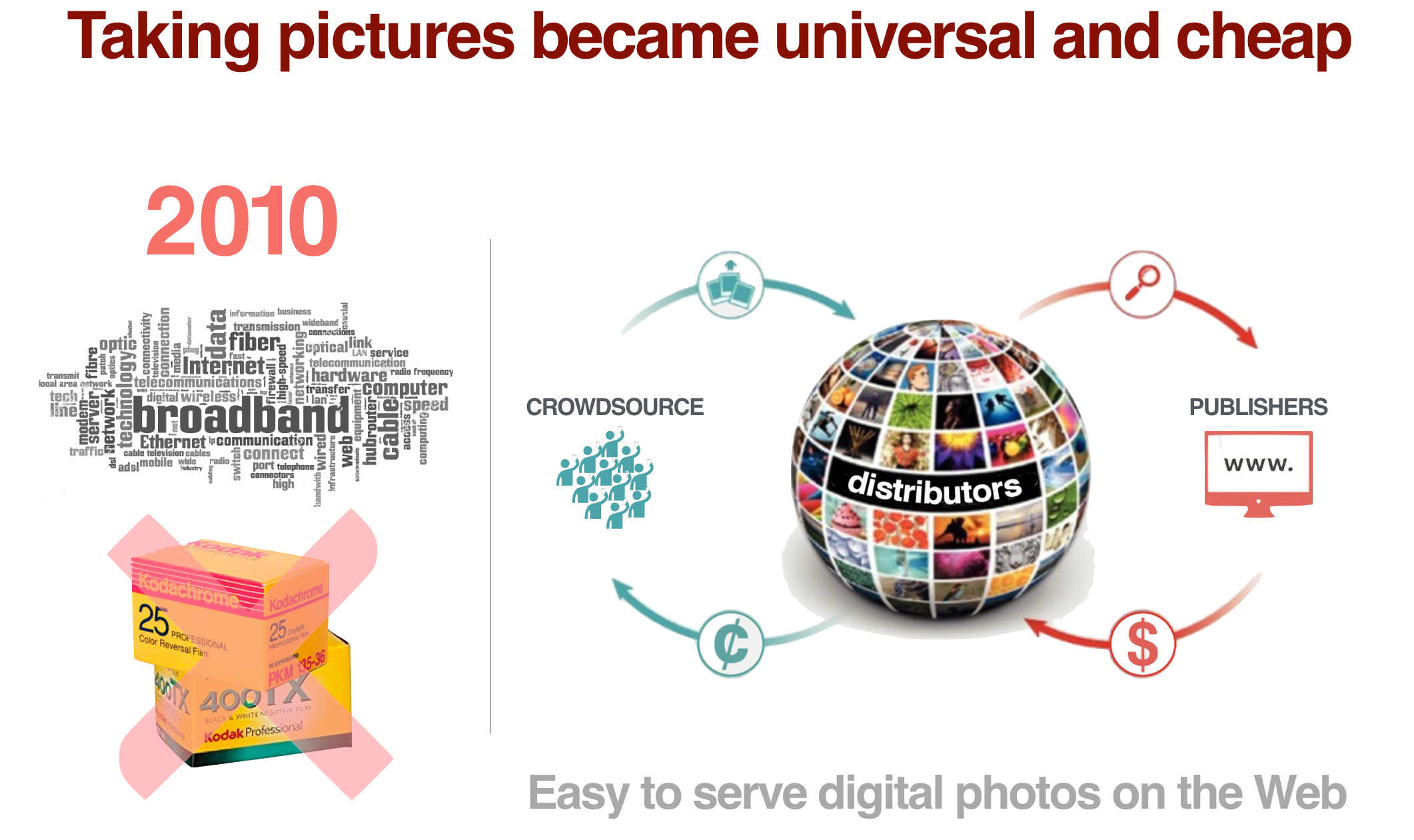
Gates and Getty knew how much photographs were worth to their respective bottom lines. But the care and feeding of photographers and the integrity of photography itself were incidental to their costs of doing business. The artistes were tolerated until what came to be known as crowd-sourcing grew widespread: an open call to the general public for submissions; an effort to obtain more photos at no upfront cost.
In the 1990s, it became obvious to investors that photography was the perfect product for electronic commerce (e-commerce). There were no manufacturing costs (photographers paid their own production costs); nominal warehousing costs (digitized files were stored on servers); customer demand was high, profit margins were huge; and there were no shipping costs. In fact, there was no need for a FedEx or UPS delivery truck at all.
Amateur camera enthusiasts, less concerned about making money but nonetheless proud of their work, were given an outlet for their photos on the Web. It’s hard to find fault with that. But when hundreds of thousands — or millions — of contributors get paid peanuts individually, what might seem like a big payout in the aggregate pales in comparison with what just a few stakeholders in Corbis and Getty raked in due to sheer sales volume.
It’s easy to see how this could be construed as exploitation. But that debate is irrelevant if one considers that the recklessness of the consolidators lies first and foremost in their conflation of all that crowd-sourced amateur content with professionally produced content — INTO ONE SALES CHANNEL.
Professionals were offered shelf space inside the store, so to speak, but only if they shared it side by side with amateurs at pathetic prices, thus taking the wind out of their sales (pun intended). Consequently, as time went on, lower licensing fees fostered a notion amongst publishers — the corporate bean counters, not the art directors — that pictures viewed on a screen were worth less than those seen in print. Baseless as that opinion was, it stuck. It didn’t take long for pros to disappear from the stock photo shelves, while, at the same time, they began to lose control over pricing their commissioned photo shoots too — their jobs. They had little recourse against a powerful alliance of capital and the supersonic pace of change it wrought.
Adversarial Relationship
Ina consumer-facing marketplace, crowd-sourced submissions made professional photo producers superfluous. Tiny businesses and freelance proprietors of all stripes, who had only recently developed a need to fill their newfangled Web sites with photos, were happy with low prices. But upscale Commercial buyers were increasingly dissatisfied with the mediocrity of images available online. Money was — and still is — left on the table that they would have been happy to pay for more consistent quality and exclusivity.
By the late aughts, which ushered in a conjunction of universal broadband with the eclipse of film (i.e., the fast uploading and downloading of digital images culminating in Kodak’s 2012 bankruptcy), the Corbis-Getty juggernaut had long since cut photographers out of the profit proposition. Professionals, an entire class of individual business owners, were treated collectively like an unskilled labor force, employees in a manufacturing supply chain creating a raw material.
There is no other way to describe it. The vendors’ disdain and disrespect for established photographers, their utter ignorance for how the business had been run successfully for decades, spawned an adversarial relationship that persists to this day. There was no reason for it. A younger generation of photographers has little knowledge of this acrimonious history and how it continues to adversely affect their careers.
Some laypeople and young photographers have a general impression that Getty Images is a bastion of photojournalism, that’s it’s a feather in any photojournalist’s cap to be a “Getty photographer.” After all, Getty offers prestigious competitive grants — albeit relatively tiny ones — that foster the work of selected photojournalists. Getty sponsors events and conferences attended by professional photographers. And one sees Getty photo credits everywhere, including on photographs it acquired for distribution long after their creation; having had no role in their production, economic or otherwise, except to vacuum up distribution rights.
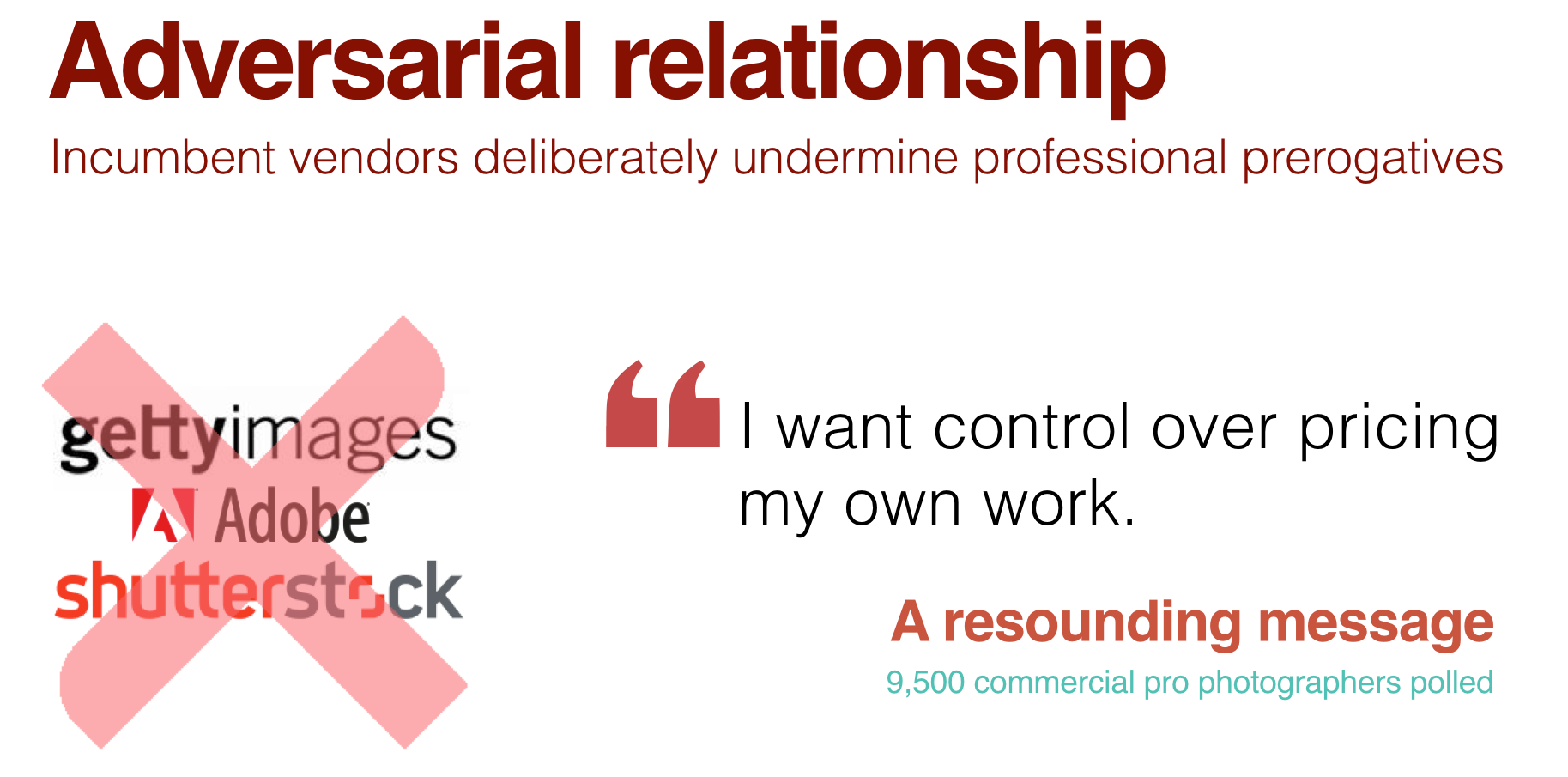
As practically the only game left in town, not due to competitive superiority but deep pockets, Getty Images became a behemoth of editorial-photo distribution (for publication). Yet Getty has never represented more than a few hundred of the tens of thousands of working pro photojournalists. It is with gross hypocrisy that Getty itself lays blame for the existential problems facing photojournalism, today, on social media and search platforms, instead of acknowledging the fact that its own cofounders, Mark Getty and Jonathan Klein, are personally responsible for creating and perpetuating photo industry dysfunction in the first place, and that they began their economic assault on photographers before the advent of the World Wide Web. That’s not this writer’s personal pique, but the broadly held opinion of virtually every industry creative, on both the buying and the selling sides. Ironically, it was the Web’s effectiveness at fostering consumer-facing, commodified transactions that saved their insidious business model from total failure.
Initially, Bill Gates, Mark Getty, and Jonathan Klein hired people to run their companies who cared deeply about photography and photographers. Whether by resignation or firing, they left in quick succession. Today, there is no longer anyone at the helm with firsthand knowledge about best practices that once governed a true photo agency. There are no photo agencies anymore; far fewer anyway, to competitively recruit and foster the best creative talent. By the time millennial photographers and photo buyers habituated to crowd-sourcing, along with a new generation of software designers and engineers, an institutional memory loss prevailed. No one knew, anymore, how to maximize the economic value of photography.
Industry-embraced best practices got lost in a fog and were consigned to oblivion, despite the hard work of an earlier generation of photographers and the guilds that represented them to establish honest principles with photo buyers. The American Society of Media Photographers (ASMP) and the Advertising Photographers of America (APA) promulgated one simple and fair principle that remains protected by federal copyright law: the more one pays to license a photograph, the more market reach one gets (i.e., broader publication rights). That principle applies irrespective of what medium a photograph is published in.
Copyright lingers in a state of disuse, hardly the yardstick it once was for meting out publication rights (hence copy-rights) for any given photograph. But with the technology available today, it doesn’t have to stay that way.
Digital Dogma Was Barking Up the Wrong Tree
Cameras, lenses, lights, and photo-editing software have flourished with technological innovation since the dawn of the Digital Century. It’s been all on the creative side. But the business side of photography is riven by technological indifference. That’s regrettable because it was always possible to shape technology for the benefit of photographers and the clients they serve, rather than to upend the way they work for the sole economic benefit of middlemen.
For example, neither Corbis or Getty Images were based in Silicon Valley; but early on they boarded a train of thought headed in that direction. The Valley is obsessed with the notion of “sharing” and a so-called “gig economy.” Uber and Airbnb are the two best known examples. However, unlike Uber, whose riders and drivers are universally interchangeable, and unlike Airbnb, whose renters and landlords are also universally interchangeable, contracting a photographer for a commercial photo shoot is a highly subjective matter. It is usually the result of a cultivated, long-term professional relationship.
Vendors who crave the competitive advantages that on-boarding professionals will bring are obliged to remember that publishers are the photographers’ clients, not theirs.
The very meaning of the word professional was skewed, if not deliberately skewered, by Silicon Valley’s obsession with “on-demand labor,” with quick and cheap transactions for simple services. The fallacy is, you can’t just collar the first person to pass by, wearing a Nikon on a neckstrap, to shoot an ad campaign for Toyota or Pepsi. You can’t call TaskRabbit to shoot a magazine cover for Wired or Forbes or a brochure for Boeing. On the other hand, if you’re a freelancer whose marketing needs don’t require more than posting pictures to Instagram, you can get by with that sort of thing. But if you are the chief marketing officer for a large company you’d be mad to ask anyone to snap pictures with an iPhone to support your advertising campaign.
Photo vendors who crave the competitive advantages of getting professional contributors to board their gravy train are obliged to remember that publishers (i.e., the buyers) are the photographers’ clients, not theirs. The revenue vendors earn comes from photographers, not from downloaders, because the photographers own what’s being sold — licensed actually: intellectual property.
Claiming that kind of economic respect may not matter to mere enthusiasts who are happy and proud to make a few extra bucks with their cameras. But harboring a notion that pro photographers should get paid so-called “royalties” by the vendors (who own nothing), instead of acknowledging that professionals pay sales commissions to the vendors, is both insincere and inaccurate because every pro photographer is a business owner running either a sole proprietorship, S Corp, C Corp, LLC, or LLP.
Professionalism, Workflow, and Copyright
The ability of individual photographers to establish professional relationships with paying clients depends as much on the practice of professionalism itself — adhering to best practices — as it does on talent. In that context, the complexity of any given licensing deal requires all parties to memorialize their agreements in writing. But it is nearly impossible for photographers to pick up a phone every time they pick up a camera, to call a lawyer to compose a contract. What can they do? Automate!
There is no such a thing as an ordinary invoice for either a commissioned photo shoot or a stock photo sale. In this business each invoice is literally a contract. It is a legal document, an agreement containing a license specifying what publication rights are granted — and specifically denying those notgranted — to any given client. The breadth of publication rights granted depends on how much, or how little, the client pays the photographer. More than a simple statement of demand for payment, each invoice memorializes the terms and conditions of a deal, and keeps it from becoming an ordeal.
On top of all that, each invoice includes a multiplicity of arcane and industry-specific, line-item billed expenses. Few photographers can remember all of them, no matter what their level of experience is. Therefore, both licensing and billing require the automation of a highly idiosyncratic workflow. The result is an Invoice/License of Rights (as it has traditionally been called in this industry). The workflow looks like this.
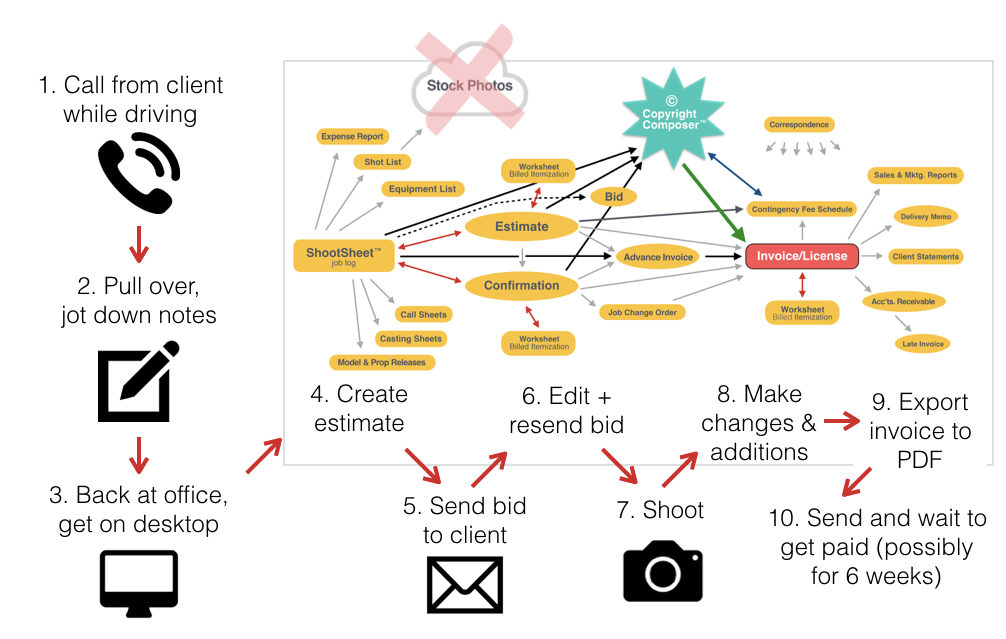
Inthe context of workflow, copyright is the most useful tool for determining a fee. It helps tally the component parts of a price and describes the publication rights granted in a license. This particular fee is called a usage fee. It is a line item that appears on every photo invoice. Copyright is the sine qua non for determining photo-licensing fees.
When a publisher’s needs can be accounted for incrementally, in units of value called publication rights, costs can be kept down for publishers; yet prices are optimal for photographers. Otherwise, photographers would have to charge higher prices — sometimes a lot higher — to cover any and all imagined uses by any given publisher, now and in the future, whether those uses would be implemented or not. On the other hand, copyright allows publishers to pay as they go and, of course, only for what they actually use. This à la carte menu process of parceling-out rights can easily be automated.
Writing a copyright license describes the size of a publisher’s appetite. For example, if you’re hungry for a T-bone steak, you needn’t pay for the entire steer. But if you have to feed an army, well, you have to pay accordingly. Prices vary from job to job, and from stock photo to stock photo; but they must always be consistent with the commercial value derived by the client from the publication of any given photograph(s). The act of composing a copyright license susses out limited needs versus comprehensive needs.
A usage fee can range all the way from an inexpensive one-time, non-exclusive publication on a single Web page at 1/8 screen size for no longer than one week, up to a total “buyout” by an ad agency representing a major corporate brand. A buyout might include the photographer’s outright sale of a copyright itself, which would transfer ownership of the photograph(s) in question to the buyer. That should cost a whole lot more than a carefully defined, limited use. On the other hand, if securing exclusivity and the broadest publication rights are of lesser importance to a publisher, a lower fee is offset by the photographer’s right to earn additional income by re-licensing, or re-selling, residual rights to the photograph(s) in question. Additional publishers, or even the same publisher, can pay more if further uses arise later on. Thus copyright helps determine fees that are affordable for the publisher and economically sustainable for the photographer; a fair balance.
Here are the five criteria used to determine price. They can be implemented by algorithm:
1) Duration — how long a picture will remain in public view
2) Exclusivity — how many different places a picture will appear in public view
3) Frequency — how many different times a picture will appear in public view
4) Prevalence — how many people, over time, will see a picture
5) Size — how big a picture appears, relative to its medium of publication
Note: A sixth pricing criterion is Reputation. It returns a production fee, in addition to a usage fee, when billing a commissioned job. It is based on the relative prestige any given photographer commands. It, too, can be determined by an algorithm that looks at each individual photographer’s previous billings and receipts, including factors like overhead, competitive market-penetration goals, who their clients are, and career longevity.Pro-sourcing vs. Crowd-sourcing
Images Are Not Widgets
Seventy percent (70%) of the buyers now served by Getty Images, Adobe Stock, and Shutterstock et al. are either ordinary consumers and freelancers or companies of fewer than twenty employees. Such small entities can easily make do with crowd-sourced content appearing on their websites. On the other hand, commercial brands and media requiring the broadest conceivable market reach are poorly served by crowd-sourced content because it inherently lacks exclusivity, the necessary condition to protect brand identity throughout vast international markets. Pro-sourcing, rather than crowd-sourcing, is a matter of recognizing who the buyers are and serving their special needs. There is nothing generic about pro-sourcing.
A shareholder in the company Shutterstock recently admitted publicly, “Worldwide, the number of customers willing to actually pay for the images they use seems to be flat.” The company’s corporate annual report validates that statement; yet, it represents only one aspect of an industry-wide malaise: stock photo revenue has fallen flat for a decade.
The same shareholder acknowledged that Shutterstock had cut its already low prices, but grew the size of its inventory by forty-six (46%) percent in 2017. THAT’S THE PROBLEM, NOT THE SOLUTION! Photo buyers continue to gripe that there are more pictures in any given vendor’s inventory than there are atoms in a cow. That means it’s hard to find photos that haven’t already been published by someone else. Incidentally, that shareholder also concluded, “AI doesn’t seem to be solving the search problem. Acquisitions don’t seem to be the answer [either].”
Toparaphrase an old truism, it’s easier to sell a thousand photos for a dollar than one photo for a thousand dollars. Of course, that’s the consumer-retail stock photo market mindset today. It seems rational. But if a buyer thinks it’s only worth paying a dollar for a photo, a vendor makes out okay because it has millions of other one-dollar photos to sell, from just as many millions of contributors. All of those photos don’t have to be “good.” Most of them are not. Nevertheless, the best ones have been published too often. That takes them out of the running when it comes to attracting sophisticated and higher-paying Enterprise customers.
Images are not widgets. They have no monolithic utility. Collectively, their use is infinitely variable, and, yet, each one is subjectively unique. That fact holds true despite the gazillions of images made every day using photographic technology.
It’s important to appreciate the distinction I just made, above, in italics. While the technology we use to perfunctorily create any given image may be photographic by definition, those we see on social media must be considered something different, defined by the context in which they are used.
The commercial value of an original image— tangible photographs notwithstanding — can only be determined by how and where it is published and how well it conveys either a social, political, or commercial message to its intended audience. (I’ll add emotional messages, too, for art’s sake.) Therefore, images cannot be packaged, priced, and sold like consumer products. In fact, even the value of original art depends on exclusivity: what a buyer is willing to pay for the relative rarity of a physical photograph.

The bottom line is, a buyer can’t expect any measure of exclusivity for a photo that costs only a dollar. A seller’s right — a creator’s right, not a middleman’s — is to demand a price that suits one’s own economic sustainability as much as it reflects commercial value, or utility, to the buyer.
Is Photo Piracy a Problem?
Piracy is not a big problem in a B2B marketplace because publishers know they’re exposed to severe economic penalties apply for infringing registered copyrights. I’ll address what it means for a copyright to be registeredin a moment. In the meantime, infringing means copying and publishing a photograph without permission, attribution, and payment.
Infringers — thieves — know they are liable, in a lawsuit, for either the actual damages suffered by the creator (i.e., the lost profits a given photographer would have earned in a legitimate transaction reflecting usage rights) or statutory damages. The US government mandates statutory damages as high as $150,000 per infringement, if proved willfull. (Enterprise-level publishers have few excuses; it would almost have to be willful). That’s $150,000 per photograph or, say, $1,500,000 if a successful lawsuit involves ten photographs.
Although every photograph is copyrighted by default, from the moment of its inception, no copyright is registered by default. Registering a photograph’s inherent copyright requires its creator to take an extra administrative step. That extra step gives creators tremendous economic leverage, to keep potential infringers at bay.
The registration of a copyright acts as a deterrent because it gives creators the keys to the courthouse, so to speak. It almost always ensures the means to pay a lawyer for the prosecution of infringers in civil court by providing a financial incentive to take cases on a contingency basis. Financial damages will be awarded by the court, not if plaintiff photographers win but when they win. Without federal statutory damages in place, and without registration, many infringers would go unchallenged because of the expensive legal costs photographers would have to pay.
It’s pretty straightforward to federally register a copyright. And it doesn’t cost much. But it’s inconvenient. It can, however, be a seamless step in an automated SaaS workflow. The routine registration of copyrights is a powerful attraction for commercial photographers and videographers.
Incidentally, when photos are infringed by small retail businesses or individual consumers on the Web, the economic consequences are minor. And it rarely occurs at all in the Enterprise segment because of the severe economic penalties attached. With automatic registration, the matter of piracy pretty much disappears.
Industry Consolidation
Back in the day, despite being fragmented throughout the US and Europe (with a lesser presence in Asia and elsewhere), traditional photo agencies made good money for themselves and for the photographers they represented. Agencies flourished from the 1940s through the 1990s; but their heyday lasted from about 1970 to 1995. They were true agents, acting in the best interests of the photographers they represented. They served buyers well, too, because pricing was fair, based on the principles of copyright ownership. And they protected both exclusivity and quality.
Some agencies marketed proprietary collections of stock photos. Others represented a “stable” of photographers shooting editorial and commercial assignments. Most agencies re-licensed residuals on behalf of the photographers who shot them. Photos were all shot on film, of course. Starting in the mid-1990s, the Corbis and Getty consolidation binge began. Agencies were gobbled up.

No one questioned the absurd proposition, that the best way to serve customers and reward shareholders was to devalue photographs as an asset class. Instead of regarding the value of photographs individually, an assertion was made that all photos were alike and should be sold as a commodity. No investors questioned the economic feasibility of a business model that excluded photographers as customers on the basis that their intellectual property was only theoretical, not actual. No one realized that technology could be used to increase productivity and simplify rights-managed pricing for online transactions. Thus, they cut commercial photographers and enterprise publishers —the more lucrative revenue stream — out of the online marketplace, relegating marketplace participants to a manual workflow and transactions memorialized on paper.
When Corbis (Bill Gates’s company) and Getty Images each imposed a consumer-facing business model (i.e., high volume, low price), they set the bar low for the entire industry. They would tell you, at the time, rights-managed pricing was useless in an online economy. But the move they made to consolidate retail-consumer sales revenue blinded them to any kind of vision for industry growth in the more lucrative Enterprise segment. They simply knew nothing about photography.
The world began to look less picturesque to pro photographers. Buyers, having gotten used to paying low prices for pre-shot pictures, now expected to pay lower fees for commissioned jobs too. Of course, Commercial-enterprise buyers, now that they too were publishing content online, expected it to cost less simply because it was online.
To replenish their “stock” when a given set of pictures in their respective inventories became too stale or outdated for further licensing, Corbis and Getty aggressively recruited new photographer-contributors. Some willingly relinquished their copyrights to any photos they might create in the future by signing work-for-hire contracts; which meant they gave up ownership — they gave up their business proprietorships too — in exchange for a minor measure of economic security. They were now expected to shoot various kinds of subject matter and themes under the aegis of Getty or Corbis. Getty and Corbis anticipated market demand and told them what to shoot. But because they would get paid less, it’s reasonable to assume that not many established professionals heeded the siren’s call. Most of the photographers who had been represented by agencies, now that they had been acquired, had already run for the hills and taken their photographs (on film) with them, rather than let them be syndicated by middlemen who would deliberately devalue them.
Sidebar
Unlike buying a record company, which generally includes a library full of songs and publishing rights, or unlike buying a Hollywood movie studio that comes with a library of feature films, and other than some notably larger collections of timeless and historically valuable photographs that were already in the public domain, the photographers who had been represented by agencies owned their photographs. The agencies did not.
When a gap became evident in any given vendor’s collection for one kind of subject matter or another, the vendor would sometimes buy an entire archive of film (color slides & b+w negatives) from a photographer who had specialized in one of those categories; e.g., music or astronomy or sports. Vendors also began to digitize entire collections for on-line licensing. But most top photographers gave up any expectation of earning income from stock after bearing witness to the Corbis-Getty buying spree. From that time on, they relied solely on contracted photo assignments to earn a living.
Today, the industry is undergoing another round of consolidation. Beijing-based Visual China Group (VCG) bought Corbis and 500px. Getty, having recently bounced back and forth between private equity companies Hellman & Friedman and The Carlyle Group, is once again in the private hands of the Getty family and its fortune. Adobe bought Fotolia and has since struck distribution deals with EyeEm and Stocksy. Getty, too, has a distribution deal with EyeEm (another content overlap). ImageBrief’s implausible low-balling business model folded like a cheap shotgun. So did Blend Images. Twenty20 can’t make ends meet. Even the enthusiast photo-sharing site SmugMug bought Flickr, to gobble up more quotidian content. But Stock Photo startups continue to pop up like mushrooms in an investment-market mulch. I predict that they, too, will fall victim to an industry cannibalizing itself; big fish eating small fish to acquire more content until there is none left.
To wit, VCG, immediately after acquiring the unprofitable Corbis from Bill Gates for pennies on the dollar, turned right around and made a distribution deal with Getty. Remember, though, Corbis had been Getty’s biggest rival. Getty’s then CEO Jonathan Klein boasted sardonically, “Lovely to get the milk, the cream, the cheese, the yoghurt and the meat without buying the cow.”
Economic Death by a Thousand Cuts
Google may be the only company big enough to bully Getty Images, and with as few scruples about intellectual property attribution. Getty was powerless to stop Google from “scraping” photos off of its exchange and letting GooglePhoto’s own users freely copy them without giving credit to, or paying, the photographers who created them.
Getty sued Google. But, after a while, instead of risking loss in litigation, Getty inked a deal with — wait for it! — Google itself. Google’s VIEW IMAGE button is now a VISIT IMAGE button that links back to Getty. But Google is still free to use Getty content in all of its own products and services. Emphasis is on the word free.
Guess who came out ahead, and who lost, that deal! Contractually, photographers have no say in transactions like that, despite the fact that they own the copyrights for the photographs in question. This is just one more reason why pros are loathe to “join the crowd” (i.e., to crowd-source).
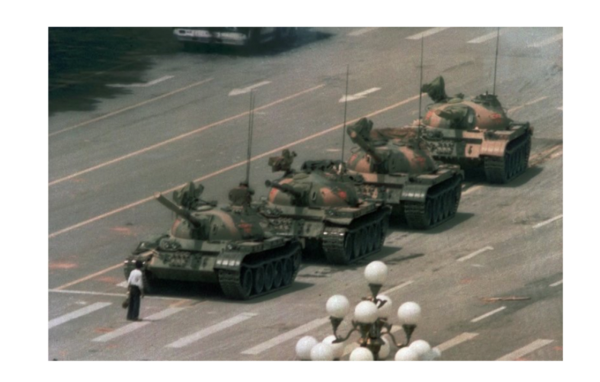
Incidentally, along with millions of other culturally iconic, previously American-owned photographs, the Chinese now have digital distribution rights to, and perhaps outright ownership of, the famous 1989 Tiananmen Square “Tank Man” photograph. Many photographs like that one could disappear at the discretion of the Chinese government, now that VCG controls their distribution.
Making photo distribution deals with sub-vendors to get access to more content is cheaper than buying whole companies and their archives outright. But it further dilutes the income of contributing photographers. And, as already stated, such deals overlap content from one vendor’s inventory to another’s, all hurled together into one big bargain-basement bin, making it harder still for buyers to discover original content.
Photographers who contribute their work to any given vendor’s inventory can expect to see their work distributed to additional — even competing —vendors, whether they like it or not. For example, EyeEm’s collection is now distributed by both Getty and Adobe. Contributors may rationalize that more buyers will see their work, download it, and publish it. But any extra income they might hope to receive is offset by progressively diminishing royalties, as an ever-expanding hierarchy of sub-vendors takes a percentage of a percentage of a percentage out of the original deal the photographer struck with whichever vendor was higher up the food chain.
Typically, a contributing photographer earns less than $300 — per year!That’s if they earn anything at all. Each and every professional photographer loses tens of thousands of dollars in income, year in and year out by keeping their best content out of circulation, away from online vendors who would only commodify it. That’s billions of dollars lost annually in combined revenue.
Fixing Jobs Fixes Stock
Ifthey could only consolidate pro photographers’ residuals, vendors would love to take a share of their revenue from independently-contracted jobs too. Ain’t gonna happen. Not only have the incumbents cost pros the income they once had from stock photo sales, it has driven down the fees they earn for their bread-and-butter business shooting jobs. Pros nurse a deep-seated antipathy for the way vendors have encouraged dysfunctional pricing practices to evolve.
That said, pros are keenly aware of the economic value of their residuals to the stock photo market. They also know how limited their reach is into that market, fragmented one-man bands that they are. Individual photographers don’t have the wherewithal to put their work in front of as many potential buyers as a well capitalized aggregator. But every effort the incumbents have made to convince professionals to contribute their work for online sales has meant looking through the lens of crowd-sourcing, the original sin.
Notwithstanding how crowd-sourcing harms photographers, it harms publishers more. It’s a matter of thousands of curated contributors serving Enterprise buyers versus millions of random contributors serving retail consumers; exclusive content at rights-managed prices versus homogenized content at commodified prices.
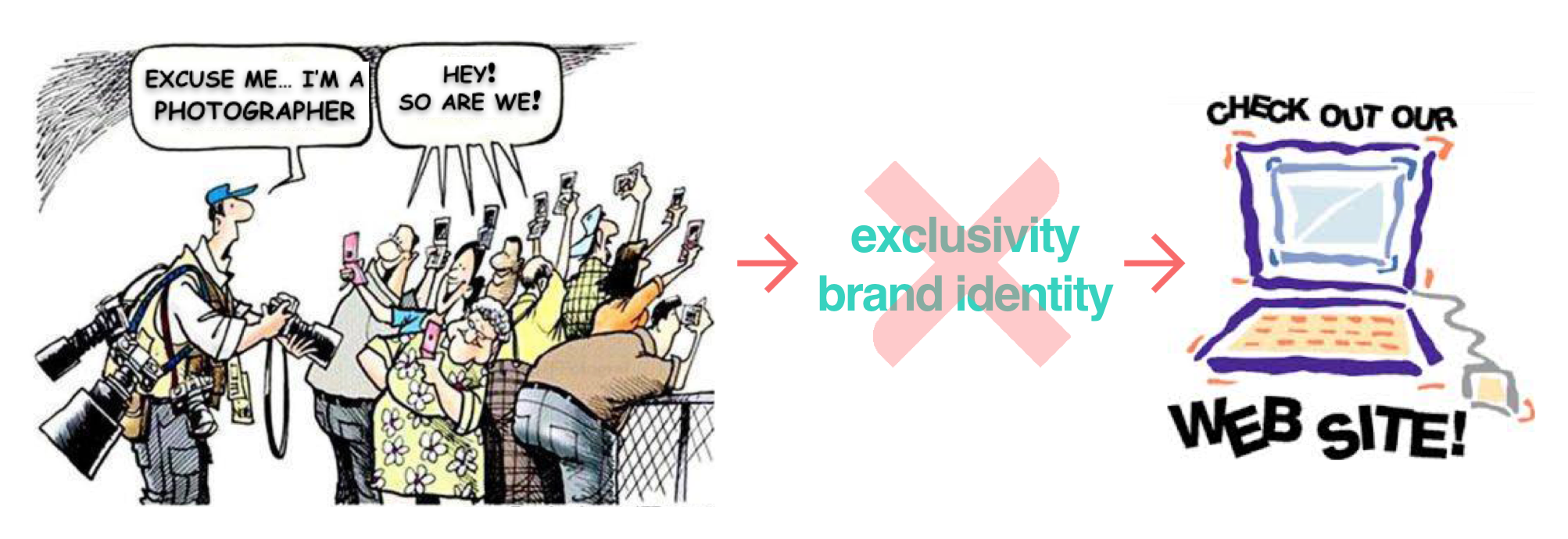
Instead of making empty promises aimed at attracting professionals, only to funnel them into a commodified sales channel clotted with amateurs, a new and parallel channel must be created for the explicit use of commercial imagemakers and publishers. The question is, How do you keep out the riff-raff?
The key to creating a discrete catalog of premium, professionally produced, and dynamically replenished stock photos is to abandon the idea that professionals will ever proactively contribute their work.
Even if they didn’t expect to be ruthlessly exploited, there is no guarantee that pros, who are busy shooting jobs, could find time to curate, caption, and upload their residuals proactively. Incidentally, I’m not suggesting that artificial intelligence should be used for that purpose. AI is not up to the task of professional editing and curating, which relies on the talent and mercurial subjectivity of humans. The question is, How do you get a critical mass of pro photographers and their residuals onto a single platform where publishers can easily find useful images and pay what they’re worth to publish them? By the way, these particular residuals are selects, already edited and curated.
The answer is, once photographers and their existing clients are connected online, residuals can indeed be captured with their tacit cooperation. Content aggregation becomes a routine part of their interactive jobs workflow, accomplished seamlessly during the electronic execution of licenses, invoices, deliveries, and payments. Production fulfillment on the creative side is thus linked to administrative fulfillment on the business side; all automated and on one platform.
In other words, fixing jobs fixes stock. Once connected online, once agency is restored both literally and figuratively, it’s easy for photographers to see for themselves how their clients will gain long-desired access to residuals at prices that make everybody smile.

The Holistic Solution
Photographers encounter too much friction, as artists, trying to navigate the world of business and shoot pictures at the same time. Their plight is worsened by having little more than 1995 desktop software to help with back-office workflow.
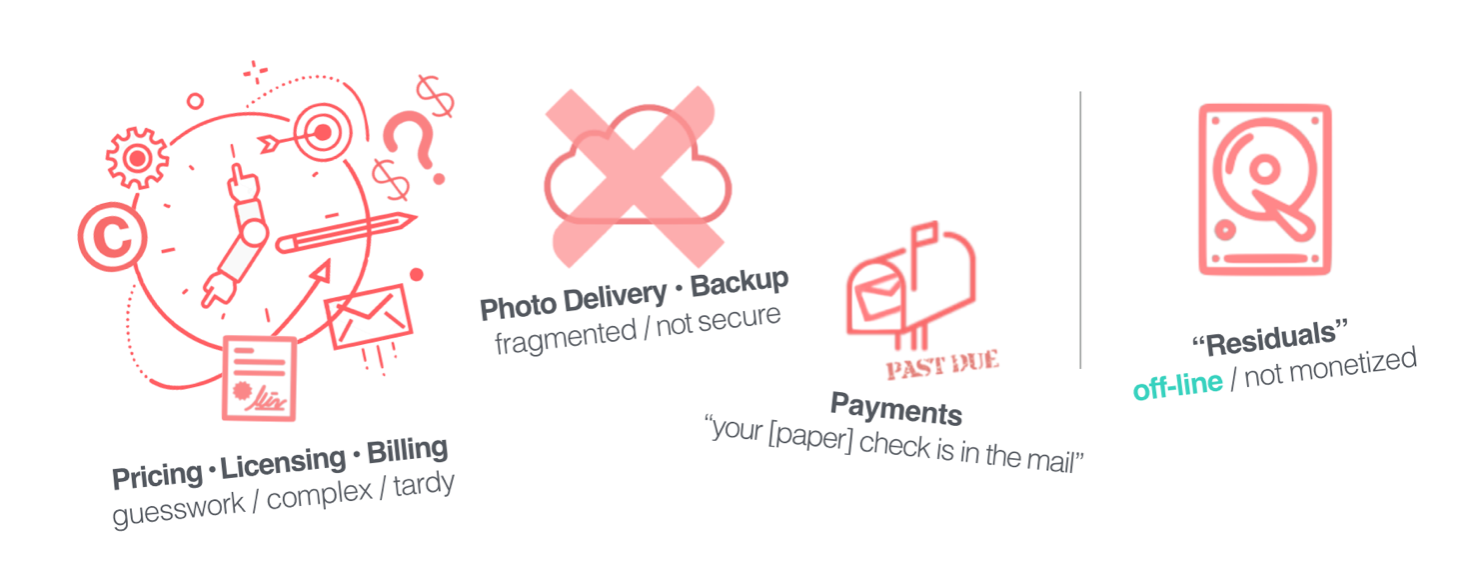
Not only is workflow off-line, it’s a different kind of workflow than that used to create invoices for consumer transactions. Each invoice for a B2B commercial photo shoot (stock photo transactions too) is a contract. And each one includes a myriad of arcane line-item, billed expenses that do not appear on ordinary retail invoices.
And another big issue is in play: pricing. Whether a photographer has been in business for two weeks, working out of the trunk of her car, or shooting for twenty years with a 7,000 sq. ft. studio and a full staff of production associates, one questions prevails: “How much do I charge?” The answer is not only different for each photographer but for each job. So far, that’s been guesswork.

Without SaaS, professional back-office inefficiencies lose money and clients:
- Photographers don’t know how much to bill because different clients require different reproduction rights (some more modest than others), and they have different budgets (some bigger than others). Individual photographers have different production costs and overhead too.
- Photographers easily forget which ones of dozens of idiosyncratic line-item production expenses to, first, estimate, then mark up and bill to their clients.
- Photographers cannot call a lawyer every time they pick up a camera, to compose a written copyright license for each and every job they shoot.
- Neither photographers nor publishers are reminded when a license expires.
- Sales tax rules are applied haphazardly, subjecting photographers to legal exposure and punishing fines.
- Electronic photo delivery is fragmented, with countless FTP sites, and exacerbated by distrust of Dropbox et al. Some photographers still put a hard drive in a FedEx box.
- Clients have to wait too long for invoices because photographers are several days into one job and weeks behind with “paperwork” for previous jobs. Cashflow makes sucking sounds.
- Photographers wait even longer to get paid (by paper check via snail mail). Alternatively, it’s counterproductive for photographers to subscribe to various on-line payment apps used by as many different clients.
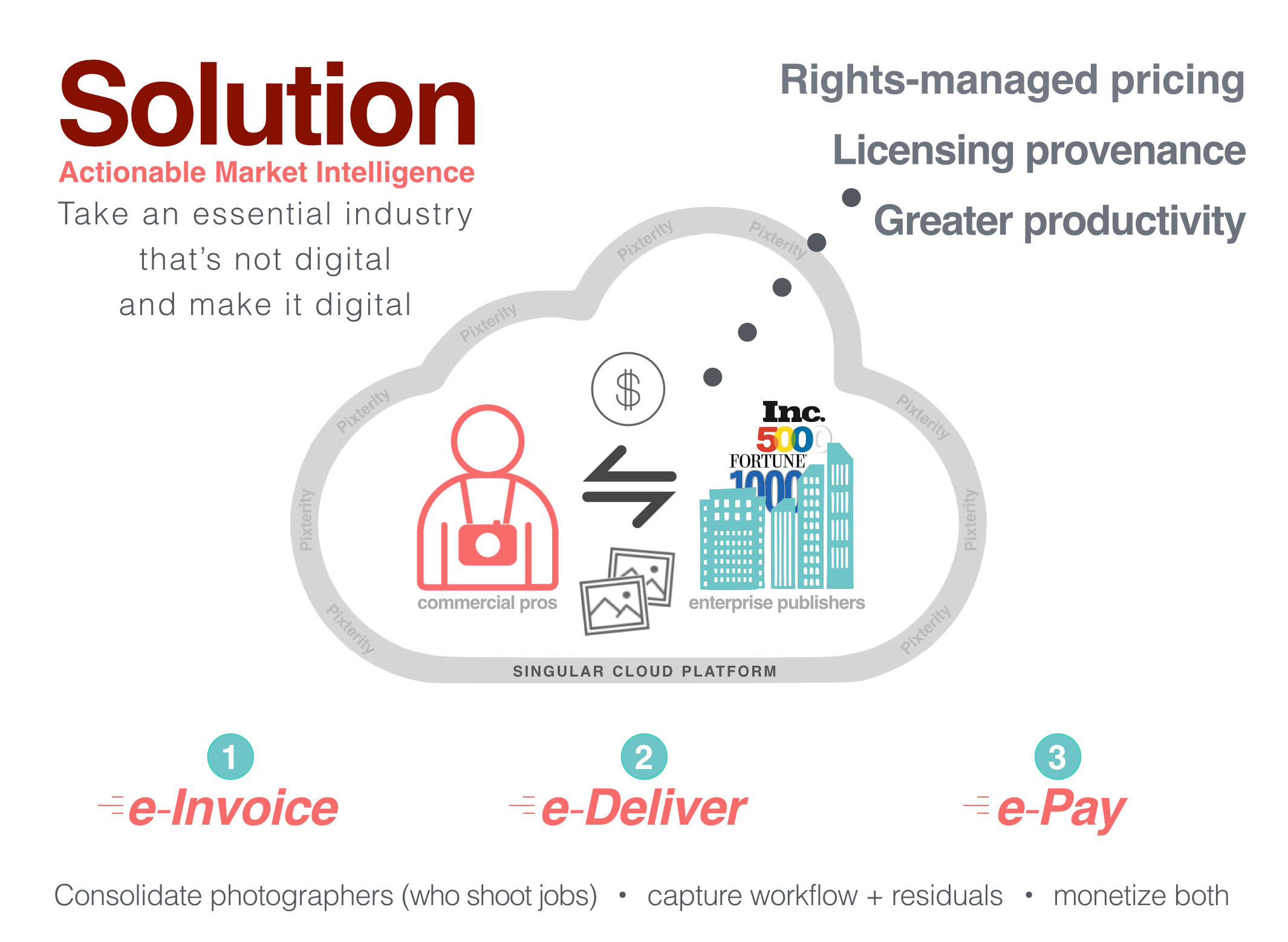
Corbis and Getty acquired photo agencies to get stock photos. There are no more agencies to acquire. Thus, having also driven away the best creators of new stock photos, who are themselves fragmented by dint of no longer having agency representation, the incumbents have come to rely on crowd-sourcing to update their inventories. The irony is that crowd-sourcing is anathema to the best-paying customers.
That’s bad news. The good news is, when photographers can electronically invoice, deliver, and get paid for jobs on a single platform, that platform becomes a magnet for fresh stock photos. It aggregates content from the very same photographers who were alienated by the incumbent middlemen. Such a platform reduces the administrative burden on both sides of every new transaction, for photographers and publishers alike. With the inauguration of such a platform, not only can residuals be captured and monetized, the transactions themselves — the workflow — can be monetized too.
Default Curation (Pre-curation)
Asa further draw for photographers to get connected online, their administrative workflow can now be integrated with the creativeworkflow they practice using Adobe Lightroom® and Capture One®.
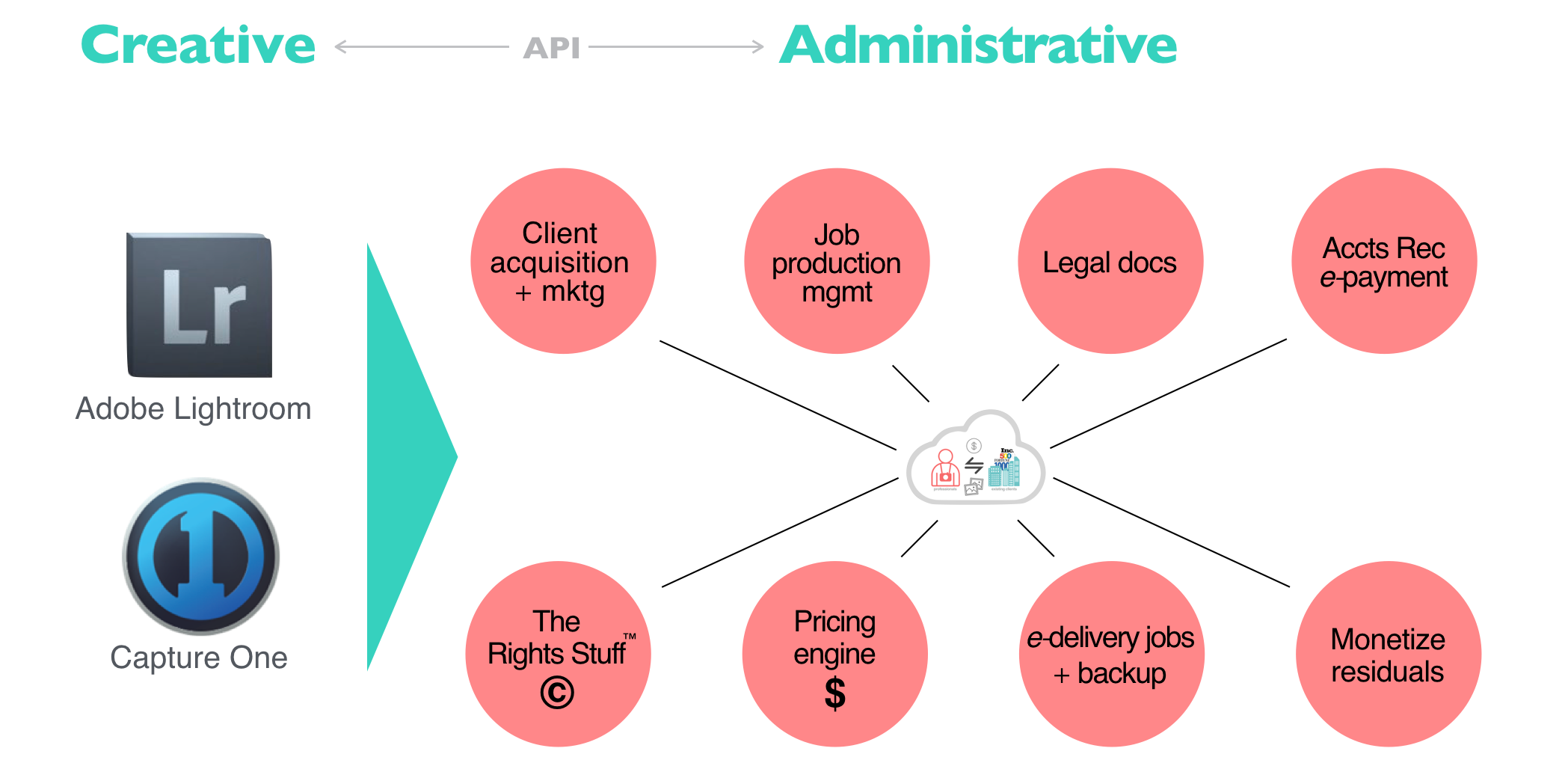
Practically all pros use either Lightroom or Capture One to cull a set of “selects” (another industry term of art) from amongst the dozens, hundreds, or even thousands of pictures they shoot on any given photo assignment. They use these two software tools to edit out duplicates, mis-flashes, out-of-focus frames, poor exposures, shots of their feet, and images that are irrelevant to the client. Once these “outtakes” are eliminated, the selects are treated to post-production editing techniques. That means they are fine-tuned for composition, color correction, cropping, retouching, and special effects. These perfectly polished pictures are finally delivered to the client.
Once it’s possible for digital selects to be delivered electronically via the same SaaS platform that manages back-office production workflow, including accounts receivable, residuals are not only captured “on the fly” but also backed-up to the cloud. The platform thus acts like a filter, trapping the best images. These images are, in effect, pre-vetted by the photographers who create them and the clients who publish them. This is tantamount to a continuously updated inventory, a collective photographic archive representing each individual photographer’s most precious assets. They are also protected, by being off-site, against natural disaster and theft, the kinds of catastophes that defeat the inherent lack of security in home/office/studio computers and back-up devices. This is another value-added service, adding magnetic appeal to the platform.
When a photographer’s client receives e-notification that a job is ready to deliver, one mouse-click agrees to the photographer’s Terms & Conditions, performs the download, and deposits payment into the photographer’s bank account.
When using a back-office workflow that’s automated and integrated with a photographer’s creative workflow, the selects can be imbued electronically with metadata. That means the written text used to describe the Terms & Conditions of any publication license granted, the “legalese”, is not only embedded in a Virtual Paper Trail™ of documentation for each and every photo shoot, but also embedded into each digital photo itself.
When a license expires for any given photograph, or, as the reserved rights of a photographer pertain to the unpublished photos made during any given job, online permissions can be obtained by the same client, or subsequent clients, to license and re-license the photo(s) in question at fair market, rights-managed prices. A Pricing Engine algorithm suggests a figure, one in accordance with each individual photographer’s economic profile vis à vis the buyer’s budget. For example, the algorithm will use answers to a few simple questions posed to each photographer when registering to use the platform for the first time:
- What annual salary (take-home pay) do you wish to earn?
- How many jobs do you wish to shoot each year?
- How much money will you put into a savings/retirement account each year?
- What’s your annual cost of doing business? (A checklist of direct and indirect overhead expenses is presented.)
Each seller’s data are analayzed in conjunction with each buyer’s history of payments and a myriad of mercurial budgets throughout the network.
A modest commission is paid to the platform’s proprietor in exchange for solving the three problems topmost on every photographer’s mind:
- How can I manage my business? (incl. monetizing my residuals) (spending less time behind a desk and more time behind a camera)
- How much should I charge? (to regain competitive control over pricing my own work)
- How can I compose a copyright license on each invoice? (I can’t call a lawyer every time I pick up my camera to shoot a job)
Information, Remuneration
The platform is comprised of a SaaS application for use by photographers, on one side, to automate the highly idiosyncratic back-office workflow for shooting jobs. It “talks” to an e-commerce stock photo exchange for publishers, on the other side. A connection is forged between photographers and publishers, becoming an interactive Digital Asset Management Network (DAMN). It provides reciprocal access to actionable market intelligence about distribution and pricing.
The Pricing Engine is an inherent part of the platform. It calculates a separate line-item assignment fee, based on each photographer’s professional profile plus a separate line-item usage fee that corresponds to the publication rights granted to a buyer. The proprietor does not pay royalties tophotographers but, instead, accepts commissions in exchange for acting as an electronic licensing agent.
With information symmetry, a fragmented army of freelancers — having been all generals, no privates — becomes a consolidated workforce, resulting in radical productivity gains across the board for commissioned photo shoots in tandem with a new and dynamically replenished source of premium stock photos for enterprise publishers.
Ultimately, the platform is imbued with the same kind of authority for pricing photographic services as Google enjoys for ranking Search results. The accumulation of information used to price jobs is extrapolated to price stock photos based on usage fees, eliminating the assignment fees associated with commissioned jobs.
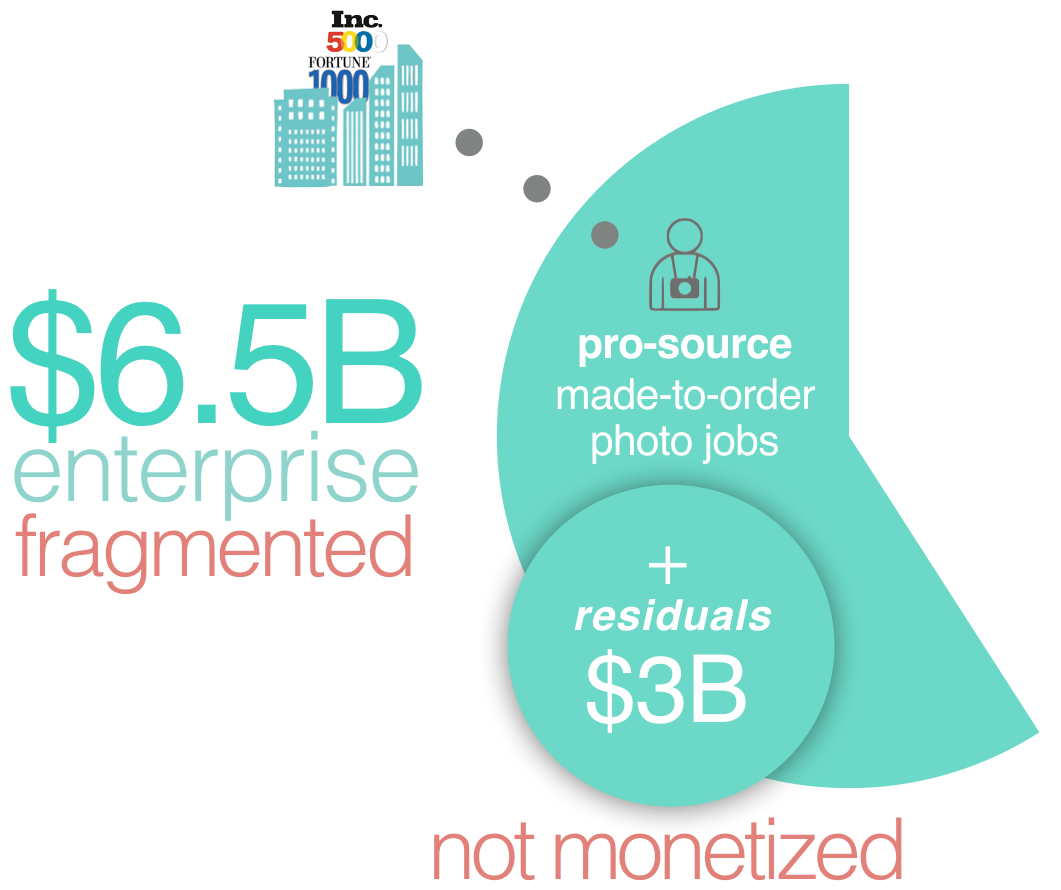
Commercial photographers are disproportionately few, considering the preponderance of cameras, yet their influence is global.
Working pros number about 120,000 worldwide. They are one-man bands. They are fragmented. But they generate more than $6.5B each year in fees for jobs. We see their work everywhere.
With an AI matrix in place (i.e., a Pricing Engine) their fees will inevitably increase, even without the additional revenue expected from their collectively vast reservoir of residuals.
Today, residuals are practically invisible to buyers because they are stored on hard-drive arrays in photo studios and home offices, hidden like cash stuffed under so many mattresses. These assets are NOT available in the cloud. They earn dividends for no one. It is estimated that residuals are worth an additional $3B in sales annually.
AI Levels the Economic Playing Field
Photography’s inherent value is memorialized by the famous one-to-a-thousand ratio representing the number of words one needs to describe what only one picture can illustrate. Such inherent value cannot be downplayed. But its monetary value has indeed been (irrationally) downplayed.
Most well rounded photographers can’t roll downhill when it comes to pricing their own work.
Nobody picks up a camera just to start a small business. Photographers hope to support their art. They hope their art will support them in turn. But they have a hard time figuring out how much to charge for any given job, let alone for a stock photo. For example, they rarely have enough information, or the right information, to calculate an assignment fee (to cover their physical effort and time; also called a camera fee or shooting fee), let alone a usage fee billed on top of that (to compensate for the realization of commercial value by a publisher). Notwithstanding everything else — call it “administrivia” — that preoccupies a photographer’s back-office responsibilities, coming up with a bottom-line price for a “simple” photo shoot (including taxes, fees, and marked-up line-item expenses) is as complex as budgeting a scene in a movie.
On the other hand, royalty-free pricing is simple. But it is also arbitrary and gratuitous for all but the most unsophisticated and least discriminating transactions. The prevailing smorgasbord approach to stock photo sales — all you can eat for one low price — doesn’t satisfy buyers with a taste and a budget for haute cuisine prepared by a top chef.
Technology to the rescue! A Pricing Engine can determine a fair market price without aiming high or aiming low, and without aiming at the middle. It acts on market intelligence to provide an optimal price for both seller and buyer. It calculates the actual commercial value to the buyer for any given photograph by weighing production costs, profit margins, and how many people will ultimately see a published picture vis à vis the extent of the rights granted to publish it and a history of previous transactions between the combined cohort of photographers and publishers in the network.
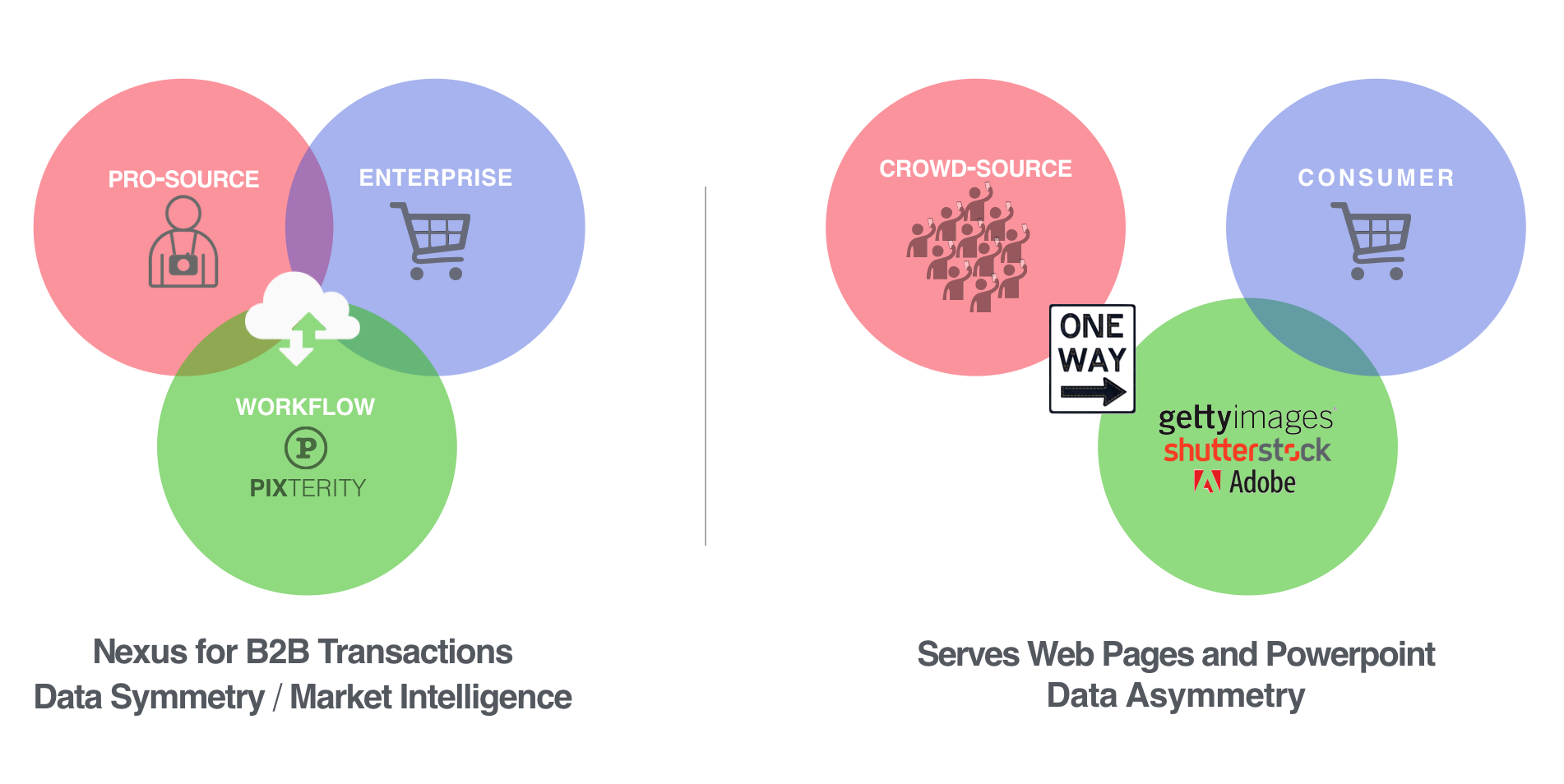
Chicago GSB Professor & Nobel laureate Eugene Fama famously said, “Prices reflect all available information.” His theory about pricing Wall Street stock market assets holds true in the consumer-retail stock photo market too.
An easy-to-use business-automation app, one that includes intelligent pricing practices integrated with an e-commerce photo exchange and distributed FREE to photographers, self-selects for professionals and enterprise publishers. Social-event photographers and retail transactions are excluded by default because only commercial pros would have any use for a tool that bills licensing fees to publishers; and, conversely, only publishers would pay licensing fees to commercial photographers. Ergo, self-selection!
Enterprise publishers recognize that the best source for stock photos is the same platform they use to work with the professionals they already trust and hire to shoot jobs.
The e-commerce photo exchange (i.e., buyers’ portal) will not look much different or operate very differently than any existing photo exchange. It’ll be just like visiting, say, Getty Images’ website. However, the content will be entirely different because it comes from an exclusive and better curated source.
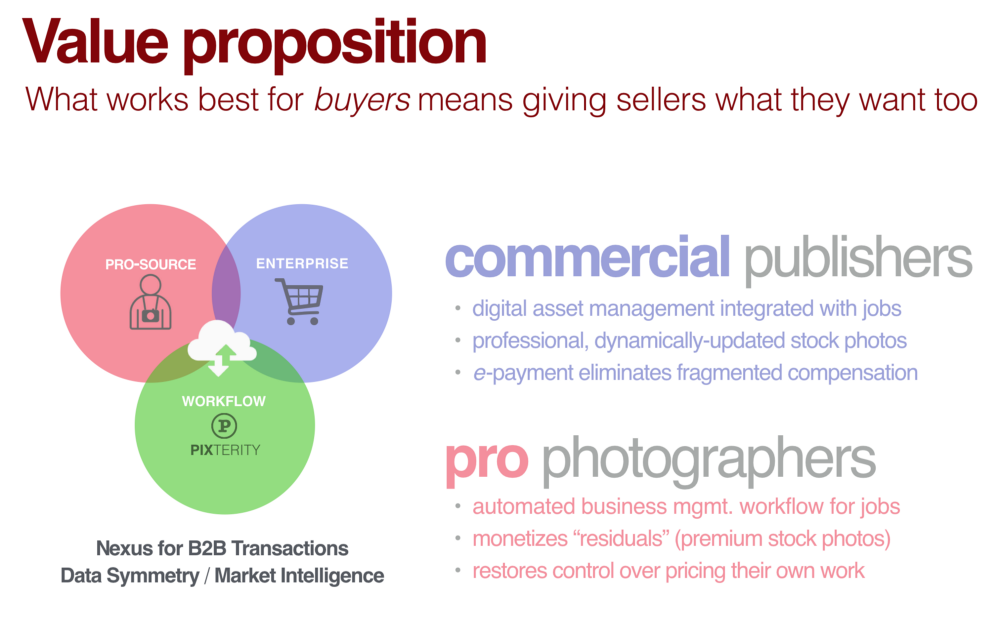
In Summary
One secret to a great marketplace is a great middleman. In the Commercial Photo marketplace, today’s middlemen didn’t so much disrupt the business as buy it. Not so great.
Years ago, they sidestepped organic growth and technological innovation to pursue the low-hanging fruit of a consumer-facing opportunity in a booming e-commerce environment. They let the more lucrative Enterprise-publishing segment fritter away because they didn’t know how to keep it. As investors, they had no hands-on photography experience; and, in the wake of their rapid expansion via serial acquisitions of photo agencies, they left a knowledge vacuum. But their fundamental error was, and still is, a failure to appreciate that both sides of a business-to-business marketplace have equal standing, that photographers and publishers are customers alike. Commercial Photo can’t be run like a consumer marketplace; not if success is tied to productivity and revenue growth for all three marketplace participants: sellers, buyers, and middleman, not just the middleman.
Both sides of Commercial Photo had, indeed, once done business directly with each other. That was before these well capitalized outsiders insinuated themselves in the middle. But in a world in which all aspects of commerce are now connected via the Internet, and when hubris makes middlemen believe they are the sellers instead of the photographers, the marketplace itself is undermined and underserved.
There are two Bs in B2B representing two sets of customers who do business with each other. In this case they are:
- Commercial photographers who create and own intellectual property
- Enterprise publishers who license it for their own commercial use
Both sets of B2B customers are complaining loud and clear:
- Photographers say, “We’ve lost control over pricing our own work.”
- Publishers say, “Stock photo catalogs offer too many choices, and too few good ones.”
Commercial Photo Marketplace Facts:
- ~120,000 photographers worldwide earn fees (in lieu of so-called “royalties”) for shooting commissioned jobs directly for their own clients: commercial brands and media companies.
- Photographers are conferred professional status, not by themselves, not even by dint of their own talent, but by their clients who have already vetted, hired, and paid them to shoot commercial jobs for publication.
- Annual fees for commissioned jobs of >$6.5B (not counting billed expenses and other ancillary revenue) are both under-billed and fragmented, with no monetization by any company that might help to increase revenue.
- Photographers create residuals while shooting jobs.
- Residuals, a term of art for professionally produced, premium stock photos, are worth an estimated $3B in additional annual revenue. But they are not monetized by anyone; not by photographers, not by middlemen.
- Pro photographers deliberately decline to contribute to the stock photo pipeline, despite the fact that their residuals are in high demand by publishers to be relicensed after initial reproduction rights expire or when, as is often the case, only a limited license was required in the first place.
- Publishers need stock photos when a looming deadline or tight budget makes it impractical to hire a photographer for a made-to-order job.
- Pre-shot, crowd-sourced stock photo billings ($4.5B annual revenue) have been static for a decade.
- Publishers say stock photo quality is undercut by the reliance of middlemen on crowd-sourcing and their inability to cultivate pro-sourcing instead (i.e., obtaining residuals from pro commercial photographers).
- Photographers spend too much time behind their desks and not enough time behind their cameras.
- Photographers run their businesses, for the most part, on paper — offline. They are too often late sending cobbled-together invoices — using myriad and non-dedicated software tools that are missing either copyright-licensing language or an accurate account of line-item billings or both — and must wait for publishers to send payment by checks in the mail, resulting in poor cashflow.
- Despite the fact that publishers and photographers generate billions of dollars in revenue each year doing business with each other, not one company collects or analyzes transactions between them; the essential condition for the fair market pricing of intellectual property online.
Strength in Administrative Consolidation
Consider that Adobe touches the work of virtually every professional photographer & videographer in the world. Why is it that Adobe has not, indeed cannot, garner default licensing-and-distribution rights to all of the residuals and outtakes that pass through Adobe’s “Creative Cloud?”
The Creative Cloud encompasses a creative workflow. Adobe (also Getty Images and Shutterstock et al.) crucially lacks the wherewithal to connect photographers directly with their own clients online; i.e., to automate and integrate photographers’ administrative workflow with their creative workflow. If they could, they would be able to capture and analyze transactions between sellers and buyers. Situated in the middle, they would see data flowing back and forth between those sellers and buyers; symmetrical information. But they are incapable of creating the infrastructure to do so without pivoting to such an extent that they would cannibalize their existing business model and revenue.
Technology has made taking pictures effortless.
No one has used technology to make the business of taking pictures effortless.
If the most tried-and-true investment thesis is to take an essential industry that’s not digital, and make it digital, it’s not hard to see how connecting photographers online with their existing clients will do the following:
- Consolidate photographers on one proprietary platform: a virtual content cartel surrounded by a moat that denies the best imagery in the world to Getty, Adobe, and Shutterstock
- Consolidate Digital Asset Management for publishers
- Automate complex B2B licensing transactions (incl. composing copyright language)
- Synchronize rights-managed pricing with commercial value to buyers
- Utilize predictive image search
- Track publication provenance & term-of-license expirations (with reminders)
- Automate federal copyright registration
- Cultivate & maintain long-term client relationships
- Protect intellectual property rights for photographers
- Foster exclusivity in the stock photo pipeline for enterprise publishers, who must protect their brand identities
- Institutionalize electronic billings & payments industry-wide.
There can’t be three Facebooks or six Googles. Those companies became institutions because, ultimately, there remained only one of each in its class. Right now, there is no “go-to” platform, no home for the worldwide community of commercial photographers and publishers to congregate.
No company monetizes either commissioned jobs or pre-shot residuals, let alone both. But a broker situated between enterprise publishers and commercial photographers, one who recognizes their equal standing as customers, sits smack in the middle of their revenue stream, where it can capture actionable market intelligence while automating complex licensing transactions, including electronic payments.
The online integration of stock photo workflow with commissioned-jobs workflow is a new idea: a single proprietary platform where creators and publishers want to be, connected directly with each other, working together within a B2B marketplace network. It need not support retail-consumer transactions or try to compete on that front to be hugely profitable.
In addition to commercial transactions, it could capture the photographs themselves; passively, seamlessly, and cooperatively during routine electronic file transfers (job delivery & fulfillment) — part of the workflow. This can start a dynamic cascade of premium residuals for exclusive monetization in the stock photo pipeline and establish a rights-managed pricing protocol managed by algorithm.
The emergence of a crowd-sourced, consumer-to-business (C2B) stock photo sales channel created a new class of customers, a new market segment in fact: shopkeepers, freelancers, bloggers, and startups with no previous need to publish pictures, let alone the wherewithal to pay for them. Suddenly, they needed photos to fill up their websites. Retail middlemen stepped in to capitalize on this need. Kudos!
At first, enterprise publishers got a windfall, paying the same cheap licensing fees for photos as retail consumers. But their advantage was vitiated by a crowd-sourced supply chain that ultimately led to photobesity: an increasingly bloated and stale inventory that left enterprise publishers underserved.
The incumbents still believe that revenue is possible only through high-volume sales at low prices. That philosophy is belied by the fact that they are unable to increase revenue, despite an obvious growth in demand for photography. Their error was, and continues to be, recklessly lumping B2B content together with C2B content into one big, bargain-basement bin.
To paraphrase Facebook’s CEO, if you move fast and break things, you have an obligation to fix them! Getty Images, for instance, was always bullish about crowd-sourcing. But they were, and still are, the biggest bull in the china shop, clumsily shattering everything valuable in sight. Many feckless startups — matadors, if you will — have dared to enter the china shop and pick up the pieces, only to be gored by the bull.
Fixing a dysfunctional marketplace requires an acknowledgement that photographers own what they create, and that their ownership of intellectual property and its commercial value are the basis for industry-wide revenue. It must be acknowledged that crowd-sourcing is useless in the Enterprise segment of the Commercial Photo marketplace. Only pro-sourcing will do.
Such a shift in thinking makes it obvious that connecting photographers directly online with their existing clientele disrupts the role of middlemen like Getty Images, Adobe, and Shutterstock. A new kind of intermediary, a broker armed with data (actionable market intelligence) is sort of like using technology to go back to the future. It both literally and figuratively gives photographers and publishers agency.
This is an opportunity for bona fide domain expertise to engage a network of like-minded professional practitioners with the kind of product-market fit that builds a moat around the most premium content in the world, creating a photography content cartel. They want a tool they can use, instead of a tool that uses them. Exploiting the incumbents’ own vulnerabilities turns the indispensable and lucrative Commercial Photo industry inside out like a sock.
Economic and creative outcomes for photographers and publishers are radically transformed by building the platform where photo industry participants want to be.
Originally published on Medium.com

Tom ZImberoff studied music at the University of Southern California before pivoting to photography. As a photojournalist, he has covered hundreds of historical and breaking news stories. He’s shot many hundreds of portraits, including magazine covers from John Lennon to Steve Jobs plus two sitting American presidents (Carter and Reagan) for the covers of Time and Fortune. Zimberoff’s career-long body of work, shot on film, was acquired for conservation and academic research by the Briscoe Center for American History at the University of Texas at Austin. Zimberoff created PhotoByte®, the first successful CRM/licensing-and billings software for commercial photographers. He founded a venture-funded startup during the “dotcom bubble” and, later, matriculated the StartX collaborative community of start-up companies affiliated with Stanford University. Zimberoff was born in Los Angeles in 1951; raised there and in Las Vegas. He lives in San Francisco. Some of his career memoires can be found at medium.com/@zimberoff.