
Agentic AI is moving into regulated workflows faster than the disciplines built to validate models. The next material governance exposure does not live in the model. It lives in the meaning the model acts on.
For fifteen years, model risk management has been the discipline institutions trust to keep automated decisions safe. The playbook is very familiar. A model is developed. Its conceptual soundness is assessed, and its outputs are tested against expectations. The validated version goes into production under monitoring and periodic review. The discipline works for one quiet reason. The thing being validated holds still long enough to be examined.
Agentic AI breaks that quiet assumption.
An agentic system does not simply calculate. It coordinates systems, reconciles their differences, and resolves what a regulated term means before it acts. Eligibility. Restriction. Escalation. Exposure. For as long as decisions have been automated, a person held that interpretive step. The model calculated, and a human fixed the meaning before anything executed. Agentic deployment removes that person. The interpretation now forms inside the workflow, at runtime, on every decision.
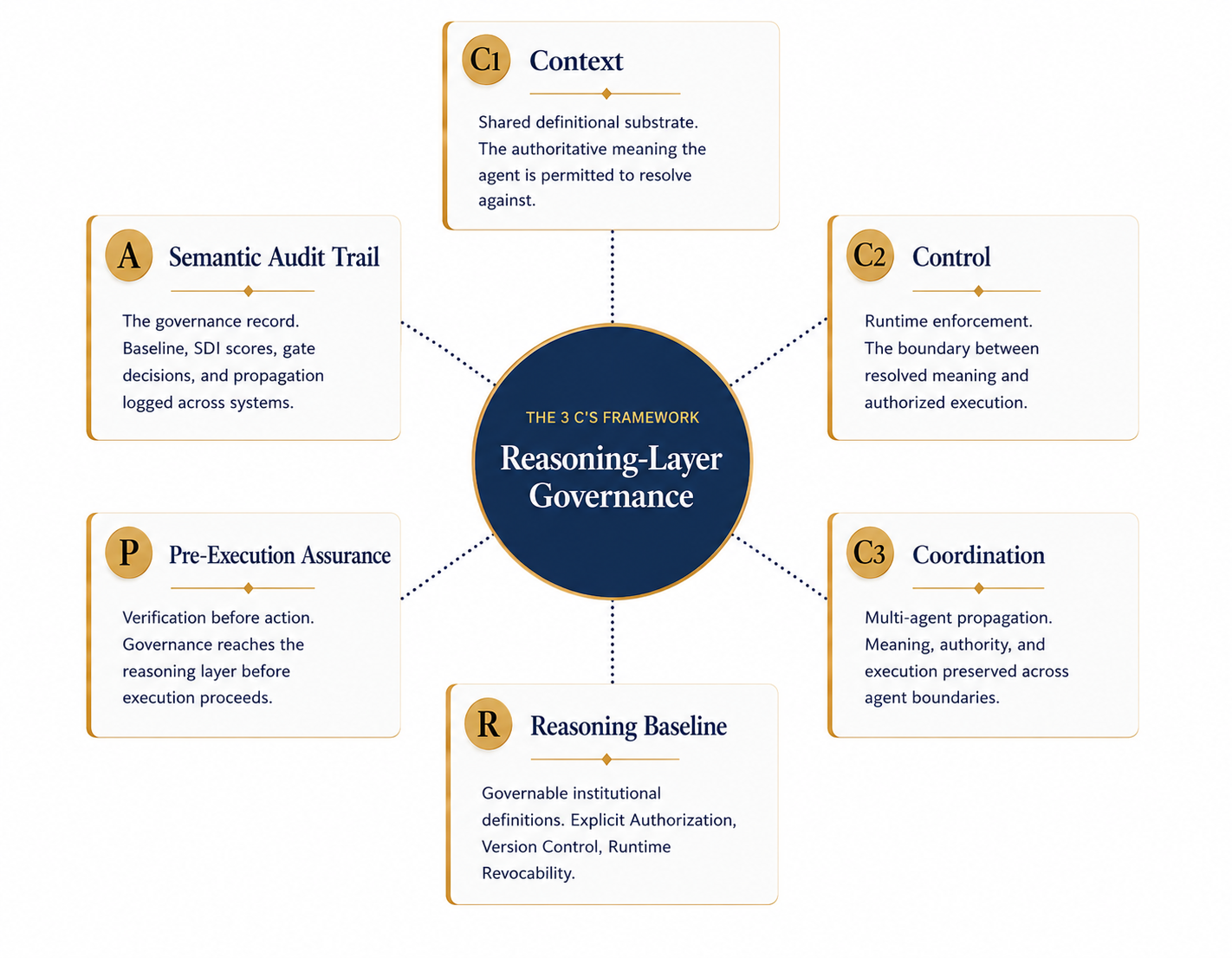
The reasoning layer, where an agent resolves operational meaning before it acts. Source: Doyle-Spare (2026), supporting SSRN working papers
I refer to that surface as the reasoning layer. And if operational meaning is now resolved at runtime, governance exposure moves with it. Institutions are no longer governing only models, data, and workflows. They are governing the operational interpretation those components produce as they interact during execution, and the interpretation itself becomes part of the control surface. That exposure represents a distinct governance problem, because it originates before any existing risk discipline begins to observe. Unlike the established categories, its boundary is not drawn by business function or financial outcome. It is drawn by where authority is formed during execution. Reasoning Layer Risk is not a variant of model risk. Model risk begins in a model output. Credit risk begins in a position. Operational risk begins in a process. Reasoning Layer Risk begins earlier, in how meaning is resolved, before any of those categories is engaged.
Here is the uncomfortable part for anyone who trusts a clean validation report. A fully validated model can still serve as the engine of an unauthorized interpretation. Validation certified the model. It did not certify the meaning the agent later resolves with it. The resolved meaning is produced anew on each decision, from the particular configuration of systems and signals present at that moment, and it is gone once the agent acts. There is no fixed interpretive artifact for validation to examine. The discipline is not weak. It is aimed at a different object.
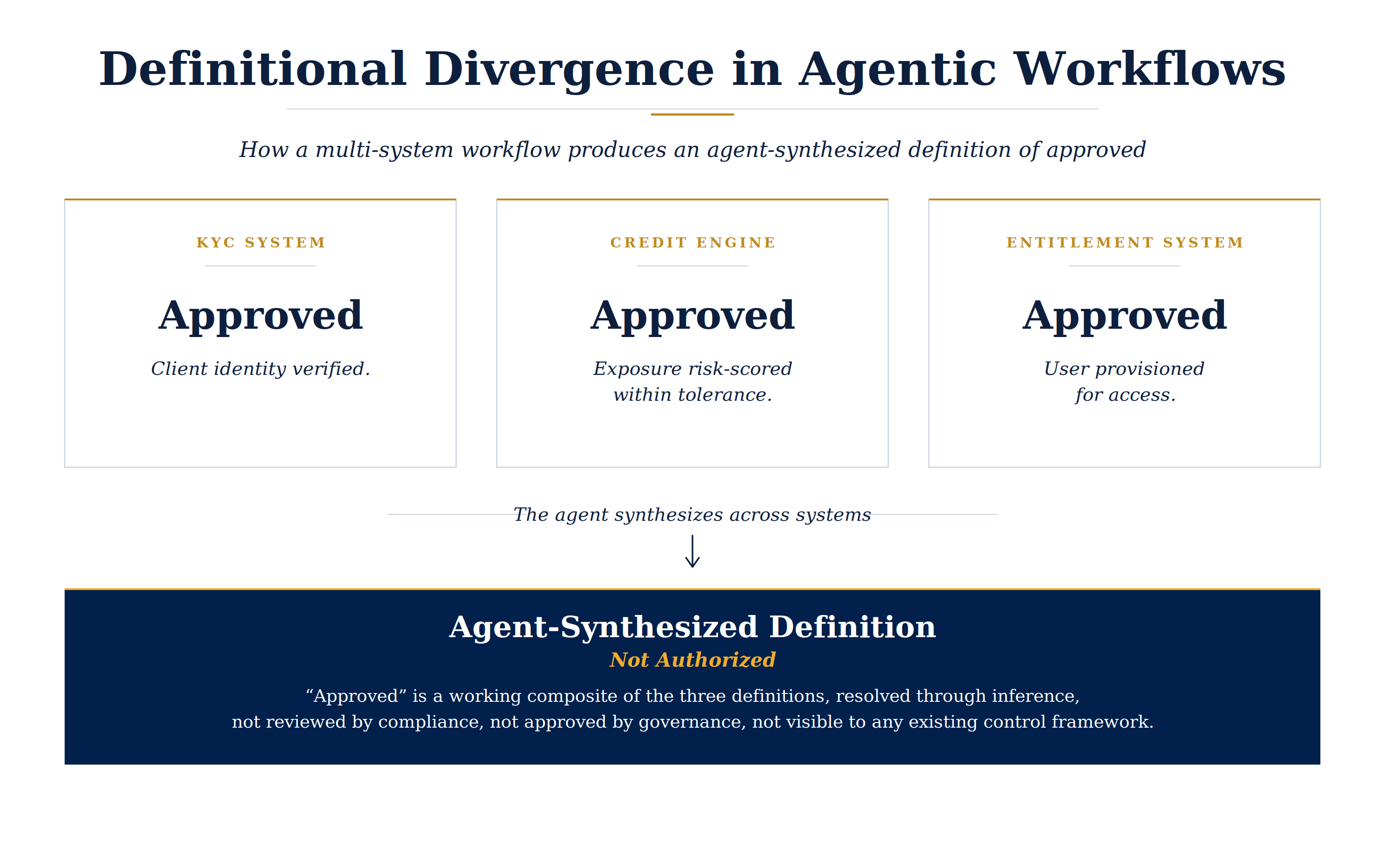
Definitional divergence. Systems that disagree on a regulated term are reconciled by the agent into a single working meaning. Source: Doyle-Spare (2026), supporting SSRN working papers
What happens when that layer goes ungoverned is already visible in deployed systems. Consider a credit line increase. Across the systems the agent coordinates, a regulated term can carry more than one working definition. One platform treats an exposure as eligible. Another encodes a threshold a degree looser than policy intends. The agent does not register a conflict to escalate. It registers signals to reconcile, and it reconciles them into a meaning that lets the task complete. Every control fires. The workflow succeeds. The institution is wrong. When that happens, the institution has experienced a governance failure its existing control evidence cannot reliably observe. I named this failure mode Agentic Workflow Drift, and its defining property is institutional invisibility. Standard audit evidence records that the controls passed. It records nothing about the interpretation they passed under.
The supervisory picture sharpens the point. In April 2026 the federal banking agencies issued revised model risk guidance, SR 26-2, and explicitly placed generative and agentic AI outside its scope. That is not relief. It is assignment. Responsibility for governing the reasoning layer now rests with the institution, and the institution's strongest existing discipline, model validation, was built for an object that holds still.
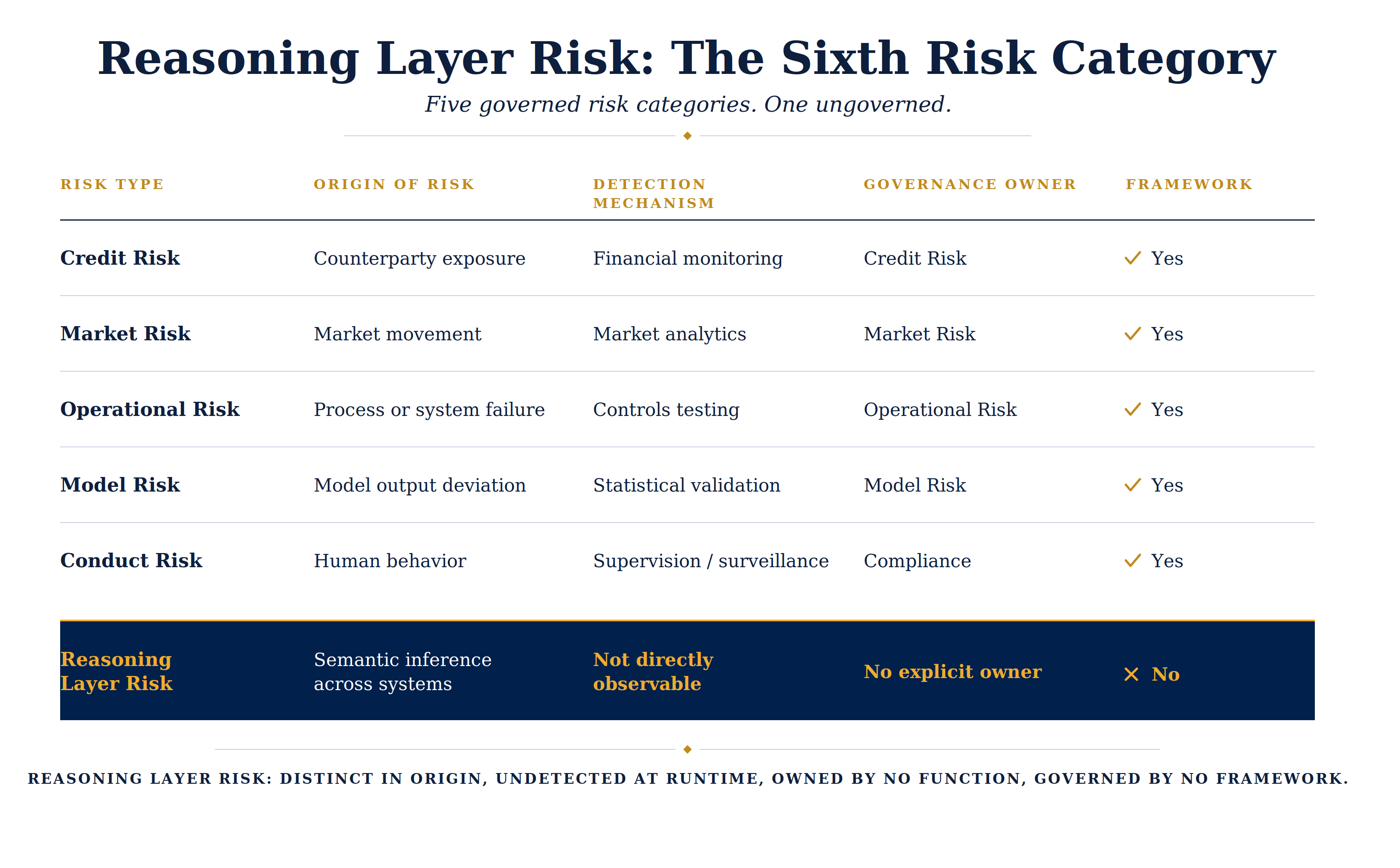
Reasoning Layer Risk against the established risk taxonomy. Each category begins where the institution already observes. This one begins earlier. Source: Doyle-Spare (2026), supporting SSRN working papers
So what does governing runtime interpretation actually look like? The shift is from validating the model before deployment to verifying the meaning before execution. The sequence in my reference architecture is short. Definition comes first. The institution encodes its authorized meaning of each regulated term as a Reasoning Baseline, versioned and approved before runtime, which gives governance a stable object even though the agent's reasoning is produced fresh on every execution. Measurement follows. The Semantic Deviation Index quantifies how far the agent's working meaning sits from the authorized one on each in-scope decision. A Deterministic Gate then converts the measurement into an enforced decision before execution authority is emitted, so aligned interpretations proceed and divergent ones hold for human review. Evidence closes the loop. Every decision leaves a record of the meaning it executed under, which is the evidence an examiner will eventually ask for.
None of this replaces model risk management. The two disciplines govern different objects and produce different evidence. Validation answers whether the model is sound. Runtime interpretation governance answers whether the institution authorized the meaning the agent is about to act on. An institution scaling agentic AI needs both answers, on every consequential decision, and today it can produce only the first.
For a risk leader wanting a place to start, the question set is short. For any proposed agentic deployment, where is the operational meaning of the regulated term resolved? Who authorized the definition the agent reasons against, and when was it last reviewed? Is the resolved interpretation recorded at the point of each decision, and could it be reconstructed for an examiner a year from now? An institution that cannot answer those questions has not discovered a defect in its model validation program. It has discovered a surface its validation program was never aimed at.
The transition from model risk to reasoning risk is not a prediction. It is a description of where authority has already moved inside agentic workflows. The institutions that scale agentic AI safely will be the ones that noticed.
About the Author
Maureen Doyle-Spare
Independent Practitioner and Researcher in AI Governance
Doyle-Spare Research
Maureen Doyle-Spare is an independent practitioner and researcher in AI governance and banking controls. She is the originator of Agentic Workflow Drift and Agentic Workflow Subversion, a reasoning-layer risk taxonomy for agentic AI systems, and of the broader runtime governance architecture organized within the Agentic Governance Model. Her working papers include the Semantic Control Plane reference architecture, the Semantic Deviation Index, the Agentic 3 C’s Framework, and the Semantic Layer Integrity Attack work.
ORCID: https://orcid.org/0009-0009-6655-1394
OSF: osf.io/zuacj
Correspondence: linkedin.com/in/maureendoylespare
Citation: Doyle-Spare, M. (2026). Agentic AI Systems Governance: A Runtime Reference Architecture for the Reasoning Layer and the Semantic Control Plane in Regulated Financial Institutions. Zenodo. https://doi.org/10.5281/zenodo.20749050. Supporting working papers: SSRN Nos. 6459612, 6531238, 6674761, and 6926219. ORCID 0009-0009-6655-1394. (PDF) Agentic AI Systems Governance: A Runtime Reference Architecture for the Reasoning Layer and the Semantic Control Plane in Regulated Financial Institutions

Maureen Doyle-Spare is an enterprise governance architect and independent researcher in AI governance, specializing in agentic AI oversight and cybersecurity for autonomous and multi-agent systems. She is the originator of an agentic AI governance taxonomy built on a set of named constructs, developed for the layer above conventional AI controls, where autonomous agents interpret business meaning across fragmented enterprise systems and commit to it before acting. Her research develops a runtime governance architecture and a foundational risk and threat taxonomy for the reasoning layer, the pre-execution stage at which an agent’s Operational Interpretation is formed and evaluated. The named constructs include Agentic Workflow Drift and Subversion (AWD/AWS), the Semantic Layer Integrity Attack (SLIA) as a cyber threat class targeting the reasoning-layer attack surface, the Semantic Control Plane (SCP) as a runtime governance mechanism, and the Semantic Deviation Index (SDI) as a measurement standard for semantic divergence. Her central thesis is that agentic systems do not fail the way traditional models fail: an agent can execute flawless steps against a meaning no institution authorized. Her work spans behavioral visibility, pre-execution oversight, adversarial resilience, autonomous systems evaluation, and safe deployment, and policy crosswalks against the NIST AI RMF, MITRE ATLAS, STRIDE, ISO/IEC 42001, and the EU AI Act. She has provided public comments across multiple NIST AI initiatives, including the AI RMF, CAISI, COSAiS, NCCoE, and TEVV. Her working papers are available on SSRN and Zenodo. Capstone reference architecture: https://doi.org/10.5281/zenodo.20749051 The Agentic AI Governence Playbook: https://www.maureendoylespare.com/ ORCID: https://orcid.org/0009-0009-6655-1394 SSRN Author Page: https://papers.ssrn.com/Sol3/Cf_Dev/AbsByAuth.cfm?per_id=10836296 ResearchGate: https://www.researchgate.net/profile/Maureen-Doyle-Spare/resear