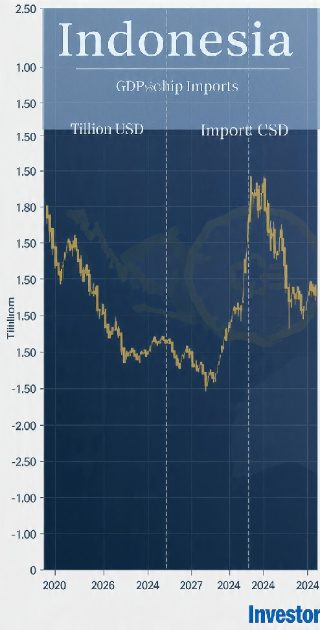
Indonesia crossed $1.4 trillion GDP in 2024, per IMF World Economic Outlook. The target is $2 trillion by 2028. That is a 43% jump in 4 years.
But there is a crack in the foundation. 90% of semiconductors used in Indonesia are still imported. No chips, no AI. No AI, no $2 trillion economy.
Jakarta has 6 years before 2030. If Indonesia fails to build chip capacity now, ASEAN’s Chip War will be decided without it. Investors are watching.
The Data Is Brutal: A 30x Trade Deficit
Numbers do not lie. Data from BPS Statistics Indonesia and UN Comtrade 2023 shows the gap.
Indonesia imported $12.3 billion worth of semiconductors in 2023. Exports were only $0.4 billion. That is a 30x deficit.
Compare that to Vietnam. Vietnam exported $18 billion in chips the same year. Vietnam started from zero in 2010. Indonesia started earlier but fell behind.
Meanwhile, demand is exploding. AI adoption, EV production, and data center buildouts in Indonesia grew 40% year-over-year in 2023. Each of those needs silicon.
This gap is a ticking bomb. Growth is capped by foreign silicon. GDP forecasts mean nothing if the hardware is imported.
Geopolitics: The Chip War Left Indonesia Behind
The global context makes this worse. The US CHIPS and Science Act allocated $52 billion to rebuild domestic chip capacity. China pledged over $150 billion in subsidies.
ASEAN became the battlefield. Malaysia secured $7 billion in new chip investments in 2023 alone. Singapore doubled down on OSAT and fabless design.
Indonesia’s role? Still a raw material supplier. Nickel and bauxite are critical inputs for chips and batteries. USGS data shows Indonesia holds the world’s largest nickel reserves.
But there is no “hilirisasi chip” strategy yet. Without it, Indonesia risks being a “quarry” in the AI era. Export raw ore, import finished chips. That model caps value capture at 3-5% of the supply chain
Three Data-Driven Moves Before 2030
Indonesia can still act. The window closes by 2030. Three moves matter most, based on data from countries that won the chip race.
1. Fiscal: Copy Vietnam’s OSAT Playbook
Vietnam attracted $5 billion FDI for chip assembly, testing, and packaging by offering 15-year tax holidays for OSAT and fabless firms. Indonesia needs the same. Target: pull $5 billion FDI for OSAT hubs in Batam and Java before 2030. Tax holiday beats raw material tax any day.
2. Talent: Scale the Surabaya Model 10x
Indonesia needs 50,000 chip engineers by 2030, per industry estimates. Politeknik Elektronika Negeri Surabaya already produces world-class talent. Scale it. Turn 10 polytechnics into chip-focused PSU programs. Partner with Intel, AMD, and local startups. Engineers are harder to copy than tax policy.
3. Alliance: Use Nickel as a Bargaining Chip
Indonesia should push for an “ASEAN Chip Alliance.” Use nickel export policy as leverage. Countries need Indonesia’s nickel for batteries and chips. Trade guaranteed nickel supply for guaranteed tech transfer and OSAT investment. This is Indonesia’s only real bargaining chip in the Chip War.
If Jakarta delays, 2030 will arrive with Indonesia still importing 90% of its silicon. The $2 trillion target will be a spreadsheet, not reality.
Signal for Investors: Watch the Hardware, Not the Headlines
$2 trillion is not a slogan. It is a math problem. Growth cannot exceed chip supply.
For US investors and fund managers, ignore GDP forecasts for a moment. Watch three real signals instead:
1. OSAT Investment Deals: Any major OSAT firm announcing a plant in Indonesia is the first real signal.
2. PSU Chip Curriculum: When 10 polytechnics launch chip engineering programs, talent is coming.
3. Nickel Export Policy Post-2025: If nickel policy ties exports to tech transfer, Indonesia is playing the long game.
Those three indicators will tell you more about Indonesia’s $2 trillion trajectory than any macro forecast. The Chip War is about hardware. Indonesia has the ore. Now it needs the silicon.
Disclaimer:
This analysis is for informational purposes only and does not constitute financial, investment, or trading advice. The views expressed are the author’s own and based on publicly available data as of June 2026. Investors should conduct their own due diligence before making investment decisions._
References:
1. IMF World Economic Outlook, April 2024 - Indonesia GDP Forecast
2. BPS Statistics Indonesia, Foreign Trade Statistics 2023 - Semiconductor HS Code 8542
3. UN Comtrade Database 2023 - HS Code 8542 Import/Export Data
4. US CHIPS and Science Act, 2022 - $52 Billion Allocation Summary
5. USGS Mineral Commodity Summaries 2024 - Nickel Reserves and Production
6. BIS Annual Economic Report 2024 - ASEAN Payment Systems and Digital Growth

Data-driven analysis on geopolitics, macroeconomics & value capture for US investors. Author of "Indonesia’s $2T Economy Can’t Win Without Chips". Brand: Economic Auditor. I turn BPS + WITS data into wallet-impact stories.