Today, a vast majority of people believe that the money they use everyday is backed by something tangible, or pegged to gold and silver reserves. This is a complete misconception. The monetary system currently dominating most countries around the world is fiat money. It is a clear and undeniable reality that this system is not equivalent to any precious metal; it can be printed endlessly, and as a result, it inherently fuels inflation.
For countries without globally dominant currencies—those whose money is not utilized outside their own borders—this system turns into nothing short of a catastrophe. To balance the rising inflation caused by the fiat system, central banks determine interest rates. When inflation becomes uncontrollable, the cost of living skyrockets, making interest rate hikes inevitable. Consequently, purchasing power plunges, and a severe liquidity crunch begins. To suppress the immediate crisis caused by this first step (raising rates), governments resort to printing even more money.
Countries that fall into this vicious cycle find themselves trapped, and this path leads directly to hyperinflation.
Today, I want to talk about natural money (tabi para), a system that not only minimizes inflationary expectations but also prevents vulnerable economies from entering this destructive spiral in the first place.
What Exactly is Natural Money and How Does It Work?
Natural money means that the value of existing or newly issued currency corresponds directly to a real, physical asset—such as a precious metal, land, or national treasury reserves. In other words, this currency cannot be printed at the whim of policymakers. Because it eliminates the vicious cycle of inflation-interest-money printing, it leaves no room for opportunistic price-setters who exploit inflationary data and interest rate expectations.
This system is not just a safeguard for weaker economies; it is an absolute prescription for countries currently battling or at risk of hyperinflation.
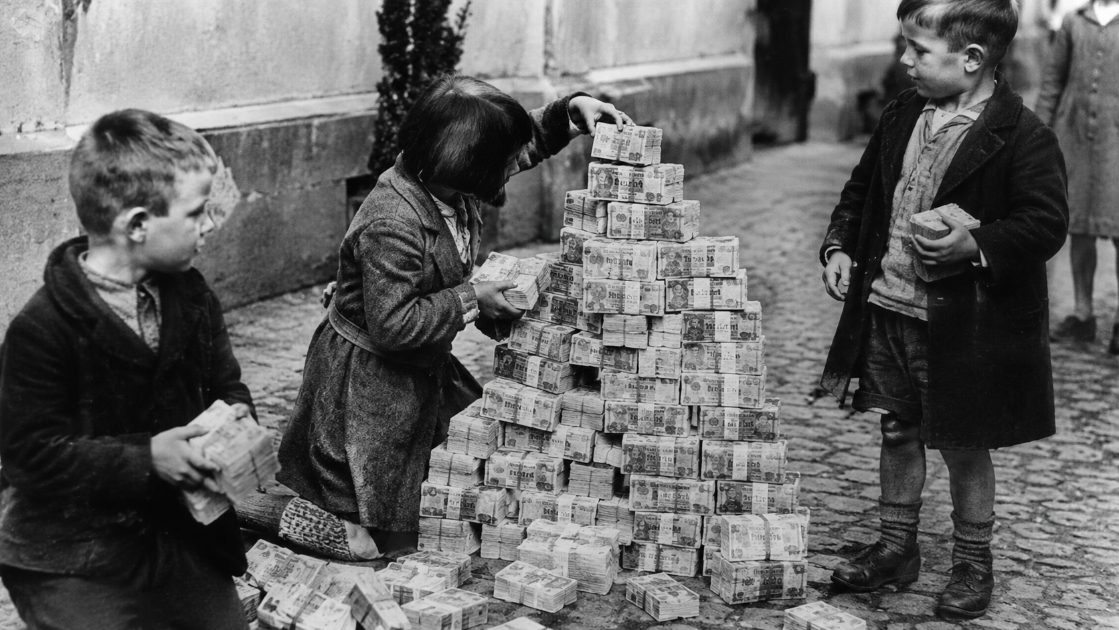
For instance, you have likely heard stories from World War I-era Germany, where citizens needed a wheelbarrow full of cash just to buy a single loaf of bread. How did Germany, having fallen into the darkest depths of hyperinflation, manage to escape this crisis? Of course, through a brilliant example of natural money: the Rentenmark.
The Rentenmark: A Miracle Backed by Land, Not Gold
Following World War I, Weimar Germany was devastated and caught in one of the most destructive hyperinflationary spirals in human history. Central bank printing presses ran day and night, erasing the currency's value within hours. Germany did not possess a single gram of gold reserves left to back its currency and revive the economy.
In this moment of absolute desperation, on November 15, 1923, a historic economic move was made: the Rentenmark was introduced. Germany couldn't find gold, but the country still possessed a tangible, "natural" value: its land and industrial capacity.
The newly established Deutsche Rentenbank pegged the Rentenmark directly to mortgages placed on agricultural land, real estate, and industrial assets owned by the state. Every single Rentenmark printed was effectively backed by a physical piece of Germany's fertile soil and factories.
The economic administration equated 1 Rentenmark to exactly 1 trillion old, worthless paper marks (Papiermark). Crucially, strict legal limits were placed on the issuance of the new currency, ensuring it could never exceed the total value of the mortgaged real assets. Seeing that the new currency was backed by concrete land and production power, the public and merchants immediately trusted it. The result? In an event recorded in economic history as the "Miracle of the Rentenmark," the massive hyperinflation holding Germany hostage was cut like a knife within a matter of weeks.
A Modern-Day Prescription: Zimbabwe and the "ZiG" Experiment
The natural money system is not just an old tactic left in dusty history books; it remains one of the strongest alternatives against modern global financial crises. We can see the most recent and striking example of this in Zimbabwe.
After struggling for decades with triple-digit—and at times unquantifiable—hyperinflation rates that completely wiped out the value of its local currency, Zimbabwe took a radical step in April 2024. Just like Germany in 1923, to escape the fiat death spiral, it introduced a new currency called "Zimbabwe Gold" (ZiG).
Behind the ZiG, there are no empty political promises or endlessly spinning printing presses. This currency is designed as a "natural money" directly backed by physical gold reserves, precious metals, and foreign currency assets safely guarded in the Reserve Bank of Zimbabwe's vaults.
To sustain this system, the government even mandated that mining companies pay 50% of their taxes and royalties not in cash, but in physical gold bullion. Thanks to this, Zimbabwe quickly multiplied its gold reserves, fortifying the natural power backing its currency. Although the process remains challenging due to deep-rooted public distrust from previous currency collapses, the ZiG system serves as a critical macro-economic anchor in reining in inflation.
Conclusion: The End of Fiat Money?
The story of the Rentenmark in the past, and the ZiG experiment today, reveals a very clear truth: when the illusion of unbacked debt and inflation created by fiat money inevitably breaks down, humanity sooner or later turns its face back to real and tangible value.
Natural money is the ultimate shield protecting economies from the price manipulations of speculators and the printing addiction of central banks. For any economy that refuses to be crushed under the hegemony of dominant powers or is actively fighting the monster of inflation, natural money is not just a memory of the past—it is the strongest financial alternative of the future.
References
German Federal Archives (Bundesarchiv). (1923). The Stabilization of the Mark and the Introduction of the Rentenmark. Deutsche Bundesbank History Records.
Bresciani-Turroni, C. (2003). The Economics of Inflation: A Study of Currency Depreciation in Post-War Germany (1914-1923). Hyperinflation in the Weimar Republic.
Reserve Bank of Zimbabwe (RBZ). (2024). Introduction of the New Structured Gold-Backed Currency: Zimbabwe Gold (ZiG). Zimbabwe Gold Official Release.
Reuters Markets. (2025). Zimbabwe's gold-backed currency reserves and economic stability assessments. Reuters Financial Reports.
I am an independent researcher focused on global macroeconomics, public finance, and fiscal policies. I analyze tax structures and modern economic trends to offer data-driven perspectives on global markets.