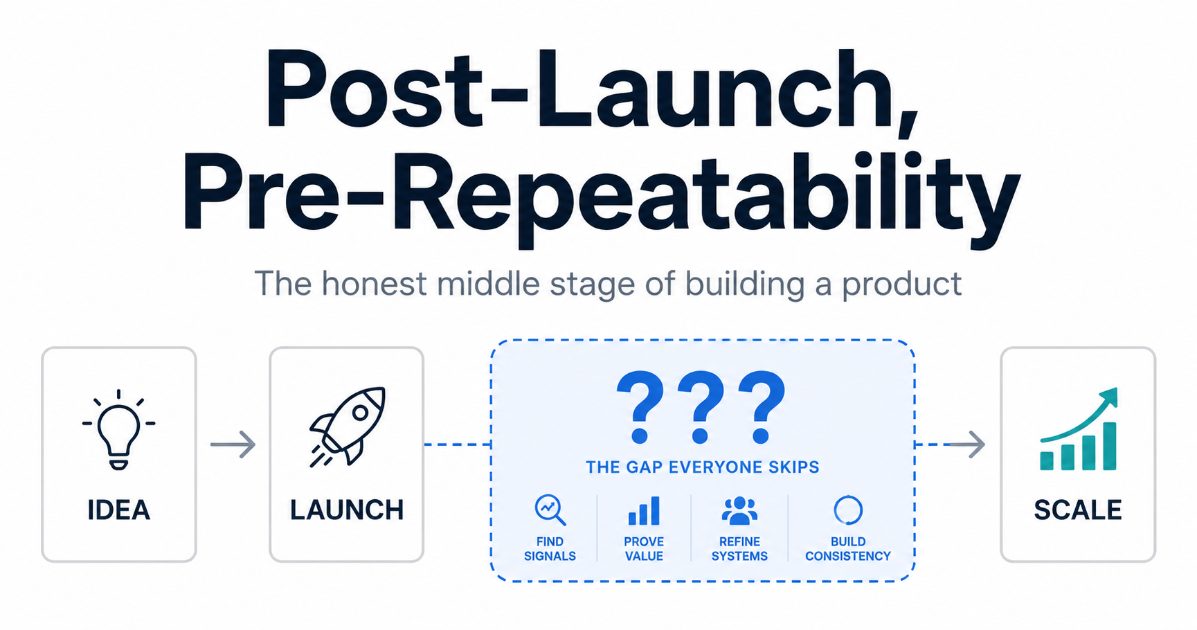
The gap between "it works" and "people find it" is where most honest founder stories actually live.
There's a stage of building a product that nobody really talks about honestly.
It's not the exciting early stage, when you're figuring out what to make and everything feels wide open. It's not the scaling stage, when you have users and revenue and distribution problems that are almost luxurious compared to what came before.
It's the middle stage. The product works. You've launched. Real people can use it and it does what it says. But nobody is finding it in any reliable way, and you haven't figured out how to change that yet.
I'm in that stage right now.
MDU Engine has been live since May 2025. It evaluates whether performance marketing campaign data meets the conditions required to make a budget decision not just what the data shows, but whether what it shows is stable and reliable enough to act on. The methodology is published. The API is documented. A UK AI founder spent time looking at the product in detail and described its position in the stack more clearly than I had: "V8 acts on signals. MDU decides whether the signal warrants action. That's not parallel, it's upstream."
That was a good week.
But good weeks and repeatable customer acquisition are different things. And the honest founder story right now is that I have the first and not the second.
What "post-launch, pre-repeatability" actually means
When most people talk about product-market fit, they mean the moment when users start finding the product faster than you can serve them. Engines rev. Growth compounds.
That's not what I'm describing.
What I'm describing is the period before that when the fit exists in individual conversations but hasn't become a system yet. When the people who see the product understand it immediately and find it useful, but there's no reliable mechanism for getting it in front of the right people at the right time.
The product works for a specific person in a specific situation: a performance marketing lead or founder at a B2B SaaS company, spending £5k–£50k per month on paid acquisition, who is tired of making budget decisions on data they can't fully trust. When that person sees MDU Engine, the problem resonates without needing to be explained. They feel it in their gut because they have felt it every week for years.
The gap is not product quality. The gap is distribution, finding that person, at the moment when the problem is front of mind, in a way that doesn't require me to be in the room.
That's the problem I'm working on now.
What I've tried so far
The approach I've taken is content-led, because it's the approach I can execute alone without burning cash I don't have.
I've published two articles on HackerNoon, two on DataDrivenInvestor, a research paper in JETIR, and written a full-length practitioner book on the decision-readiness framework. I have a YouTube channel with twenty-something videos on decision systems for performance marketing. I'm active on LinkedIn, not in a post-every-day-about-your-journey way, but in a write-about-the-actual-problem way.
This has produced inbound interest. Conversations. A few people who found the articles and reached out. A UK founder who reviewed the API seriously enough to ask about integration.
What it has not produced is repeatable acquisition. The right person finds the content, understands the product, and tries it but not at a reliable enough rate to call it a system.
The honest assessment
I think the content-to-acquisition gap is a sequencing problem. The content builds credibility. The credibility enables conversations. The conversations create trust. The trust converts to usage. But each step in that chain is long and each link is weak enough that the chain breaks more often than it holds.
What I'm missing is something that collapses that chain, a direct route from "person with the problem" to "person using the product" that doesn't require them to read an article, visit a profile, understand a framework, and then decide to try a tool.
The most direct version of that route is a sales motion. Direct outreach to the specific segment, with a message that names the problem precisely enough that the right person responds and everyone else doesn't. I haven't built that system yet. Building it is the next thing.
Why I'm writing this
Not to be self-deprecating, and not to manufacture authenticity by performing vulnerability.
I'm writing it because the honest version of building something new is almost never represented accurately. The stories that get told are either about the exciting early days or the eventual success. The middle where you have something real and working and the problem is purely distribution tends to get skipped.
But the middle is where most of the time is spent. And the skills the middle stage requires patience, honest diagnosis, willingness to stay with a problem rather than pivot away from it are different from the skills that get celebrated.
If you're building something and you recognise this stage, I'd say two things.
The product being real is not nothing. It's actually most of the work. The distribution problem is solvable, even if you haven't solved it yet.
And the conversations you have while you're in this stage, even the ones that don't convert are telling you things about your customer that you cannot learn any other way. Don't rush past them.
Satish Saka is the founder of MDU Engine, a decision-support platform for performance marketing budget decisions. The underlying methodology is published in JETIR (ISSN 2349-5162). Try the product at app.mduengine.com.

Satish Saka is a practitioner working on decision-support systems in analytics environments. He developed MDU Engine, a public decision-support platform designed to evaluate data readiness, confidence stability, and downside risk before optimisation actions are taken in performance-driven systems. His work focuses on decision-making under uncertainty, validation-gated optimisation, and human-in-the-loop analytics architectures. He writes on decision intelligence, applied analytics, and responsible automation in data-driven domains.