The 2008 Financial Crisis: Anatomy of a Trillion-Dollar Illusion

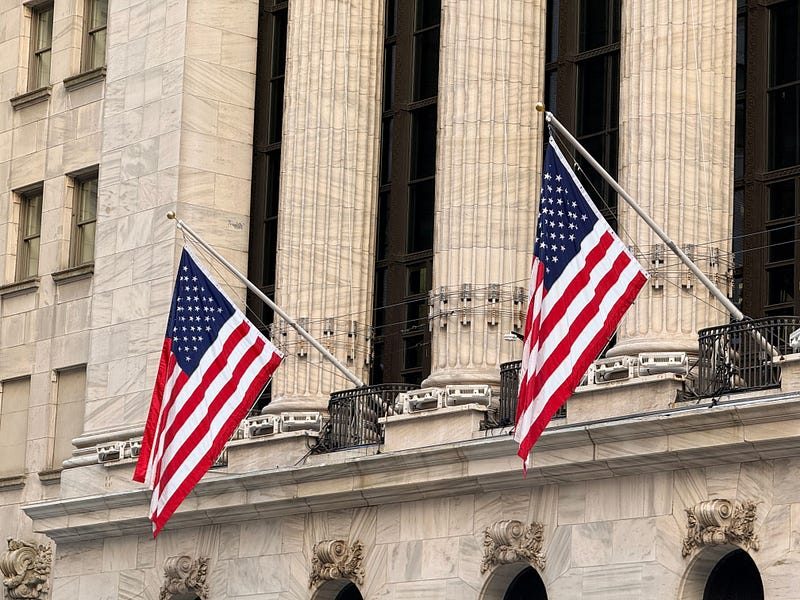
The 2008 crisis was not a natural disaster. Wall Street’s toxic incentive structures privatized gains while socializing losses, contributing to one of the most severe financial crises in modern history. Why was Lehman sacrificed while AIG was saved? And more importantly: Are we actually safe today?
Most people believe the 2008 Global Financial Crisis began on the day Lehman Brothers filed for bankruptcy. In reality, that event was only the culmination of problems that had been building within the financial system for years.
The crisis wiped out trillions of dollars in wealth, displaced millions of people, and triggered a severe global recession. While the financial losses were enormous, the more important lesson lies in the incentive structures that encouraged excessive risk-taking throughout the financial system.
This article provides a step-by-step examination of the factors that contributed to the 2008 financial crisis and the lessons they offer for today's leaders.
1. Setting the Time Bomb: 2001–2007

Major financial crises often emerge from policy responses to previous downturns. The housing bubble of the 2000s developed partly in the aftermath of the dot-com crash and the post-9/11 slowdown. When the dot-com bubble burst in 2001, compounded by the shock of 9/11, the Fed responded to economic deceleration and geopolitical uncertainty by aggressively slashing interest rates from 6.5% down to a historic 1%.
The goal was to stimulate the economy; the result was a massive housing bubble. As cheap money flooded the market, two things happened:
Housing prices rose rapidly as low interest rates and expanding mortgage credit fueled demand.
Institutions like Fannie Mae and Freddie Mac played a massive role in aggressively expanding the mortgage market.
Risk had not disappeared. Rising home prices and easy credit conditions created the perception of stability, encouraging investors to underestimate the vulnerabilities building beneath the surface.
2. The Subprime Factory: Turning Risk into a Product
Traditionally, banks carried the loans they issued on their own balance sheets, which made them inherently cautious. However, the rise of the “Originate to Distribute” model completely severed this link. Issuing a mortgage was no longer a relationship; it became an assembly line:

The Mortgage Broker: Issued loans to virtually anyone, often without requiring income verification. They collected their commission and passed the risk up the chain.
The Investment Banks: Bundled thousands of these toxic, low-quality loans into complex financial pools, repackaging them as MBS (Mortgage-Backed Securities) and CDO (Collateralized Debt Obligations).
The Rating Agencies (Moody’s, S&P): Paid directly by the issuers themselves, they rubber-stamped these junk-filled CDOs with pristine AAA ratings.
The CDS Market: Credit Default Swaps were created as insurance policies on these products. The catch? You didn’t even need to own the underlying asset to buy insurance on it. Before the crash, the nominal size of this synthetic casino reached trillions of dollars.
Most participants in the securitization chain benefited from short-term fee generation while transferring risk elsewhere in the system. The bill for the damage, however, would ultimately be footed by the entire world.
3. The Maverick Voice: Michael Burry and the Whisper of Data

"While markets celebrated profits, a few investors focused on the data."
At the height of the housing boom, most market participants believed housing prices would continue rising. A small number of investors reached a different conclusion after examining the underlying mortgage data. The most notable among them was Dr. Michael Burry.
While much of Wall Street focused on increasingly complex structured products, Burry examined the mortgage pools underlying those securities in detail. He concluded that many institutions were relying on a critical assumption: that housing prices would not decline nationwide at the same time.
His analysis revealed a deterioration in lending standards and a growing concentration of high-risk borrowers within mortgage-backed securities. Early signs of rising default rates suggested that the risk embedded in these products was greater than widely assumed.
Investors who focused on fundamentals rather than market sentiment recognized that the structure supporting the housing market was becoming increasingly fragile (see Michael Lewis, The Big Short). However, strong short-term returns and continued growth in housing prices reduced the incentive for many institutions to reassess their assumptions.
4. The Risk Wall Street Chose Not to See

Banks relied heavily on quantitative risk models, particularly Value at Risk (VaR), to estimate potential losses. However, these models were largely based on historical data from a period characterized by relatively stable market conditions.
At the same time, Basel II regulations allowed banks to hold minimal capital against assets carrying AAA credit ratings. As a result, many investment banks operated with leverage ratios of approximately 30 to 40 times their equity capital.
This structure left institutions highly vulnerable to even modest declines in asset values. A relatively small drop in the value of mortgage-related assets was sufficient to erode a significant portion of their capital base.
Although the models appeared sophisticated, many of their underlying assumptions proved unrealistic once housing prices began to decline and market conditions deteriorated.
5. The First Domino: Bear Stearns (March 2008)
Months before Lehman’s collapse, in March 2008, Bear Stearns ran out of cash. To prevent a systemic meltdown, the Fed and JPMorgan Chase stepped in to orchestrate a frantic weekend fire sale.
The scale of the destruction was brutal: Bear Stearns stock, which had hit a 52-week high of $133, was abruptly sold to JPMorgan for just $2 per share (later revised to $10).
The Bear Stearns intervention reinforced expectations that major financial institutions would be rescued during periods of distress. This perception weakened market discipline and encouraged further risk-taking, as many participants believed a government safety net would ultimately protect the system.
6. Lehman Brothers Last 72 Hours: A Chronology of Events
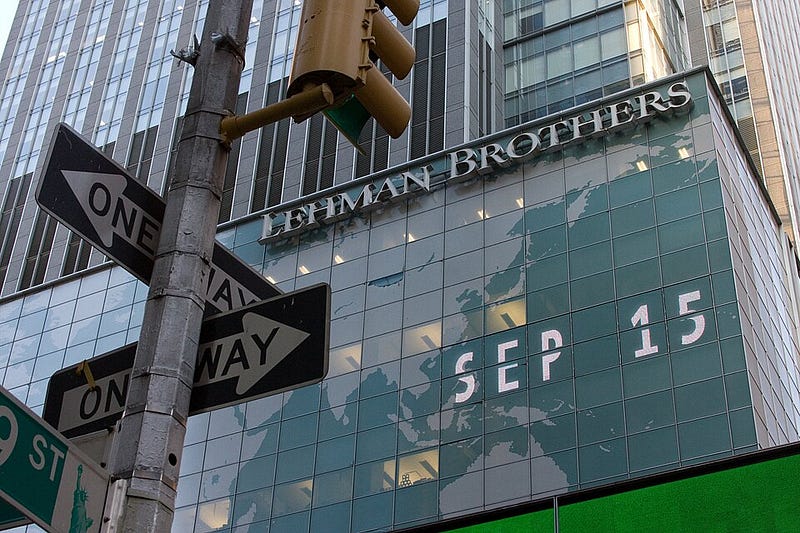
The digital billboard outside Lehman Brothers’ corporate headquarters displaying September 15 — the exact day a 158-year-old banking empire evaporated. / Photo by Alyarudan/Wikimedia
On Friday, September 12, Fed Chairman Ben Bernanke and Treasury Secretary Hank Paulson summoned Wall Street’s top CEOs to an emergency meeting. The directive was blunt: “You are going to save Lehman. There is no taxpayer money on the table.”
Friday to Saturday: High-stakes negotiations began with Barclays and Bank of America.
Sunday Morning: UK regulators vetoed the deal, refusing to let Barclays inherit Lehman’s toxic liabilities. Bank of America pivoted to a safer harbor, acquiring Merrill Lynch instead.
Sunday Midnight: All rescue options evaporated. Dick Fuld’s 158-year-old banking empire was officially dead.
On Monday morning, September 15, Lehman Brothers filed for bankruptcy. This wasn’t just the death of a corporation; it was a severe shock to global market confidence. The repo market froze instantly, banks refused to lend to one another, and global trade ground to a halt (FCIC Report, 2011).
7. The Grand Paradox: Why Did AIG Live While Lehman Died?
The answer to this question lies not in justice, but in pure systemic mathematics.
Lehman was an investment bank; its failure was catastrophic, but regulators believed it could be contained. AIG, on the other hand, was the world’s largest insurance company. It had sold hundreds of billions of dollars in CDS protection to global giants like Goldman Sachs, Deutsche Bank, and Société Générale S.A.
If AIG went under, it wouldn’t just collapse on its own; it would trigger a domino effect of immediate, cross-border bankruptcies across the entire global banking architecture. While Lehman was handed a “disciplinary death sentence,” AIG was immediately thrown an $85 billion government lifeline. Policymakers effectively abandoned traditional market discipline in order to prevent systemic collapse (Federal Reserve crisis documentation).
8. The Strategic Pivot: This Was a Governance Crisis
To look at the 2008 crash merely as a failure of credit quality or a lack of regulatory oversight is to miss half the picture. The core issue at the center of the crisis was not a lack of information, but a catastrophic failure in incentive design.
One of the most striking lessons of the crisis is that it was not merely a failure of financial engineering; it was a failure of the incentive structures that shaped human behavior.
In the vast majority of financial institutions, decision-makers were rewarded based on short-term performance metrics. The risk manifested over the long term, but the bonuses were paid out in the short term. This severe time asymmetry triggered a classic principal-agent problem, structurally incentivizing highly intelligent actors to manufacture systemically irrational outcomes (see Jensen & Meckling’s agency theory literature).
Therefore, 2008 was not just a liquidity crisis; it was a profound crisis of corporate governance and incentive architecture.
9. Five Strategic Lessons from 2008 for Today’s Leaders
History doesn’t repeat itself, but it certainly rhymes. For modern executives, strategists, and founders, 2008 offers five timeless principles:
Incentives Dictate Behavior: Flawed, short-term bonus structures will consistently drive even the most brilliant executives to take on existential, systemic risks.
Complexity Does Not Equal Security: Advanced financial engineering does not eliminate risk; it merely camouflages it. A model you do not fully comprehend is a risk you cannot manage.
Liquidity Trumps Book Value: What your assets are worth on paper during a bull market matters far less than how fast you can convert those assets into cold cash during a panic.
Trust Precedes Mathematics: The moment market confidence evaporates, the most sophisticated risk models become utterly useless. Trust is the invisible collateral holding the entire economic system together.
“Too Big to Fail” Is an Illusion: Sheer corporate scale is not a permanent shield against macroeconomic shocks. No institution is larger than the macroeconomic ecosystem it inhabits.
10. Conclusion: Math or Trust?
Ultimately, 2008 proved that financial systems do not run on pure mathematics; they run fundamentally on trust.
When the math breaks, you write off a loss. When the trust breaks, the entire system stops.
The day Lehman Brothers collapsed, it wasn’t just a bank that failed — it was the global collective belief that the financial system could seamlessly self-regulate.
As we look at today’s highly leveraged global economy, the underlying question remains unchanged:
When the next inevitable shock hits the wire, will we actually be better prepared, or are we just repeating the exact same structural errors with far bigger numbers?
References
Bernanke, B. S. (2015). The Courage to Act: A Memoir of a Crisis and Its Aftermath. W. W. Norton & Company.
Financial Crisis Inquiry Commission (FCIC). (2011). The Financial Crisis Inquiry Report: Final Report of the National Commission on the Causes of the Financial and Economic Crisis in the United States.
Jensen, M. C., & Meckling, W. H. (1976). Theory of the Firm: Managerial Behavior, Agency Costs and Ownership Structure. Journal of Financial Economics, 3(4), 305–360.
Lewis, M. (2010). The Big Short: Inside the Doomsday Machine. W. W. Norton & Company.
Basel Committee on Banking Supervision. (2004). International Convergence of Capital Measurement and Capital Standards: A Revised Framework (Basel II).
Federal Reserve Board. Historical Federal Funds Rate Data.
U.S. Securities and Exchange Commission (SEC). (2008). Summary Report of Issues Identified in the Commission Staff's Examinations of Select Credit Rating Agencies.
U.S. Department of the Treasury. (2008). Troubled Asset Relief Program (TARP) Documentation.
Federal Reserve Bank of St. Louis (FRED). Historical Housing Market and Interest Rate Data.
McLean, B., & Nocera, J. (2010). All the Devils Are Here: The Hidden History of the Financial Crisis. Portfolio.
Recep Melih Ozmutlu | Business student exploring, financial history, risk management, and corporate strategy
#FinancialHistory #RiskManagement #2008Crisis #LehmanBrothers #CorporateStrategy #TooBigToFail #Economics
Frequently Asked Questions
What caused the 2008 financial crisis?
The crisis was driven by a combination of excessive leverage, weak lending standards, complex financial products, and incentive structures that rewarded short-term gains while transferring long-term risks throughout the financial system.
What was the Originate-to-Distribute model?
Instead of holding mortgages on their own balance sheets, banks increasingly sold them to investors through securitization. This reduced incentives to carefully evaluate borrowers and contributed to the expansion of risky lending.
Why was Lehman Brothers allowed to fail while AIG was rescued?
Policymakers believed Lehman's failure could be contained, while AIG's collapse threatened a much broader network of financial institutions through its CDS obligations. As a result, regulators viewed AIG as a greater systemic risk.
What lessons does the 2008 crisis offer today?
The crisis demonstrated the importance of incentive design, risk management, capital adequacy, and market confidence. It also showed that complex financial products cannot eliminate risk; they can only redistribute it.
I am Recep Melih OZMUTLU, a Business Administration student with a deep investigative focus on financial history and systemic risk. I have spent significant time analyzing major corporate failures and market collapses from the 1929 Great Depression and the 2008 crisis to the Enron scandal specifically examining how flawed structural incentives trigger institutional meltdowns. My writing bridges historical precedent with future corporate architecture. As an aspiring M&A and Strategic Management Consulting professional, I write to deconstruct the complex mechanisms behind corporate governance, risk management, and market psychology.