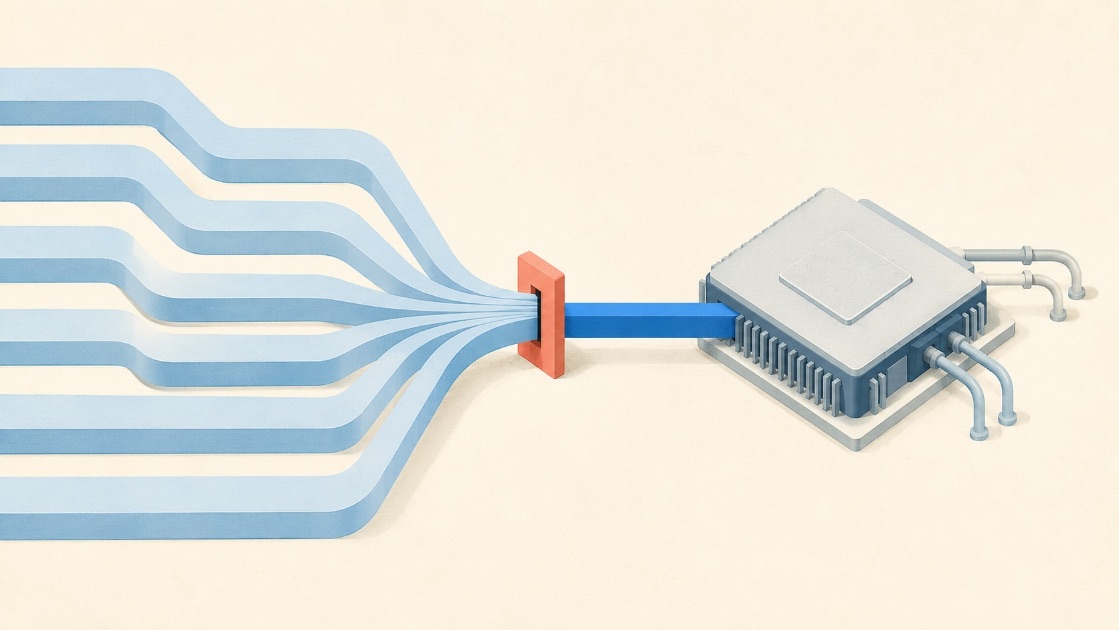
I followed a frontier accelerator from design software to power and cooling. At each step, the apparent alternatives became fewer
I began by mapping critical suppliers. The picture changed when I stopped counting firms and started testing which production paths could actually be rerouted.
When I started mapping the manufacturing chain behind frontier AI, I made the obvious choice: I counted companies.
ASML for advanced lithography. TSMC for leading-edge fabrication. SK hynix, Samsung and Micron for high-bandwidth memory. ASE and Amkor in packaging. Foxconn, Quanta and Wiwynn in server and rack integration. Then Vertiv, Schneider Electric, Eaton, Hitachi Energy, Siemens Energy and GE Vernova across the power and cooling layers.
The concentration was serious, but it was visible. It also appeared to be improving.
TSMC is investing outside Taiwan. Three companies manufacture HBM. Packaging capacity is expanding. Server assembly is moving into Mexico and Southeast Asia. Governments are spending heavily to create domestic semiconductor industries. Hyperscalers are developing their own chips.
Then I tried a different test.
Instead of asking how many companies operated at each layer, I tried to reroute the chain when one of them was removed.
That was when many of the alternatives began to disappear.
Another foundry existed, but the accelerator had not been designed and qualified for its process. Another memory manufacturer had capacity, but its HBM was not yet validated for that accelerator package. Another packaging company could perform similar work, but not necessarily with the same substrate, thermal design, tooling and yield. A plant existed in another country, but still depended on engineers, process knowledge and suppliers located at home.
The company map showed several suppliers. The production map showed far fewer usable paths.
That difference is where the risk sits.
The route matters more than the names on the map
A frontier accelerator does not emerge from one factory. It has to move through a sequence that looks approximately like this:
EDA software → advanced lithography → leading-edge foundry → qualified HBM → advanced packaging → substrate → testing → board and network integration → rack assembly → power and cooling
Even that description is simplified. Each arrow contains technical interfaces, customer approvals, capacity reservations, software dependencies, and manufacturing knowledge that may have taken years to establish.
This is why two suppliers should not automatically be counted as two alternatives.
If they both depend on the same lithography platform, part of their independence is already lost. If two overseas factories rely on one engineering center to maintain yield, their physical separation says little about how they would behave during a prolonged crisis. If only one HBM supplier has passed the required qualification for the current accelerator, the others may be future options, but they are not current resilience.
I kept returning to the word qualified.
It looks almost administrative. In this chain, it changes the entire map.
A component can exist, meet its own specification, and still be unusable inside a particular product. A supplier can have available capacity and still be unable to take over the flow. An alternative process can be technically credible but arrive too late for the product generation that needs it.
This is not the normal procurement problem of finding another vendor and negotiating a new contract. In many cases, substitution means redesigning, retesting, and qualifying part of the system again.
The relevant unit of risk is therefore not the individual company. It is the complete production route that has already been proven to work.
A network contains many possible relationships. Once companies design products and facilities around a small number of those relationships, something changes. Switching supplier is no longer a commercial decision alone. It becomes an engineering programme, sometimes a multi-year one.
That is the point at which a network begins to behave like infrastructure.
Frontier AI is already there in several critical layers.
Where the passage narrows, value accumulates
The first infrastructure principle I applied to the map was that value moves towards bottlenecks. The AI manufacturing chain gives that principle a very physical meaning.
ASML’s position cannot be understood simply by counting the machines it sells. An advanced lithography system sits inside a much larger capability made of optics, light sources, precision motion, vacuum systems, software, calibration, servicing, spare parts, and specialized engineering knowledge.
Opening a second factory somewhere else does not reproduce that ecosystem.
The same is true of TSMC. Its importance is not only a matter of fabrication capacity. It comes from process technology, accumulated yield learning, supplier coordination, design-tool integration, packaging capability and years of customer qualification.
Those elements reinforce one another. They are also difficult to separate and move.
HBM creates another narrowing point. There are three major manufacturers, which initially looks reassuring. But memory is not selected independently from the rest of the accelerator. A specific HBM product has to work with a specific logic die, package, interconnect, and thermal design. It then needs to perform reliably at the required volume.
The same logic continues into advanced packaging. Logic and memory may both be available, yet productive accelerators cannot be delivered unless they can be combined through a repeatable process at acceptable yield.
By the time the chain reaches the data center, the dependencies are no longer confined to semiconductors. A completed rack needs networking, firmware, switchgear, transformers, cooling equipment, sufficient grid capacity and, increasingly, regulatory approval for the power it will consume.
One missing layer can leave all the others waiting.
This explains why announced capacity can be misleading. Capacity measured at a single stage is not the same as capacity available across the complete route.
Ten thousand additional accelerators have limited value if HBM cannot be supplied. More packaged chips do not help if racks cannot be powered. A completed data center does not become operational simply because the servers have arrived.
The scarce asset may be a component. Quite often, it is the working combination of components.
A new factory is not always a new capability
Geographic diversification is one of the main answers being offered to semiconductor concentration, and rightly so. The industry needs more production outside its traditional centers.
But I am not convinced we are measuring this diversification correctly.
Most announcements tell us where a new plant will be built and how much capacity it is expected to add. They say much less about how independently that plant could operate if access to the original technological center were interrupted.
Could it sustain target yield for six months without engineers arriving from abroad? Could it service and calibrate its equipment? Would it still receive the unique masks, chemicals, gases, spare parts, and software updates required for leading-edge production? Who controls the process recipes and the decisions needed when something goes wrong?
There is also a legal question. A plant may be able to manufacture the same product but no longer be permitted to serve the same customers if export controls or national-priority rules change.
None of this makes overseas investment cosmetic. A geographically separate plant can absorb natural disasters, local power failures and some logistical interruptions. It creates jobs, knowledge and, over time, a stronger regional ecosystem.
The caveat is in those last two words: over time.
A new fab begins as a location. Becoming an autonomous production capability takes longer.
If governments want to measure semiconductor resilience seriously, announced wafer capacity is not enough. I would like to know how many days a plant can sustain advanced production at the required yield without access to its original engineering and supplier base.
That would produce a rather different map.
Today, the supply chain is becoming more geographically distributed. Its operational dependencies are moving much more slowly.
The shock does not stop at the bottleneck
The second infrastructure principle concerns who ultimately carries the risk.
My first assumption was that the most exposed actors would be the smaller suppliers around the major bottlenecks. That is only part of the story. Risk also moves downstream to companies that have committed capital around a route they cannot easily leave.
An accelerator designer may control the product architecture, software ecosystem and customer relationship while still depending on a foundry and packaging process that cannot be replaced within the current product cycle.
A hyperscaler can use its scale to secure long-term supply. It also commits billions to data centers designed around particular accelerators, rack densities, networking systems and cooling technologies. Once the concrete has been poured and the electrical architecture installed, changing direction is no longer a simple procurement exercise.
The same problem appears further down the hierarchy. Smaller cloud providers and AI companies may be technically able to use different hardware. In a shortage, flexibility matters less if the available capacity has already been reserved by larger buyers.
This is how a stressed infrastructure is likely to behave. It may continue operating without serving everyone.
The largest customers retain allocation. Smaller buyers wait longer or pay more. Data-center projects with weaker economics are postponed. Older accelerators remain in service. Companies that planned to train models at the frontier move down a generation or buy access from someone with stronger purchasing power.
There may be no spectacular factory shutdown and no single day that looks like a crisis.
Instead, lead times extend, delivery schedules slip, and access becomes more selective.
The bottleneck owner can emerge stronger from this process. The cost is absorbed elsewhere through delayed revenue, redesign work, idle infrastructure, or exclusion from the latest compute generation.
This is why commercial power alone is not sufficient protection. NVIDIA has immense influence over its suppliers, but it cannot recreate an alternative leading-edge manufacturing ecosystem on demand. A hyperscaler can outbid smaller customers, but it cannot instantly convert an air-cooled facility into one able to operate the newest high-density liquid-cooled racks.
Large companies can improve their position in the queue. They cannot make the queue disappear.
We are optimizing faster than we are creating alternatives
The third principle was the one I found most uncomfortable: as performance improves, substitutability can deteriorate.
Nothing irrational is happening at the engineering level.
HBM is placed close to logic because bandwidth matters. Advanced packaging reduces distance and improves performance. Racks combine compute, networking, power, cooling, firmware, and mechanical design because each element has to work with the others. Data centers are built for higher power densities because the newest accelerators require them.
Each decision solves a real problem. But the cumulative effect is a much more specific system.
Ordinary DRAM capacity cannot be converted quickly into HBM capacity. A different foundry cannot manufacture an existing design without substantial work. A packaging supplier may not be able to use another company’s substrate. A data center built around one cooling architecture may not accept the rack that is actually available.
Even completed hardware does not represent productive compute until the networking, software, power and cooling are in place.
There are alternatives in almost every part of the chain. What matters is how long they take to become usable.
New fabs require construction, equipment installation, process stabilization and customer qualification. HBM capacity has to be expanded and validated. Packaging routes have to reach acceptable yield. Data-center designs have to be approved, powered and commissioned.
Meanwhile, the frontier keeps moving.
An alternative route may eventually work perfectly and still fail as resilience if it is ready for the previous product generation.
This is why adding capacity does not settle the question. We need to compare the speed at which independent routes are becoming operational with the speed at which new products are increasing specialization and coupling.
My reading of the current map is that the second is moving faster than the first.
What the map eventually revealed
I initially approached frontier AI manufacturing as a supply network with several severe concentrations.
That description no longer feels sufficient.
Calling it one global infrastructure would also go too far. Governments, companies and regions are still competing to shape it. New fabs are being built. HBM and packaging capacity are expanding. Cloud providers are investing in custom silicon. Alternative accelerators, networking systems and cooling designs remain in play.
There is still movement in the architecture.
But movement at the edges should not hide what has already happened in the center.
EDA workflows are deeply embedded. Advanced lithography is highly concentrated. Leading-edge foundry routes are difficult to replace. HBM options narrow once qualification is considered. Packaging and substrate requirements are becoming increasingly specific. At rack level, compute architecture is becoming inseparable from power and cooling.
The classification I arrived at is therefore more precise:
Frontier AI manufacturing is a contested infrastructure containing several hardened production corridors.
Contested matters because alternatives are still being developed and control has not been settled.
Hardened matters because several routes are already difficult to change within the time available to the companies depending on them.
The system is not uniformly fragile. Some disruptions can be absorbed through inventories, alternative products, older generations, or changes in allocation. Nor does the failure of one supplier necessarily stop AI manufacturing altogether.
The more likely effect is a reduction in the number of routes capable of delivering productive frontier compute.
That distinction matters. A risk dashboard may show that factories are still operating and aggregate capacity still exists. At the same time, the capacity available to a particular accelerator, customer or data-center configuration may have shrunk sharply.
The infrastructure survives by becoming narrower.
How the disruption would probably appear
I cannot tell whether the event that tests this structure will be geopolitical, technical, environmental, regulatory or electrical.
It may begin with a semiconductor company in Taiwan or South Korea. It could also begin with a Japanese substrate producer, a European lithography supplier, a transformer plant, a specialty chemical, a cooling system, or a small group of engineers who cannot reach the facility where they are needed.
The trigger is difficult to predict. The response of the system is easier to imagine because we have seen similar allocation mechanisms elsewhere.
The first signs would probably be mundane: longer lead times, qualification delays, changed delivery dates, and customers quietly moved down the allocation list. Data-center commissioning would slip. Less powerful buyers would accept older hardware or purchase compute indirectly from larger platforms.
Only later would the scale of the constraint become visible.
This is also where the strategic impact goes beyond supply-chain continuity. If access to frontier compute becomes more selective, control over the bottlenecks starts shaping who can train the largest models, offer the lowest-cost inference and bring new AI services to market.
A manufacturing constraint becomes a market-structure decision without anyone formally making that decision.
Why the timing matters
I do not think a collapse is imminent, nor is that the point.
The reason to map this now is that the largest design and investment decisions are still being made. Fabs, packaging lines, power agreements, cooling standards and data-center architectures are not yet fixed for the next decade.
There is still room to qualify a second production route before it is needed. Regional plants can be built with greater operational autonomy. Data centers can preserve some flexibility in rack density and cooling. Strategic inventories can be placed at points where recovery time is genuinely long rather than where components are simply expensive.
None of these choices is cheap. They become much more expensive once the product, facility, and operating model have all been designed around one path.
When I began this work, I expected to finish with a ranking of critical companies.
I ended with a different question:
If one part of the chain becomes unavailable, how many independent and already qualified ways remain to reach a working rack?
Across too much of the frontier AI infrastructure, the answer is one. In other areas, a second route exists, but may not be ready when it is needed.
That is the part the current investment numbers do not show. The buildout is accelerating. The ability to reroute it is not keeping pace.

Flavio Aliberti brings with him a 25-year track record in consulting around business intelligence, change management, strategy, M&A transformation, IT and SOX auditing for high regulated domains, like Insurance, Airlines, Trade Associations, Automotive, and Pharma. He holds an MSc in Space Aeronautic Engineering from the University of Naples and an MSc in Advanced Information Technology and Business Management from the University of Wales.