Enterprise AI isn't stuck at the pilot stage. Most large organisations stopped asking "should we adopt AI" a while back. What they're stuck on now is why last year's rollout didn't deliver what leadership was promised, and nine times out of ten, the honest answer isn't the model. It's whatever got built, or didn't get built, underneath it. Skip a coherent enterprise AI architecture, and the whole thing stalls the second it hits real scale. Doesn't matter how good the model is. I've watched this play out the same way across three different industries now, so it's not really a one-off pattern.
This piece walks through the structural elements that separate deployments built to last from expensive pilots that get quietly shelved six months in. Written for technology leaders, architects, and operations heads. People who need something usable, not another vendor pitch dressed up as thought leadership.
What Enterprise AI Architecture Actually Means
Enterprise AI architecture is the combined set of data pipelines, model infrastructure, orchestration logic, integration layers, and governance controls. Together, they let an organisation run AI systems reliably across departments, not just in one team's sandbox. It's not a single tool. Definitely not a vendor stack you buy once and forget about. A well-designed enterprise AI architecture treats models as one component among several. Replaceable. Testable. Monitored. Instead of treating the model like it's the whole solution, which is where most teams go wrong. Right from day one, in my experience.
Skip this framing and here's what you actually get: a pile of disconnected AI features. A chatbot here. A summarisation tool over there. A recommendation engine was bolted onto the CRM last quarter because a vendor demo looked good at the time. Each piece works fine on its own, sure. None of it adds up to a real capability advantage, though, because there's no shared architecture holding any of it together.
The Five Layers of a Modern AI Architecture Blueprint
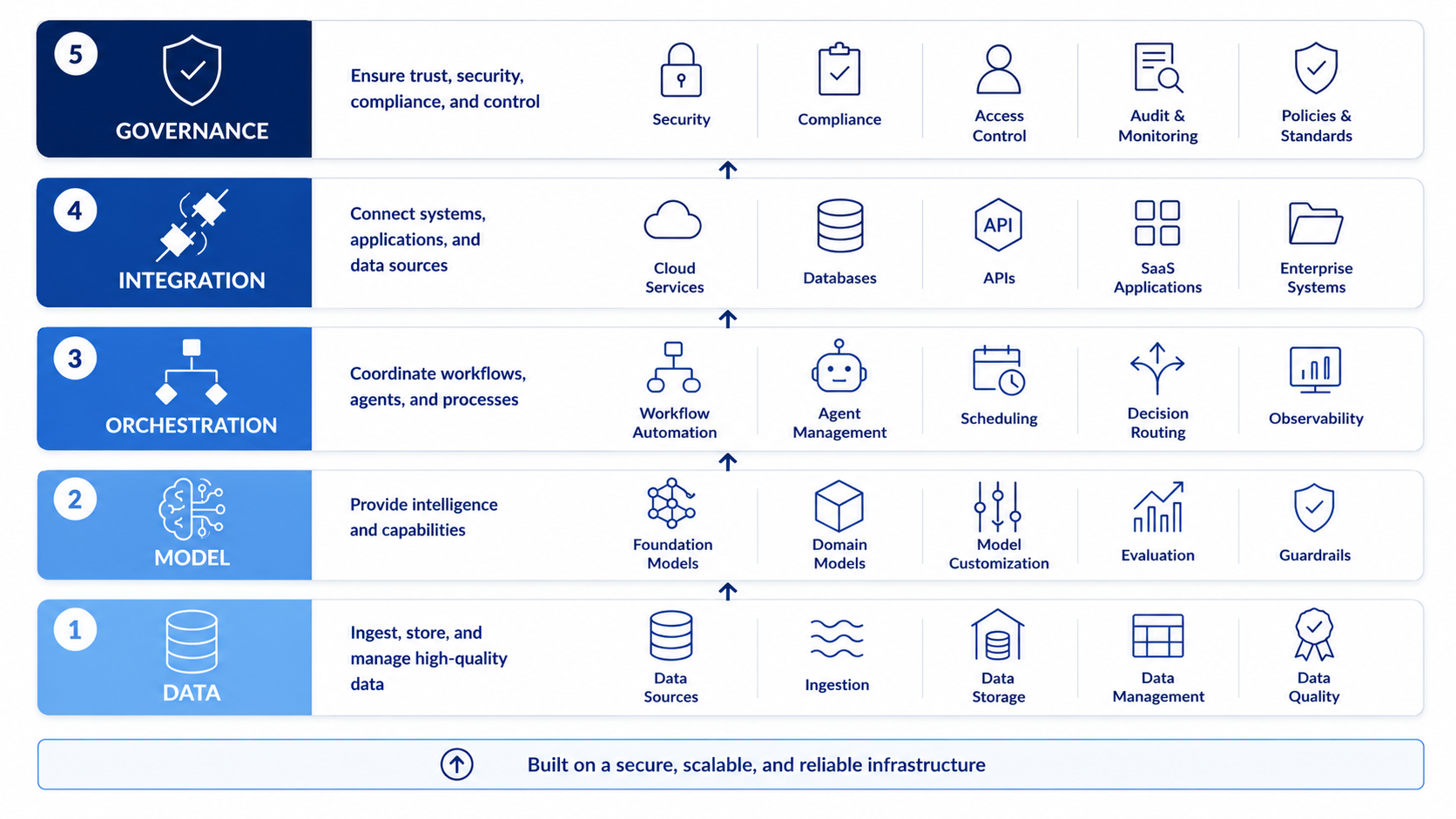
Strip away the marketing language, and most working AI architecture blueprint frameworks end up with roughly the same five layers. Doesn't matter the industry. Doesn't really matter the vendor either.
1. Data Layer
Everything downstream depends on this one. Data quality, lineage, access control, all of it. Ingestion pipelines, data warehousing or lakehouse infrastructure, the metadata systems that make data usable for analytics and model training alike. Enterprises chronically underinvest here and then spend months wondering why model outputs keep coming back inconsistent. Spoiler: it was never the model.
2. Model Layer
Foundation models, fine-tuned variants, smaller specialised models for narrow tasks. This is where all of it sits. A mature setup rarely bets everything on one model provider. It keeps an abstraction layer in place instead, one that lets models get swapped out, benchmarked, and run in parallel. Nobody has to rewrite the application logic underneath every time a better model ships, which happens more often than most roadmaps account for.
3. Orchestration Layer
This is where prompts, retrieval systems, agents, and business logic actually meet. It decides which model handles which task. How retrieval-augmented generation pulls from internal knowledge bases. How multi-step workflows get sequenced. Weak orchestration is, in my view, one of the more common reasons an AI project looks great in a demo and then falls apart the moment it hits production.
4. Integration Layer
AI only creates value once it's connected to the tools people already use day to day. CRMs, ERPs, ticketing systems, telephony platforms, internal dashboards, that sort of thing. The integration layer handles authentication, API contracts, and event-driven triggers. Outputs land where decisions actually get made instead of sitting in a report nobody opens.
5. Governance Layer
Model monitoring, audit trails, access permissions, bias testing, compliance reporting. Governance covers all of it. For regulated sectors like banking, insurance, and healthcare, it isn't optional in the slightest. Often, it's the one thing deciding whether a deployment even clears internal risk review in the first place.
Where Conversational and Voice Interfaces Fit
Customer-facing AI is one of the fastest-growing use cases sitting inside this broader architecture. It earns its own section here because it touches nearly every layer at once. A voice or chat interface pulls from the data layer for context, routes through the model layer for language understanding, leans on orchestration to hand off complex queries to a human agent, then reports back through governance for quality checks.
You see this play out pretty clearly with AI in Customer Support India, where enterprises are rolling out multilingual voice and chat systems to handle huge call volumes across regional languages without scaling headcount at anywhere near the same rate. Whether that system actually cuts resolution time or just adds one more layer of friction customers have to push through comes down to what's built underneath. Not the marketing copy sitting on top of it.
Contact centres make this obvious fast, in my experience. AI Call Centre Solutions succeed or fail based on how tightly they plug into existing telephony infrastructure, CRM records, and escalation workflows. Not on how impressive the model sounds in a sales deck somewhere. A genuinely brilliant model sitting on top of a badly integrated stack still produces long hold times. And customers repeating their account number for the third time on one call, which nobody enjoys.
Security, Compliance, and Data Sovereignty
For enterprises operating in India and other regulated markets, compliance weighs on architecture decisions from day one. Not after legal gets looped in three sprints later, which is what usually happens otherwise. Data residency rules, sector-specific regulations, information security certifications. All of it shapes where models can run, how data gets stored, who's even allowed to touch the outputs. Build without accounting for these constraints, and a costly rebuild is coming. Usually, right after a pilot has gained enough internal momentum, ripping it apart feels genuinely painful to everyone involved.
Encryption in transit and at rest, role-based access controls, detailed audit logging. Table stakes at this point, not advanced features worth bragging about in a pitch deck anymore. Anyone evaluating vendors should treat certification status, things like ISO 27001, SOC 2, and relevant local frameworks, as something that knocks vendors out of contention. Not a box to check and move past quickly.
A Practical Rollout Roadmap
A phased rollout beats one big-bang deployment almost every time, at least in what I've seen. Roughly how it should go:
Phase 1 — Foundation: Nail down the data layer and integration contracts before picking models at all. Fix data quality problems now; they'll surface downstream regardless and later cost more.
Phase 2 — Narrow Deployment: Pick one high-volume, well-defined workflow. Customer query triage is a fairly common choice. Take it end-to-end with monitoring included from day one.
Phase 3 — Governance Hardening: Once that narrow deployment is stable, lock in audit trails, access controls, and compliance reporting before scope expands further than planned.
Phase 4 — Horizontal Scale: Extend the same architecture to other departments now. Reuse whatever orchestration and integration work was already built the first time around.
Reverse that order: scale widely before governance is solid, and technical debt piles up quietly. Tends to surface during a compliance audit. Or worse, during a public failure. Neither is a great time to find out, obviously.
Common Architecture Mistakes
A handful of patterns keep showing up in enterprise AI architecture failures. None of them surprising once you've sat through a couple of postmortems:
Treating model selection like the primary decision, when integration and data quality usually matter more for what actually happens once it's live.
Putting off governance until a security or compliance incident forces everyone's hand, which is a rough way to learn the lesson.
Building separate point solutions per department instead of one shared architecture that other teams could extend later.
Underestimating monitoring and retraining costs. Recurring expenses, not a one-time line item you budget for once and forget about.
None of this is exotic, honestly. Avoidable with reasonable planning, which is exactly what makes it frustrating that it keeps happening anyway. Year after year, at companies that should really know better by now.
Conclusion
Architecture is what separates enterprise AI systems that deliver lasting value from the ones that quietly fade out after launch. Getting the data, model, orchestration, integration, and governance layers right up front takes more planning than most teams want to put in. But it beats the alternative: retrofitting governance and integration into a system that's already live, which costs more, disrupts more people, and rarely goes smoothly. The enterprises still running their AI systems confidently a year or two later are, almost without exception, the ones that treated this as an architectural discipline from the start. Not a string of one-off tool purchases made department by department, one after another.
Frequently Asked Questions
What is enterprise AI architecture?
Enterprise AI architecture is the combined set of data pipelines, model infrastructure, orchestration logic, integration layers, and governance controls that allow an organisation to run AI systems reliably across departments. It treats models as one replaceable component among several, rather than the entire solution.
Why do enterprise AI deployments fail at scale?
Most failed deployments fail not because of the AI model itself, but because of inadequate underlying architecture. Without a coherent enterprise AI architecture, disconnected AI features and tools cannot integrate effectively, preventing real capability advantages even when individual components work fine.
What are the five layers of modern AI architecture?
The five layers are: the Data Layer (pipelines, warehousing, metadata systems), the Model Layer (foundation models and specialized variants), and three additional structural layers that support reliable AI operations across an enterprise.
Why is the data layer critical for enterprise AI?
The data layer is the foundation for all downstream AI systems. Data quality, lineage, and access control directly impact model consistency and performance, which is why enterprises that underinvest in data infrastructure often experience inconsistent model outputs.
Should enterprises rely on a single AI model provider?
No, a mature AI setup keeps an abstraction layer in place that allows models to be swapped out, benchmarked, and run in parallel, rather than betting everything on one model provider.
What's the difference between a pilot AI project and enterprise-scale AI?
Pilot projects work in isolated team sandboxes with disconnected features, while enterprise-scale AI requires a coherent architecture with shared data pipelines, governance controls, and integration layers that function reliably across multiple departments.
I'm Paridhi Purohit. I work in Marketing at Azilen Technologies, where I create content focused on AI, voice technology, customer experience, and emerging business trends for author submission. I enjoy researching complex topics and turning them into engaging, easy-to-understand articles that provide practical insights for businesses and readers alike. Through my writing, I aim to explore how innovation is transforming industries and making technology more accessible to everyone.