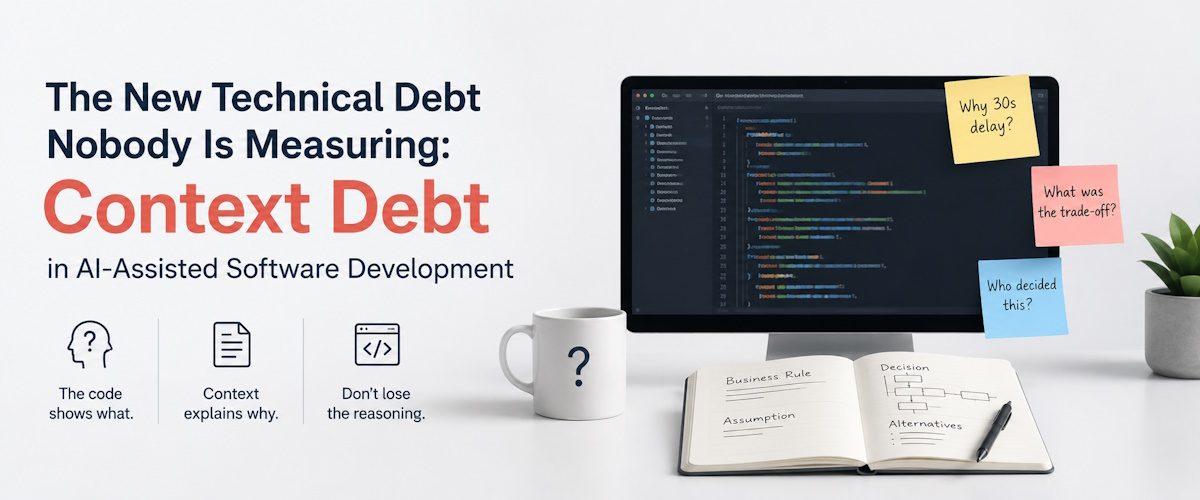
A developer asks an AI coding assistant to add retry logic to a payment service. The assistant produces a clean-looking function, adds tests, and handles the obvious failure cases. The pull request passes review and reaches production. Three months later, another developer changes the retry interval. The change looks harmless. It is not.
The original interval was chosen because a payment provider applies a temporary lock after a failed request. That fact was discussed during a call, mentioned in the prompt, and never recorded in the repository. The generated code preserved the decision, but not the reason behind it. The team now owns working code with missing history.
Software teams have dealt with technical debt for decades. They know how rushed code, weak abstractions, duplicate logic, and neglected maintenance can make future changes harder. AI-assisted development adds another kind of debt that is less visible in code-quality dashboards.
Call it context debt. Context debt is the gap between what a software system does and what the team can still explain about why it does it.
It includes forgotten business rules, undocumented trade-offs, assumptions hidden inside prompts, rejected options, temporary constraints, and product knowledge held by one developer. The code may be readable. The tests may pass. The architecture may look reasonable. Yet the reasoning that shaped the system has started to disappear.
AI coding assistants do not create this problem alone. Software teams have always lost knowledge. What changes with AI is the speed at which code can be produced without an equal increase in shared understanding.
Faster code does not mean faster comprehension
Traditional software development leaves traces of thought. A developer spends time reading the codebase, discussing requirements, comparing approaches, and debugging failed attempts. That work builds a mental model of the system. Even when documentation is weak, the developer often remembers why a choice was made because they struggled through the choice themselves. AI compresses much of that process.
A developer can describe the desired outcome, receive a plausible solution, adjust it twice, and commit the result within an hour. The output may be correct, but the developer may never build the same depth of understanding they would have gained by working through the problem manually.
This creates an awkward mismatch. The codebase grows at machine-assisted speed, while human comprehension still grows at human speed. That mismatch matters because software maintenance depends on more than reading syntax. A future developer must understand the business rule, operational constraint, security concern, and architectural boundary behind the syntax.
A generated function can tell you that an account is locked after five failed attempts. It cannot tell you whether five was selected because of a security policy, a customer-support concern, an old database limit, or a decision copied from another product. Those reasons lead to very different future changes.
DataDrivenInvestor has previously discussed why clean code must remain understandable and changeable. Context debt extends that concern. Clean code can explain its mechanics, but it may still fail to explain its history.
What context debt actually contains
Context debt is not simply missing documentation. A team can have hundreds of wiki pages and still carry a large context burden. The missing material usually falls into a few recurring groups.
Business intent
Business intent explains the user or commercial reason behind a technical rule. A developer may see a condition that prevents customers from changing a subscription within 24 hours of renewal. The code shows the restriction, but not whether it exists because of billing-provider limits, fraud concerns, refund disputes, or a product experiment. Without that knowledge, changing the condition becomes guesswork.
Architectural reasoning
Architecture diagrams show components and connections. They rarely show why the team rejected other designs.
Perhaps a synchronous call was used instead of an event because the business required an immediate response. Perhaps a service owns duplicated data because a third-party API has strict rate limits. Perhaps a monolith was retained because the team lacked the operational capacity to manage several services.
When the reason disappears, future engineers may “fix” a deliberate compromise and bring back the original problem.
Prompt-only knowledge
AI-assisted work introduces a new hiding place for engineering knowledge: the prompt.
Developers often feed an assistant details that do not exist anywhere else:
expected edge cases
private API behavior
naming preferences
known defects
regulatory limits
rejected approaches
temporary workarounds
The generated code reflects some of that information, but the repository may contain no durable record of it. Chat histories are often personal, difficult to search, or lost when tools and accounts change. The prompt becomes an informal design document that nobody treats as a design document.
Operational knowledge
Production systems are shaped by incidents, traffic patterns, vendor failures, support tickets, and customer behavior. A timeout value may exist because a downstream service failed during a past traffic spike. A validation rule may protect against malformed data from an older mobile app. A scheduled job may run at an unusual hour because another process holds a database lock overnight. AI can reproduce the pattern without carrying the operational story forward.
Ownership knowledge
Sometimes the missing context is simply knowing who understands a piece of the system. When code is created quickly across many files, ownership can become blurry. One developer may accept an AI-generated change, another may review it, and a third may deploy it. Six months later, nobody feels confident enough to modify it. The code has contributors, but no clear steward.
Why normal code review may not catch it
Most review processes are designed to find faults in the proposed change. Reviewers ask whether the code works, whether tests cover expected behavior, whether it follows team standards, and whether it creates security or performance risks. Those questions remain necessary. They do not reveal whether the team has preserved enough reasoning to change the code safely later.
A reviewer can verify that a caching rule is technically sound without knowing why the cache duration is seven minutes. They can confirm that an API response is mapped correctly without knowing why one field is deliberately ignored. They can approve an access check without knowing which contract or internal policy requires it.
AI-generated pull requests can make this harder because they often arrive as polished, complete-looking packages. Good naming, comments, and tests create confidence. Reviewers may focus on whether the package works rather than whether the reasoning behind it has been captured.
Large changes create another problem. When AI helps a developer produce hundreds of lines quickly, the reviewer has to absorb those lines at ordinary reading speed. Review fatigue encourages surface checks, especially when the output looks conventional. The issue is not that reviewers are careless. The review workload has changed while the process often has not.
The warning signs appear after delivery
Context debt usually becomes visible during change, not during initial delivery. One warning sign is a growing number of “ask this person” dependencies. A team cannot explain a module without contacting the developer who last touched it.
Another is fear around apparently small changes. Engineers can read the code, but nobody is confident about the effects of modifying it.
Repeated rediscovery is another clue. Teams revisit the same architectural debate because the earlier decision and rejected options were never recorded. Onboarding time can also rise while code output rises. New developers have access to more code but fewer stories explaining how the parts fit together.
A subtler sign appears in code review comments. Reviewers repeatedly ask questions such as:
Why is this value fixed?
Is this behavior required?
Can this service call be removed?
Why are we keeping both data fields?
Which client still depends on this response?
Those are not only questions about code. They are signals that the system’s memory is weakening.
Measuring context debt without inventing another vanity metric
Context debt cannot be measured as neatly as test coverage or defect counts. Trying to reduce it to a single score may create false confidence.
Teams can still track useful indicators.
Decision recovery time measures how long it takes to explain the reason behind a past technical choice. Select a few recent changes and ask someone outside the original task to reconstruct the decision from the repository.
Knowledge concentration looks at how many modules depend on one person for safe maintenance. A high concentration does not always mean poor documentation, but it exposes risk.
Repeated decision rate tracks how often teams reopen questions that were supposedly settled. Repeated debates often point to missing or inaccessible records.
Review explanation rate looks at how often reviewers request the reasoning behind a change rather than corrections to the code itself.
Change hesitation can be captured through short developer surveys or retrospective notes. Which areas do engineers avoid because they do not understand the hidden consequences?
These measures are imperfect. Their value comes from starting conversations that output metrics cannot start. Lines of code, pull-request counts, and cycle time tell leaders how quickly software is moving. They do not tell them whether the team still understands what it has built.
Documentation should capture decisions, not narrate code
Teams often respond to knowledge loss by asking developers to write more documentation. That request usually produces longer pages, stale diagrams, and resistance from engineers who see documentation as separate work. A better approach is to record the facts that code cannot express.
A useful decision note can be brief:
Decision: Retry failed payment requests twice with a 30-second delay.
Reason: The provider temporarily locks duplicate requests, and immediate retries increase rejection rates.
Alternatives considered: Exponential retry and queue-based retry.
Constraint: The customer must receive a final status within two minutes.
Review trigger: Revisit when the provider releases its new API.
That note carries more future value than a paragraph describing how the retry function works. The code already describes the mechanics. The note preserves intent.
Architecture decision records, concise pull-request templates, issue comments, and repository-based notes can all serve this purpose. The storage format matters less than whether the record is close to the code, searchable, and part of normal delivery.
WeblineIndia’s software development guide makes a related point by placing requirements, architecture planning, code review, testing, deployment, and ongoing maintenance inside one connected lifecycle. AI-assisted coding works best when it remains inside that broader engineering process rather than becoming a shortcut around it.
Treat prompts as working material, not private scratchpads
Saving every prompt would create noise and may expose confidential data. Ignoring prompts entirely loses useful reasoning. Teams need a middle ground.
A prompt should leave a durable trace when it contains information that materially shaped the code. The full conversation does not need to be stored. The developer can extract the meaningful parts into the pull request or decision note.
That may include:
assumptions given to the assistant
constraints that changed the answer
edge cases the assistant was asked to handle
external behavior not visible in the repository
alternatives that were rejected
parts of the output that required manual correction
This shifts the focus from archiving chats to preserving engineering judgment. It also prevents a common mistake: treating the assistant’s answer as the decision. The assistant can propose options. The team still owns the choice and should be able to explain it without reopening a private chat window.
Change the review question from “Does it work?” to “Can we own it?”
AI-assisted code should meet a higher standard than passing tests. The team must be able to maintain it after the prompt, chat session, and original developer are gone.
A practical review can include four questions:
What business rule does this change encode?
Which assumption would make this solution wrong?
What alternative was considered and rejected?
Could another engineer safely change this six months from now?
These questions do not need to become a heavy checklist for every small edit. They matter most for changes involving business rules, architecture, security, data ownership, third-party services, or unusual constraints.
Review size also matters. AI makes it easy to generate a broad change in one pass. Smaller pull requests remain easier to understand, challenge, and explain. The cost of review should shape how much generated code enters a single change.
Software engineering has always depended on shared learning. DDI’s earlier piece on software engineering as a sharing culture is even more relevant when part of the reasoning process happens between one developer and an assistant. Knowledge that stays inside that exchange cannot help the rest of the team.
AI should help preserve context too
The same tools that speed up code creation can help teams maintain their engineering memory. An assistant can draft a decision record from a pull request, identify unexplained constants, compare code changes with architecture notes, or flag a business rule that lacks a linked requirement. It can summarize an incident discussion and suggest which findings belong in the repository.
These uses are valuable because they reduce the friction of recording context. They still require human review. A generated explanation may sound convincing while missing the real reason. The person making the decision must confirm that the record reflects what the team actually chose. The goal is not automatic documentation. The goal is to make good engineering memory easier to maintain.
The real productivity test comes six months later
AI coding assistants can reduce the time needed to create a feature. That is useful, but it is only the first part of the cost. The full cost appears when the feature must be modified, audited, debugged, transferred to another team, or explained during an incident. A change delivered in two days is not truly fast if the next change requires two weeks of rediscovery.
That is why context debt deserves attention now. The risk is not simply that AI will produce bad code. Bad code can often be caught by tests, scanners, reviewers, and production monitoring. The harder problem is good-looking code whose assumptions have vanished.
Teams that preserve those assumptions will get more lasting value from AI-assisted development. Teams that do not may find themselves shipping faster while gradually losing the ability to explain, trust, and safely change what they ship. The codebase is only one part of a software system. The other part is the shared understanding that makes the code maintainable.
Frequently Asked Questions
What is context debt in AI-assisted software development?
Context debt is the gap between what a software system does and what the team can still explain about why it does it. It includes forgotten business rules, undocumented trade-offs, assumptions hidden in prompts, and product knowledge that disappears even when code is clean and tests pass.
How does AI-assisted development create context debt differently than traditional development?
AI compresses the development process by allowing developers to describe outcomes and receive solutions within hours, without building the same depth of understanding they would gain by working through problems manually. This creates a mismatch where code grows at machine-assisted speed while human comprehension grows at human speed.
Can context debt be detected by code quality tools?
No. Context debt is less visible in code-quality dashboards because the code may be readable, tests may pass, and the architecture may look reasonable, yet the reasoning that shaped the system has disappeared.
Why does the payment service retry logic example illustrate context debt?
The original retry interval was chosen based on a payment provider's temporary lock policy discussed in a call and mentioned in the prompt, but never recorded in the repository. When another developer later changed the interval, they had no way to understand why it was originally set that way.
What information gets lost when AI generates code?
The reasoning and decision-making process gets lost—including why specific choices were made, trade-offs considered, constraints that applied, and rejected options. This knowledge traditionally accumulated through the struggle of manual problem-solving.
How does context debt affect future software maintenance?
Future developers cannot understand the business rules, operational constraints, security concerns, and architectural boundaries behind the code, making it difficult to make safe changes or understand the full implications of modifications.

As a writer at WeblineIndia, I bridge the gap between complex tech concepts and everyday understanding, making innovation accessible to all. With a background rooted in custom software development, I dive deep into trends, breakthroughs, and emerging technologies, translating them into enlightening articles.