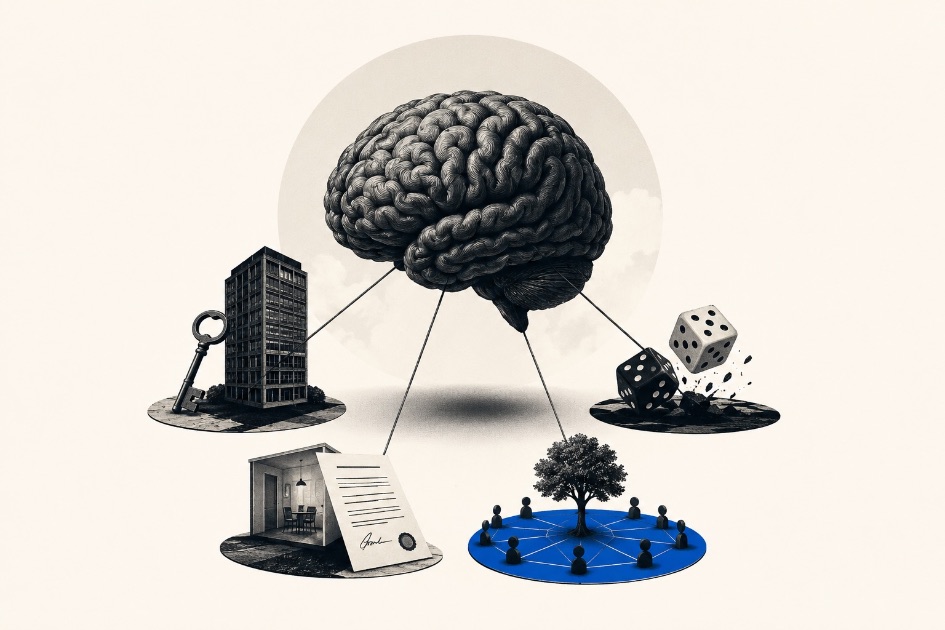
Four scenarios for how business evolves when AI becomes the decision layer. Life Sciences is running the experiment first
In April 2026, Novo Nordisk signed an enterprise agreement with OpenAI reaching into research, manufacturing, supply chain and commercial operations. The value was not disclosed. One month later, Roche paid $750 million upfront, with $300 million to follow, to own PathAI outright. Two companies in the same industry, in the same quarter, answering the same question in opposite ways:
when intelligence enters your operating model, do you rent it or do you own it?
Over the past twelve months I tracked more than thirty AI-related strategic moves across Life Sciences for an analysis I called the AI control map. Four postures kept recurring: own the capability, bet around it, operate inside someone else’s platform, or use open capability to reduce dependency. I have come to believe these four postures are not a pharma story. They are a preview of how every capital-intensive business will organize itself over the next decade.
Why watch an industry you may not work in
Life Sciences is the wind tunnel of the AI economy. In aeronautics, you do not learn how a wing behaves by flying the production aircraft. You put a model under extreme load in a chamber where every force is instrumented, and you watch where the structure bends. Life Sciences is that chamber.
The loads are extreme. A patent cliff worth roughly $300 billion in expiring revenue is forcing efficiency at industrial speed. The sector moved more than $200 billion of M&A in a single year, and committed a further $30 billion or so, mostly contingent, to AI. Few industries combine this much money with this much pressure to spend it well.
And the instrumentation is total. This is an industry where every carton carries a serial number, every batch has a record, every deviation has a log, and every consequential decision needs evidence before a regulator will accept it. In most sectors, the question of who controls an AI-shaped decision can stay comfortably vague for years. In a track-and-trace world it cannot. When a model recommends and a human releases the lot, somebody’s name is on the release certificate. The control questions that other industries will eventually face are being forced here first, in writing. Watch the wind tunnel, and you can read the forces before they reach your own structure.
Here are the four scenarios, generalized beyond pharma. They are postures, not stages of maturity, and no serious company will live in only one.
Four scenarios for 2030
Scenario one: the Owner’s economy
In this future, firms conclude that certain layers of intelligence sit too close to the product to rent. Roche bought PathAI and, separately, built a hybrid AI factory with NVIDIA running more than 3,500 GPUs. Eli Lilly committed up to $1.0 billion over five years for compute, models and robotics. Notice what gets owned. Not the broad, glamorous drug-discovery platforms, but bounded assets close to a product, a dataset or an operating control point: pathology, diagnostics, devices, infrastructure.
Generalize this and you get the 2030s version of vertical integration. AI appears on the balance sheet as capex rather than opex. The scarce executive is the one who can write a validation protocol, not a prompt. Because ownership is expensive and must be maintained, it concentrates on the few layers that genuinely define advantage, and the test for which layers those are is an auditor’s test: if this capability failed tomorrow, whose name is on the control that catches it? If the honest answer is a vendor’s name, the layer was never yours.
Scenario two: the Gambler’s balance sheet
Novartis committed up to $5.7 billion for access to Monte Rosa’s molecular glue platform. Lilly signed with Insilico Medicine for up to $2.75 billion. Sanofi went up to $2.56 billion with Earendil Labs. Read past the headlines and the architecture is always the same: a modest upfront payment, an enormous contingent tail, and the platform stays with the seller. Pharma calls these biodollars. Most of them will never be paid in full, and that is the design, not a defect.
In the gambler’s scenario, this style of contingent-value contracting spreads to every sector where the technology is uncertain and the payoff is distant. Corporate balance sheets start to resemble option portfolios. Headline value and controlled value drift apart, and press releases quietly stop distinguishing between the two. The posture is rational where science moves faster than diligence can price it. The discipline it demands is equally plain: an option buys you a seat at the table, while the engine, the team and the right to sign the next deal remain with the counterparty. A company holding forty options controls precisely none of them.
Scenario three: the tenant signs the lease, the landlord writes the rules
Merck committed up to $1.0 billion with Google Cloud to put agentic AI across its enterprise functions. OpenAI launched GPT-Rosalind, a reasoning model aimed at scientific work. Anthropic shipped Claude for Life Sciences with connectors into the tools scientists already use. None of these providers is merely selling software. Each is working to become the environment where the work itself happens.
Years ago, in a post-merger integration, I watched a steering committee spend the better part of an hour on the cover design of the integration playbook and roughly ten minutes on who would own the master data once the transition service agreement expired. I have watched some version of that scene many times since. The tenant scenario is that meeting replayed at the scale of an economy: the exciting conversation is about what the AI can do, and the neglected one is about who owns the environment it does it in.
In this future, most firms become tenants inside a small number of decision infrastructures. The rent is predictable, the capability is instant, and the lease terms are written by the landlord. The durable bottleneck turns out not to be model quality, which commoditizes, but the workflow where a model output becomes a validated decision, which does not. Adoption is not control. A company can use AI in every function and still control none of the intelligence on which it depends.
Scenario four: the Commons
DeepSeek’s open-weight models, the OpenFold structural-biology tools, the federated training initiatives now forming across biomedical institutions: these rarely appear in deal tables because they are rarely transactions. They still change every negotiation in the room. When a serviceable open alternative exists, the closed vendor’s pricing and terms bend toward it.
The commons will not be where most regulated work runs. Open capability still needs validation, governance, quality controls and auditability before anyone stakes a decision on it. Its function in this scenario is different: it is where bargaining power gets manufactured. Of the four futures, it is the cheapest to enter and the easiest to ignore, which is usually the profile of the thing that resets an industry’s economics.
The objection, and what survives it
The obvious objection is that Life Sciences is unrepresentative. Margins are unusual, regulation slows everything, and what happens in a wind tunnel is not flight. That is partly right, and it narrows the claim: the timing will not transfer. Sectors with lighter oversight will drift comfortably in the tenant scenario for years before the control question bites.
The direction, however, transfers, because the instrumentation is coming to everyone. The EU AI Act and its siblings are, in effect, track-and-trace for decisions. Once your decisions must carry evidence, the four postures stop being strategy-deck material and become line items with owners.
The Monday exercise
These scenarios will coexist, inside industries and inside single companies. The failure mode is not picking the wrong one. It is renting everything while believing you control the strategy.
So here is a working exercise for your next leadership meeting. Put four questions to the team, in writing, and require named answers: Who owns the data? Who hosts the workflow? Who validates the decision? Who captures the learning loop? Then count how many answers require a call to a vendor before anyone can respond. Every question your organization cannot answer alone is a lease you have already signed, possibly without reading it.
Who hosts the workflow? Who validates the decision? Who captures the learning loop? Then count how many answers require a call to a vendor before anyone can respond. Every question your organization cannot answer alone is a lease you have already signed, possibly without reading it.
Whatever the intelligence recommends, make sure you know who signs.
_____________________________________________________________
Thanks for reading my article. If you want to know more you can download the full report from linkedIn (https://www.linkedin.com/smart-links/AQE2yZP7S2Hp9w)
_____________________________________________________________
The analysis draws on the author’s AI control map of 30+ strategic AI moves in Life Sciences, June 2025–June 2026, based on publicly available information. Views or opinions represented in this article are personal and belong solely to the article writer and do not represent those of people, institutions or organizations that the writer may or may not be associated with in professional or personal capacity, unless explicitly stated.
_____________________________________________________________
Flavio Aliberti brings with him a 25-year track record in consulting around business intelligence, change management, strategy, M&A transformation, IT and SOX auditing for high regulated domains, like Insurance, Airlines, Trade Associations, Automotive, and Pharma. He holds an MSc in Space Aeronautic Engineering from the University of Naples and an MSc in Advanced Information Technology and Business Management from the University of Wales.