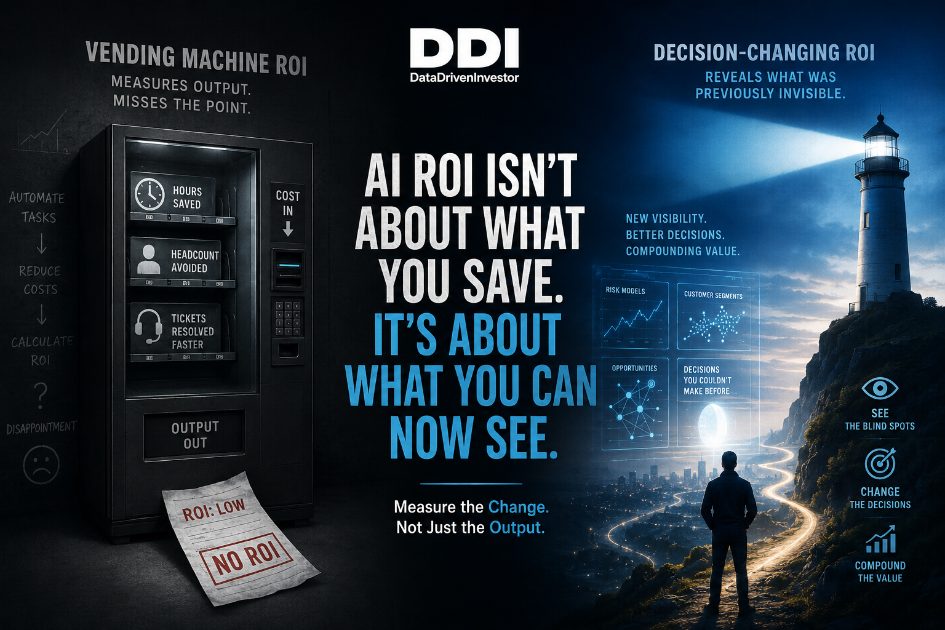
Every board deck about AI investment eventually arrives at the same slide. Cost on one side. Return on the other. And the return column is almost always populated with the same kinds of numbers: hours saved, headcount avoided, tickets resolved faster.
This is the wrong way to measure it. Not slightly wrong, fundamentally wrong, in a way that explains most of the "AI has no ROI" headlines you've been reading.
Here's the comparison that's actually being made, whether anyone says it out loud: companies are measuring AI the way they'd measure a vending machine. Money goes in, a product comes out, and you calculate the margin. Cost in, output out. Clean, simple, auditable.
But the systems that actually generate value don't work like vending machines. They work by changing what gets decided in the first place, and a vending-machine calculation has no way to capture that, because the value isn't in a transaction. It's in a decision that never got made the old way, or got made at all.
Think about what a transaction-based ROI calculation can see. It can see that a support ticket got resolved in three minutes instead of fifteen. It can see that a report got generated automatically instead of by an analyst. These are real savings, and they're easy to put in a spreadsheet. They're also the least interesting thing AI does, and they're nowhere near where the actual value or the actual risk — lives.
What that calculation can't see is the decision that didn't happen at all. The risk assessment that used to take two weeks and therefore only got done quarterly, now done weekly because it's no longer a two-week project. The customer segment that was too small to analyze manually and therefore got the average treatment- the same product, the same pricing, the same messaging as everyone else- now gets its own analysis because the marginal cost of analyzing it dropped to nearly zero. None of this shows up as "automation." It shows up, if it shows up at all, as a slow shift in outcomes that nobody connects back to the system that caused it.
This is the first problem. The second is worse, and it's the one almost nobody wants to sit with.
The real cost of an AI initiative isn't the project budget. It's the years an organization spends operating on the wrong foundation before anyone is willing to admit the ROI math was set up incorrectly from day one. A company spends two million, ten million, fifty million building a system on top of data infrastructure that was never designed for this. The system technically works. It produces outputs. Someone runs the ROI calculation, gets a number that looks unimpressive, and the conclusion drawn is "AI doesn't work for us". When the actual conclusion should have been "we built this on a foundation that can't support what we're asking it to do, and the dollar figure we just calculated is measuring the foundation, not the AI."
That distinction matters enormously, because the response to each conclusion is completely different. "AI doesn't work for us" leads to scaling back, waiting, watching competitors. "We built on the wrong foundation" leads to fixing the foundation, which is exactly the thing nobody wants to hear, because it's expensive, it's slow, and it makes the first investment look like a write-off.
So instead, the easier story gets told. The pilot gets quietly shelved. A new vendor gets brought in next year, promising the same outcome on top of the same foundation, and the cycle repeats. This is, almost exactly, what happened with big data a decade ago, and the resemblance is not a coincidence.
Now to the third piece, which is the one that actually matters if you're trying to fix this rather than just diagnose it.
The honest measure of AI ROI isn't "what did this save us." It's "what did this let us see that we were blind to before." A risk model that used to evaluate a borrower on five data points and now evaluates them on fifty hasn't necessarily saved anyone time. What it's done is make visible a set of borrowers who were previously invisible, too costly to assess individually, so they got bucketed into an average that didn't fit them. Some of those borrowers were better risks than the average suggested. Some were worse. Either way, the organization that can now see them has information it didn't have before, and that information has value whether or not it shows up as a cost saved this quarter.
The problem is that "what can we now see" doesn't fit into a standard accounting structure. It's not a line item. It doesn't have a unit cost or a unit return. It compounds, quietly, across every downstream decision the system touches, in ways that are real but genuinely difficult to attribute to any single initiative on any single spreadsheet.
That difficulty is exactly why it doesn't get measured. Not because it's unimportant, but because it's hard, and "hard to measure" quietly becomes "doesn't count" in most organizations, regardless of how much it actually matters.
If there's a single shift worth making here, it's this: before running the next ROI calculation on an AI project, ask what the project was actually supposed to change, not produce, change. What decision, what segment, what blind spot. If the honest answer is "nothing, it just does the same thing faster," that's a legitimate automation project, and it should be measured as one. But if the honest answer involves a decision that wasn't possible before, measuring it like a vending machine will produce a number that says "no ROI", and that number will be lying.
The 95% of companies reporting no measurable return aren't necessarily wrong about their numbers. They're wrong about what the numbers are supposed to be measuring.
I am a Director of Data & AI, Data Architect, and technology leader with 15 years of experience building data organizations, AI platforms, and large-scale analytics systems. I write about the intersection of data, artificial intelligence, business strategy, and decision-making. My work focuses on how organizations create value from data, why AI initiatives succeed or fail, the hidden costs of poor data foundations, and how metrics often miss what truly drives business outcomes. I am particularly interested in the gap between averages and reality, whether in machine learning, product design, customer experience, or executive decision-making, and how better systems can help organizations see what they are currently blind to.