The "Self-Made" Billionaire Myth: What They Don’t Tell You About the Garage Startup Legend
We love a good underdog story. In fact, it’s the go-to story everyone in tech and business just accepts as fact: a brilliant, sleep-deprived visionary locks themselves in a cluttered garage, survives on instant ramen, and emerges a few years later as a billionaire who changed the world.
It’s the ultimate evolution of the American Dream. It tells us that raw talent and relentless hustle are the only real gatekeepers to unimaginable wealth.
It’s romantic. It’s inspiring. It's deeply marketable. But is it actually true? Mostly, no.
When you peel back the slick PR narratives of the world’s most celebrated "self-made" tycoons, a very different picture emerges. They weren't fighting their way up from the absolute bottom. Instead, they started the race with a massive financial, social, or educational head start.
Here is the reality behind the legend, told through the starting lines of the world's most famous billionaires.
The Billionaire Starting Lines
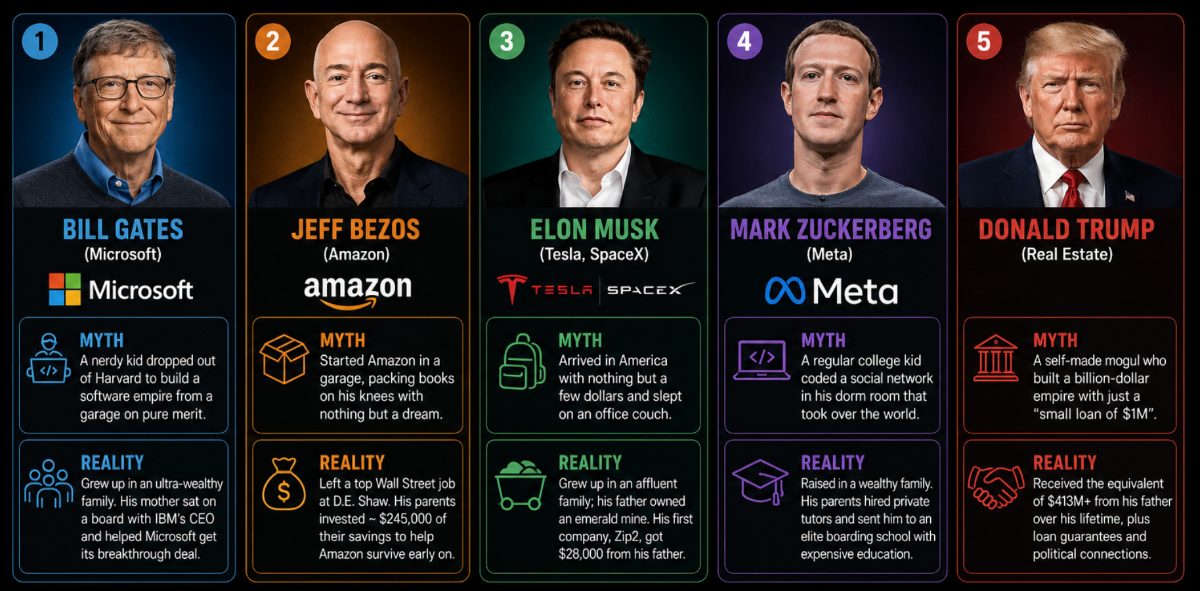
1. Bill Gates (Microsoft)
The Myth: a nerdy kid dropped out of Harvard to build a software empire from a garage on pure merit.
The Reality: Gates grew up in an ultra-wealthy Seattle family. His father was a prominent corporate lawyer, and his mother, Mary Maxwell Gates, was a highly influential businesswoman. It was his mother who sat on a national board alongside John Opel, the chairman of IBM. She personally pitched her son’s little company, helping Microsoft secure the legendary operating system contract that catapulted them into a global monopoly.
2. Jeff Bezos (Amazon)
The Myth: started Amazon in a garage, packing books on his knees with nothing but a dream.
The Reality: Bezos didn't retreat to that garage from a state of poverty; he left his high-paying job as a Senior Vice President at D.E. Shaw, a prestigious Wall Street hedge fund. Furthermore, when Amazon needed early capital to survive, his mother and stepfather invested roughly $245,000 from their savings. It was a massive financial safety net most startups never get.
3. Elon Musk (Tesla, SpaceX)
The Myth: arrived in America with nothing but a few dollars and slept on an office couch to survive.
The Reality: Musk’s work ethic is undeniable, but his childhood was deeply privileged. He grew up in an affluent South African household; his father was a successful engineer, real estate developer, and co-owner of an emerald mine in Zambia. This provided Elon with elite private schooling and expensive computer hardware. His first venture, Zip2, was kickstarted with a $28,000 investment from his father and family connections.
4. Mark Zuckerberg (Meta)
The Myth: a regular college kid coded a social network in his dorm room that accidentally took over the world.
The Reality: Zuckerberg grew up in an affluent New York suburb, the son of a dentist and a psychiatrist. Recognizing his talent early, his parents hired a private software tutor and sent him to Phillips Exeter Academy, an elite boarding school where tuition costs more than many universities. He entered Harvard already armed with an elite, expensive educational foundation.
5. Donald Trump
The Myth: a self-made real estate mogul who built a multi-billion-dollar empire starting with just a "small loan of a million dollars" from his father.
The Reality: The "million-dollar loan" is a massive understatement. A New York Times investigation revealed that Trump received the modern equivalent of at least $413 million from his father’s real estate empire over his lifetime. His father, Fred Trump, also guaranteed his bank loans, opened doors to New York’s political elite, and repeatedly bailed him out when his casinos faced bankruptcy.
The Real Capital: The Price of Failure
When we look at these stories, it's easy to focus purely on the cash. But the greatest asset these billionaires inherited from their families wasn't just a check.
The biggest head start they actually had was a massive safety net.
Think about it this way. If an average person takes out a massive loan, quits their 9-to-5, and pours everything into a risky startup that fails, the consequence is catastrophic. They face financial ruin, a ruined credit score, and potentially years of crushing debt. They might lose their home. This extreme cost of failure is exactly what prevents millions of brilliant, creative minds from ever taking a leap of faith. They simply can't afford to miss a paycheck.
For Gates, Bezos, or Musk, the cost of failure looked entirely different. If their first companies had crashed and burned in year one, they wouldn't have ended up on the street. They would have gone back to Harvard, returned to Wall Street, or used their family's network to secure another elite position.
Think of it like playing a video game. If you have infinite respawns, you play completely differently. You take wild, massive risks because a "Game Over" doesn't mean anything. It lets you focus entirely on winning the game, because you aren't constantly stressing about how you're going to pay rent if things go south.
Why Demystifying the Narrative Matters
Acknowledging the wealthy backgrounds of these titans doesn’t mean we have to discount their achievements. Billions of people are born into wealthy families, but very few have the vision, grit, and obsessiveness to build global empires. They are, without a doubt, exceptional operators.
But the "self-made from zero" myth does a massive disservice to everyone else. It messes with our expectations, making regular people feel like failures if they haven't launched a unicorn startup by their late twenties just because they "didn't hustle enough." It completely ignores the structural realities of capital, networking, and basic security.
Top #1 Community Creator on CoinMarketCap according to CoinGape | Investor and trader, sharing strategic market analysis