
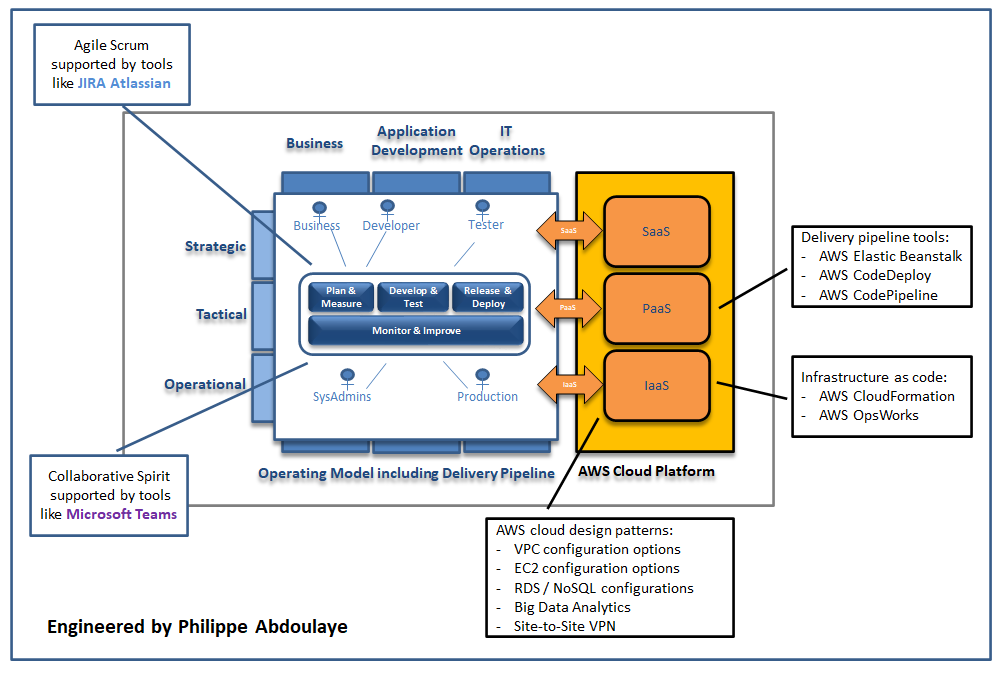
 The above exhibit is a macroscopic blueprint of the IT organization for the COVID-19; it came out of the workshops held, they involved the client's staff including a transformation program sponsor, business analysts, developers, testers, system, database, and network administrators.
The macroscopic blueprint served as the baseline for the organization's architecture detailed design. It highlights five principles you should never ignore:
The above exhibit is a macroscopic blueprint of the IT organization for the COVID-19; it came out of the workshops held, they involved the client's staff including a transformation program sponsor, business analysts, developers, testers, system, database, and network administrators.
The macroscopic blueprint served as the baseline for the organization's architecture detailed design. It highlights five principles you should never ignore:
- The goal is to responsively deliver applications as well as digital products and services in line with market opportunities and guarantee superior customer experience.
- Organize the application management effort around a delivery pipeline that focuses on business priorities, speedy delivery, and superior customer experience.
- Stress work from home and proper tools to ensure social distancing and remove fear so as to keep high the IT staff productivity.
- Take advantage of cloud computing to cut costs, avoid resources shortage, speed up IT operations, and make IT agile and responsive.
- Use infrastructure as code to automate IT operations, speed up applications deployment, and make IT agile.
- Connecting the business and IT to make sure priorities are addressed in a way that secures revenue streams.
- Making sure applications delivery flow is speed enough to responsively tackle market opportunities.
- And making sure cloud architecture best practices are implemented to make efficient key IT processes.
Connecting Business and IT, Focusing on Priorities, Securing Revenue Stream
As stay home measures and people survival instinct advocated for all online business, I recommended e-commerce projects including digital products, services and infrastructure as the company's priority. This aspect of the application delivery effort would be part of the Plan & Measure stage of the delivery pipeline. The Plan & Measure process would build on Scrum agile principles and practices including:- Business representatives acting as Product Owner and a Scrum Master representing IT.
- The use of Product Roadmap, Release Plan, and Scrum Product Backlog not only as the means to connect the business and IT, but also to prioritize business requests.
- The use of Atlassian Jira Scrum to support the Plan & Measure planning process and Microsoft Teams as the tool supporting collaboration.
Speeding Up Applications Delivery Flow, Responsively Tackling Market Opportunities
"COVID-19 has already taken the global economy into recession, slower demand, fear, uncertainty, and falling average income are making market opportunities scarce," I argued before concluding, "being responsive to market opportunities will be your best competitive asset." I recommended the implementation of a Four-Stage Delivery Pipeline that cuts across the organization from business to IT. The idea was to implement a platform that mobilizes key factors that guarantee the delivery of high priority applications in a timely manner and with the expected superior customer experience. These factors included:- Relevant staff with the proper skills and experience. "Inventivity, commitment, and collaboration spirit will be key to succeed," before concluding, "Make no mistake about it, you will need a Dr. Tony Fauci in your team," I argued.
- Relevant processes and the related logic, practices and tools. "Well-established software development, testing, and deployment processes aligned to scrum agile philosophy and automated using infrastructure as code will be needed across the Develop & Test, Release & Deploy, and Monitor & Improve stages," I claimed.
Applying AWS Cloud Design Patterns, Automating Applications Deployment
"Make no mistake about it, whatever your size or the value of your company's capitalization, growing or staying in business in recession conditions will be challenging," I explained. "Investing in analytics, machine learning, and IoT is a must, it advocates for cloud adoption. They will make your business more transparent, more flexible, and more efficient," I added. "However, investing in cloud is one thing and properly implementing it for your business is another," I tempered. "Approach your cloud platform as a virtual datacenter and manage it using an infrastructure as code lifecycle including three macro steps: Create, Audit, Update," I concluded. The AWS cloud management kit I recommended suggested:- A rapid implementation of the AWS cloud using an infrastructure as code lifecycle creating, auditing, and updating it based on proven architecture design patterns.
- The use of AWS CloudFormation and AWS OpsWorks to implement the design patterns in way that guarantees performance efficiency, reliability, security, and cost optimization.
- The implementation of a delivery pipeline using AWS Elastic Beanstalk, AWS CodePipeline or AWS CodeDeploy.
The Key Takeaways
Keep in mind that to stay alive in the COVID-19 economic context, expecting value from the sole IT tools won't help; you need to change your paradigm and embrace a vision that smartly considers the human, process, tool and infrastructure factors as a whole.- Never limit your IT transformation to a matter of migrating your infrastructure to cloud and deploying DevOps tools.
- Never underestimate the vision, inventiveness, commitment and expertise experienced staff can bring. Hire strongly experienced experts.
- Invest in analytics as, improved analytics help to understand the business, how the recession is impacting it, and where operational improvement areas are.
- Invest in digital technology, analytics, and agile business practices to better understand the threat faced by the business and responsively respond to it.

Philippe Abdoulaye is technology leader with hands-on expertise in leading IT organization transformation to cloud, IT infrastructure migration to AWS, and DevOps deployment. He is a member of Amazon Partner Network (APN) and Rackspace Partner Program and has been extensively working in Cloud and DevOps Transformation Advisory and Consulting. Founder of ITaaSNow LLC, a digital transformation advisory startup, Philippe is an international technology speaker, author of 7 books and more than 100 articles. He has been named in the top 20 cloud computing e-book sellers of all time by The Book Authority and featured in global technology and business magazines as prestigious as Forbes, ZDNet, Inc and foreign magazine like Germany's ComputerWocher. He is translated in French, Spanish, German, Chinese and cited in numerous digital transformation works.