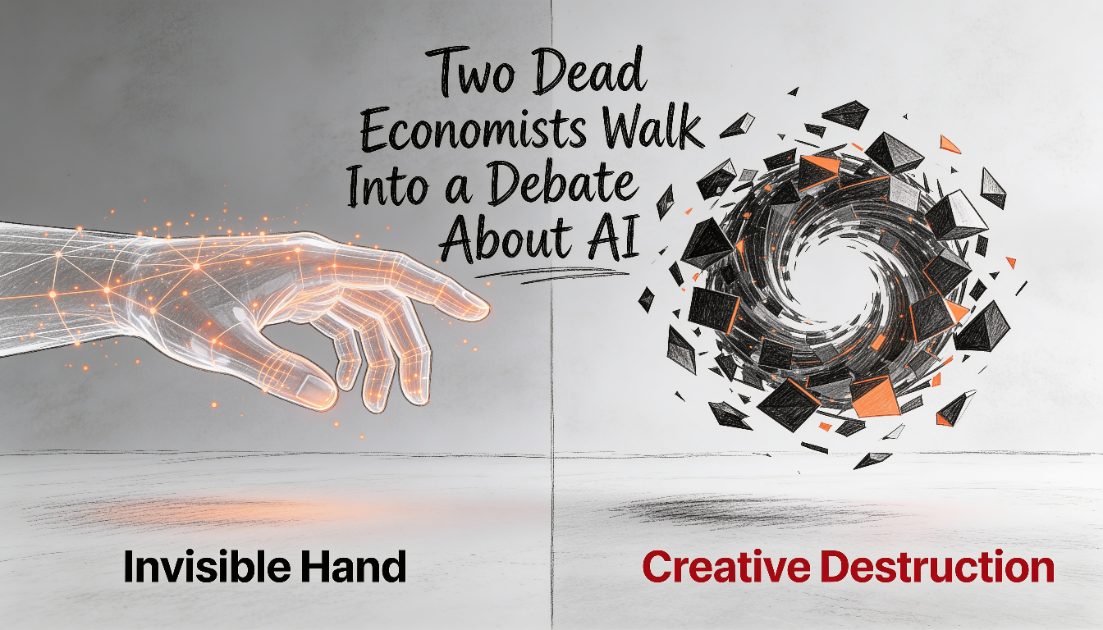
Every conversation about artificial intelligence and work eventually summons the ghost of Joseph Schumpeter. Creative destruction. Waves of technology washing away old occupations and depositing new ones on the shore. It is a vivid story, it has an excellent brand name, and it arrives with a built in cast of casualties: The punch card operator. The video rental clerk.
The story is so satisfying that almost nobody notices it has been losing the argument for two hundred and fifty years.
Because there is a second dead economist in this debate, one who wrote before the word technology meant anything like what we mean by it, and the evidence suggests he has been quietly right the entire time. His name was Adam Smith, and his answer to the question of where new jobs come from had nothing to do with invention at all.
The pin factory, briefly
Smith's insight is so familiar it has been sanded down into a slogan, which is unfortunate, because the actual mechanism is more interesting than the phrase.
A job, in Smith's framing, is not a thing. It is a bundle. It is a collection of tasks that happen to be held together inside one person because that arrangement was convenient. His pin factory made the point crudely. One artisan making pins from start to finish produces very few pins. Split the work into cutting the wire, sharpening the point, attaching the head, and output explodes.
The important part is what happens next. When you split tasks, you do not just get more pins. You get new job titles. In Britain, the occupation of clock maker in the sixteenth century had fractured, two hundred years later, into a small crowd of specialists: watch engraver, watch gilder, watch spring maker. Nobody invented those jobs. They were extracted from an existing one, the way a large rock becomes gravel. Turning big rock into small rock.
So we have two competing accounts of where your job came from. Either some machine created it, or some older job was pulled apart and you are holding one of the pieces.
The scoreboard is not close
Researchers have recently tried to settle this by going through more than a century of Swedish labor market records and scoring every occupation twice. One score for how much the job owes its existence to specialization. One score for how much it owes its existence to a new technology.
Between 1990 and 2019, strongly Smithian jobs accounted for around sixty percent of employment. The strongly Schumpeterian ones accounted for roughly a third.
There is a second number from the same work that is genuinely startling. About seventy percent of employment across those three decades sat in occupations that already existed at the end of the nineteenth century.
Sit with that for a moment. We have lived through electrification, the automobile, the assembly line, antibiotics, aviation, the computer, and the internet.
And the overwhelming majority of people are still doing jobs a Victorian would recognize by name. The teacher, the nurse, the accountant, the salesman, the manager, the driver, the cook. The titles survived. What changed was the contents of the bundle.
This is the part worth paying for. The technological revolution did not mostly replace occupations. It mostly reorganized what went on inside them.
The cruelest finding
Here is where the story turns against intuition, and where I would slow down if I were you.
The jobs that owe their existence to a specific technology are the ones that die fastest.
The punch card operator was not a relic. In 1965 that was the cutting edge. It was the job you got by being early, technical, and comfortable with machines that intimidated your colleagues. It was, in the language of its moment, a technology job. And it was erased more completely than the job of shopkeeper, which is three thousand years old and doing fine.
Technology jobs are load bearing for the economy in the sense that they enable enormous amounts of work elsewhere. But the roles themselves are strapped to a particular generation of hardware, and when that generation ends, so do they. Specialization jobs, by contrast, tend to be tethered to a durable human need rather than a specific machine. Someone has to do the bookkeeping regardless of whether the ledger is paper, spreadsheet, or model.
Which produces an uncomfortable inversion of the standard career advice. The place that feels safest during a technological revolution, which is standing on top of the technology, is structurally among the more fragile places to stand. The label "AI engineer" has more in common with "punch card operator" than anyone currently holding the title would like to consider.
Enter a third dead economist
If Smith explained why jobs multiply, someone still has to explain why they might stop.
Ronald Coase supplied the missing piece in 1937 when he asked why firms exist at all. His answer was coordination cost. You hire a specialist rather than learning the skill yourself when the cost of learning exceeds the cost of coordinating with an expert. You outsource when coordination is cheap. You bring work in house when it is not.
Specialization, then, was never a law of nature. It was the output of an arithmetic problem. Learning was expensive, coordination was comparatively cheap, so tasks kept getting handed to other people, and the number of occupations kept climbing.
Artificial intelligence attacks that equation from the side nobody was defending. It does not primarily make coordination cheaper. It makes access to specialist competence cheaper. And when the cost of doing a neighboring task collapses, the logic that pushed the task out of your bundle in the first place quietly reverses.
The economist Luis Garicano, who has written about exactly this, notes that some task bundles are only weakly held together, which makes them ripe for being pulled apart. But he also raises the stranger possibility: if AI makes specialist knowledge accessible enough, it may become easier to simply bring the work back inside, rather than pay the cost of dealing with another expert. Think of the writer who used to hire someone to build her website and now does not bother.
There is already a faint signal in the data. Roughly seventeen percent of work related messages sent to AI systems concern tasks belonging to somebody else's occupation. People are trespassing. Quietly, at scale, and mostly without telling anyone.
If that continues, we are not watching creative destruction. We are watching the division of labor run backward for the first time since the pin factory, which would make this revolution genuinely unlike the ones before it.
What this actually means for you
Stop asking whether your job will be automated. It is the wrong unit of analysis and it produces panic instead of planning.
Ask instead what is in your bundle, and why. Write down the tasks that make up your week and sort them into two piles. The first pile contains tasks that sit together because they genuinely require the same judgment, the same relationships, or the same accumulated context. That pile is structural. It holds.
The second pile contains tasks that sit together because at some point it was administratively convenient, or because the software was awkward, or because nobody wanted to negotiate with another department. That pile is held together by nothing but habit and coordination cost, and coordination cost is precisely what is being repriced.
The second pile is where the movement happens. Some of it leaves. Some of it gets replaced by tasks arriving from other people's second piles. Your title will very likely survive, in the same way that accountant survived the spreadsheet. What it means in practice will not.
For anyone allocating capital rather than labor, the same logic points somewhere specific. A meaningful share of the service economy exists purely as coordination arbitrage. Agencies, freelance marketplaces, outsourcing firms, and the long tail of businesses whose real product is access to a specialist you could not otherwise reach. Their margin is the gap between what expertise costs and what reaching expertise costs.
That gap is the thing being compressed. Not eliminated, because judgment and accountability still command a premium, but compressed in a way that separates firms selling genuine scarce competence from firms selling convenient access to ordinary competence.
The question worth keeping
Schumpeter gets the headlines because destruction is cinematic and arrives with a body count. Smith gets the results because reorganization is boring and arrives without a press release.
The last thing the Swedish researchers concluded is the line I would hold onto. Technological revolutions do not tend to resemble each other. Every generation confidently applies the template of the previous one and every generation is somewhat wrong in a new direction.
So perhaps the honest answer is that both ghosts are in the room and only one of them is being interviewed.
The question is not whether your job survives. The question is what gets quietly stuffed into it while you were busy worrying about the wrong economist.

Finance is a thinking sport. Investing, markets, and the mental models behind the money & economics.