
For most of the last decade, "voice technology" in enterprise settings basically meant one thing: an IVR tree. Press 1 for this, press 2 for that, hold music, then eventually a human picks up. Anyone who has ever called a bank's helpline knows the drill. That phase is ending now, and not because the script got smarter. It's ending because the system behind the call can finally listen, reason, and act on its own, closing the gap between what a customer says and what actually happens in the backend, mid-call, with nobody typing a note into a ticket afterward.
A lot of content on this topic treats "sounding human" as the whole story. It isn't, not even close. There's a real difference between a call that ends with "let me transfer you," and one that ends with "your refund has already gone through." The first is a cost center dressed up nicely. The second is a resolved ticket. And that gap has nothing to do with tone of voice; it comes down to whether the system can execute, full stop.
From Scripted Responses to Executable Actions
Traditional conversational systems ran on intent classification, and not much else. A user said something, the system matched it against a predefined intent bucket, and out came a canned response. That's fine for FAQs. It falls apart fast once money, dates, or actual account records enter the picture.
Modern voice-based AI systems don't work that way. Instead of just labelling what a caller wants, they turn the spoken intent into a structured action an API call, a database update, a workflow trigger then read the outcome back in plain, conversational language. A booking link isn't good enough anymore. The appointment needs to land on the calendar while the person is still on the phone, not five minutes after they hang up and forget to click through.
Why This Distinction Matters for ROI
Most enterprises evaluating Voice AI Agents tend to start with the wrong question: how natural does it sound? That's table stakes at this point, not really a differentiator anymore. The question that actually moves the ROI needle is a narrower one: how many steps of a real business process can this system complete on its own, without handing off to a human? An agent that sounds convincingly human but still escalates every non-trivial request is, functionally, an expensive voicemail system with better manners. One that resolves account changes, claim status checks, or delivery rescheduling entirely on its own is a different category of tool altogether, and the unit economics show it.
The Technical Architecture Behind Workflow Execution
It helps to break the architecture down here, because it explains both what these systems can do and, just as usefully, where they tend to fail.
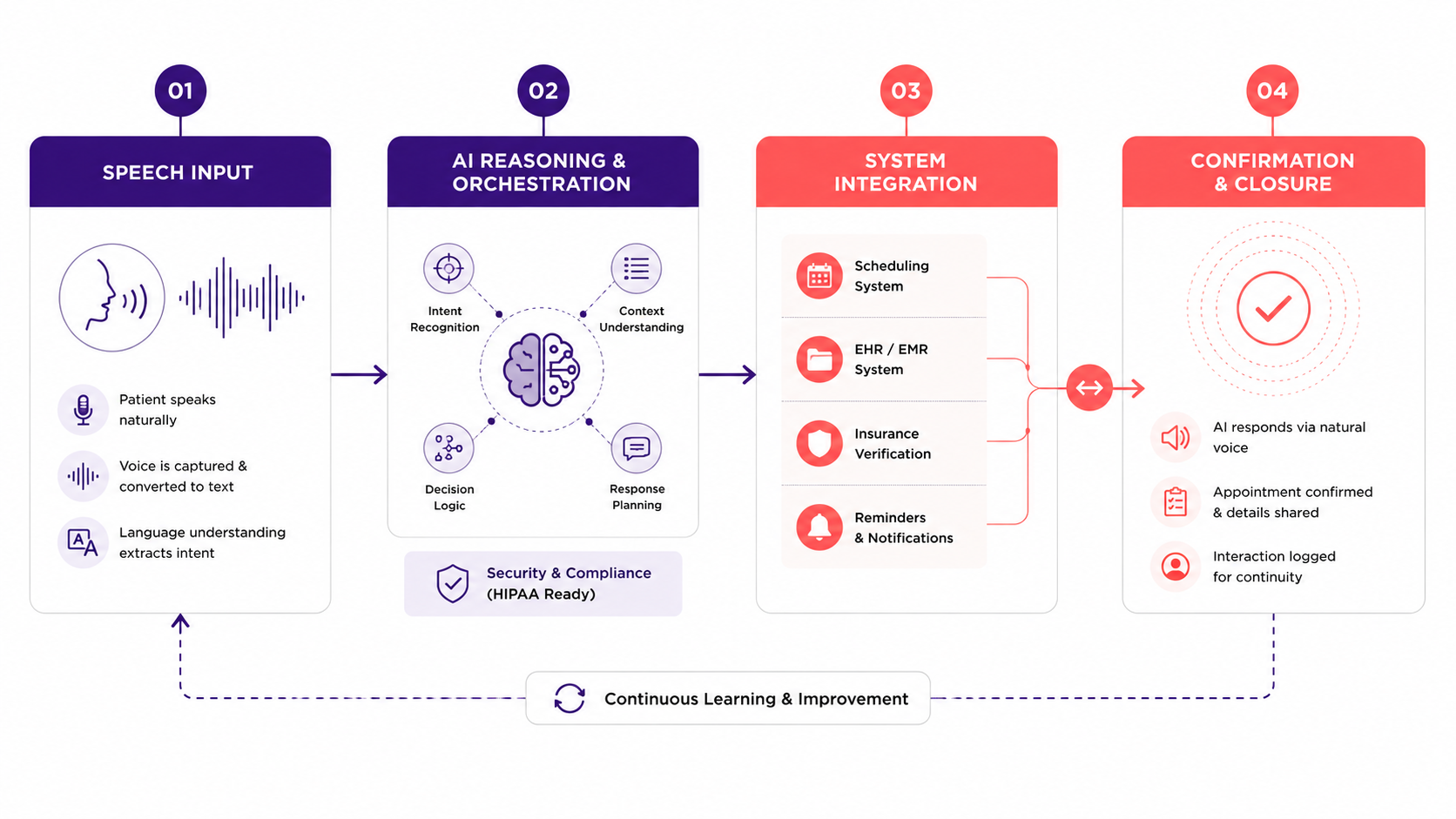
Speech-to-Intent Layer
First, automatic speech recognition converts audio to text. This part has genuinely gotten better for Indian English, code-mixed speech (Hinglish, Tanglish, and similar blends), and a good number of regional languages too. But accuracy here isn't some cosmetic nice-to-have. A mistranscribed account number, or a garbled date, doesn't just disappear; it quietly propagates downstream and shows up as an error several steps later, usually when it's harder to trace back. Enterprises in regulated sectors have learned this the hard way, which is exactly why ASR benchmarks get picked apart so aggressively during vendor selection.
Reasoning and Orchestration Layer
This is where large language models come in, though honestly, not quite in the way most marketing decks frame it. The model isn't just generating a reply. It's deciding which function to call, with what parameters, based on everything that's been said in the call up to that point. Function calling, tool use call it whatever a given vendor prefers to call it; this is the real mechanism that separates a workflow from a glorified chat transcript.
Integration and Action Layer
None of that reasoning means anything without something to actually act on. A model can decide a refund should go out, sure, but nothing happens unless there's a live, working integration into the payments system, the CRM, or the core banking platform sitting behind it. This is honestly where most enterprise deployments succeed or fail, not on how smooth the conversation sounds, but on how deep and how reliable that integration actually is underneath it.
Confirmation and Fallback Loop
Well-built systems close every single action with an explicit confirmation, and this part matters just as much as a defined fallback for whenever confidence dips. An agent that guesses instead of escalating isn't a feature. It's a liability waiting to become a headline. This layer, more than any other, is what separates the responsible deployments from the reckless ones.
Why Enterprises Are Adopting This Now
Three forces are converging here, and none of them are particularly hype-driven, which is refreshing given how much noise surrounds AI right now.
Cost Pressure on Contact Centers
Support operations across nearly every sector are being asked to do more with flat, sometimes shrinking, headcount. That part isn't new; it's been true for years. What's changed is that voice agents resolving queries end-to-end, instead of just deflecting them to yet another channel, actually move the needle on average handling time and repeat-contact rates in a way earlier automation attempts never quite pulled off.
Sector-Specific Demand
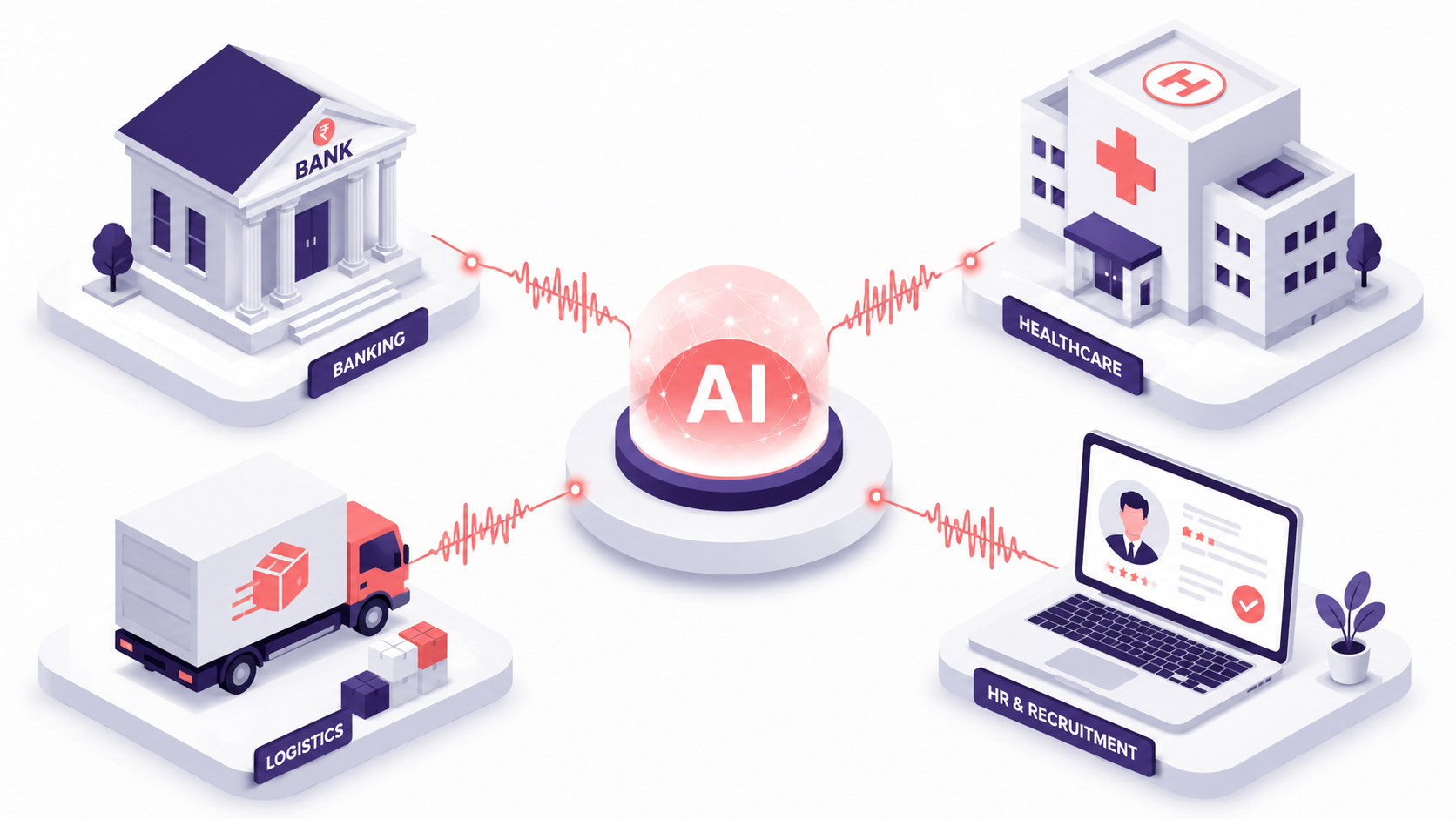
BFSI players are already running balance inquiries, EMI reminders, and even fraud verification calls through voice agents now, with an audit trail attached to every single action. Healthcare has leaned into voice pretty heavily too, mostly for appointment scheduling and pre-consultation triage. Logistics teams handle delivery rescheduling and exception cases without a human ever opening a ticket. Recruitment is a quieter example, but no less real: candidate screening calls at a scale no human calling team could realistically pull off, not without hiring an army of recruiters.
Rising Expectations Around AI in Customer Support India
Consumer patience for slow support has more or less disappeared at this point. People expect fast, accurate resolution no matter which channel they happened to pick, and that shift in expectations around AI in Customer Support India specifically is really what's pushing enterprises to treat voice automation as a competitive requirement now, not some side experiment they'll get to eventually.
Business Impact: Beyond Cost Savings
Cost reduction gets top billing in pretty much every pitch deck, but honestly, it isn't the most interesting number in the room.
First-call resolution goes up noticeably once the agent can actually execute the transaction, instead of just explaining how the caller could go do it themselves somewhere else.
Consistency goes up too. A well-governed AI agent doesn't have an off day, doesn't skip a compliance disclosure because the queue's backed up, and doesn't sound different at 11 PM than it does at 11 AM.
Data quality improves almost by accident; every call now produces structured, queryable data instead of a recording that just sits in cold storage, never reviewed by anyone.
Scalability during demand spikes festive-season order volumes, policy renewal cycles, exam-result-driven EdTech traffic, that sort of thing stops requiring a last-minute scramble to hire and train temporary staff.
None of this is aspirational, by the way. It's already happening at enterprises that have moved past the pilot stage and into actual production.
Security, Compliance and Governance Considerations
Responsible vendors don't skip this part of the conversation, and enterprises shouldn't either, no matter how polished the product demo looked.
Data Residency and Handling
For BFSI and healthcare especially, where calls are touching financial or medical data, residency and retention policies can't just be assumed. They need to be written down and confirmed, in plain terms. Enterprises should be asking vendors directly: where's the audio stored, for how long, and who exactly has access to it?
Audit Trails
Every action taken needs a traceable log behind it: what was requested, what was actually executed, and which system version handled it. Regulators are asking for this level of traceability more and more from automated financial and healthcare interactions, and it's really not something you want to bolt on after go-live, once it's already too late to redesign around it.
Human Escalation Paths
No governance framework really holds up without a clear, defined threshold for handing off to a human. And that handoff shouldn't be treated as an admission that the AI failed; it's a designed, intentional part of the workflow, the same way a human agent knows when to escalate to a supervisor.
None of the above happens in a vacuum, either. The DPDP Act has already started shaping how enterprises think about consent, storage, and retention for voice data specifically, and TRAI's stance on automated calling keeps evolving too, so a compliance framework built today needs to leave room to adjust, not lock itself into whatever the rules happen to say this quarter. Vendors who treat this as a one-time checkbox during procurement tend to find out the hard way, a year or two in, that the ground shifted under them.
Total Cost of Ownership: What the Pricing Conversation Usually Misses
Vendor pricing decks tend to lead with per-minute rates, and that number alone rarely tells the full story. It looks clean on a slide. It doesn't hold up once the actual bill arrives.
There's the integration cost first: connecting into CRM, core banking, or hospital management systems isn't a flat fee most vendors quote upfront, and it often takes longer than the sales cycle implied. Then there's ongoing tuning. Language models drift, call patterns shift with new products or policies, and someone has to keep retraining the system so it doesn't quietly get worse over time. Nobody budgets for that in year one.
Human oversight costs money too, and that's fine; it should. A supervising team reviewing escalations, auditing transcripts, and refining fallback logic isn't overhead to be trimmed away eventually. It's the thing keeping the system accountable. Enterprises that treat oversight as a temporary phase, something to phase out once the model "learns enough," tend to run into compliance gaps a year or two down the line.
The honest comparison isn't cost-per-minute against a human agent's hourly wage. It's total cost of ownership against total cost of the status quo, including the escalations, the repeat calls, and the churn that comes from support that never quite resolves anything the first time.
Implementation Challenges to Plan For
Adoption is nowhere near as smooth as most vendor case studies make it look, and pretending otherwise doesn't do anyone favours.
Legacy system integration ends up, more often than not, being the longest lead-time component of the whole project, not the AI model itself, which is usually the easy part.
Multilingual accuracy across India's linguistic diversity needs ongoing tuning, not a one-time setup you configure once and forget about.
Change management internally matters more than most rollout plans account for. Support teams need retraining around exception handling and oversight, not the expectation that they're simply being replaced.
Measurement discipline matters just as much. Without clear before-and-after metrics defined ahead of rollout, ROI conversations six months later turn into anecdote and guesswork rather than anything useful.
What's Next: Multi-Agent Orchestration
Where all of this is actually heading isn't one voice agent managing a call start to finish, alone. It's several specialised agents working together on a single interaction: one verifying identity, another checking eligibility against a policy engine, a third executing the transaction itself, and a supervising layer deciding when a human genuinely needs to step in. This model is still maturing, no question. But enterprises putting real investment into their integration architecture today are, whether they'd describe it this way or not, quietly laying the groundwork for exactly this.
Conclusion
Machines talking convincingly isn't the interesting part anymore; that milestone was crossed a few years back, and nobody's impressed by it alone now. What's actually changed is that a conversation can end in a completed action: verifiable, logged, tied directly into the systems of record that run the business day to day. That's the distinction worth building a strategy around. It's also the one worth pressure-testing the hardest, before signing with any vendor in this space.
Frequently Asked Questions
What is a Voice AI Agent and how does it differ from traditional IVR systems?
A Voice AI Agent is a conversational system that can listen, reason, and execute actions in real-time during a call, unlike traditional IVR systems that simply route callers through scripted menus. Instead of transferring customers to a human, Voice AI Agents can resolve issues directly—such as processing refunds or updating accounts—while the caller is still on the phone.
Why is execution capability more important than sounding human in Voice AI Agents?
While natural-sounding speech is now table stakes, the real ROI driver is whether the system can complete actual business processes without human handoff. An agent that sounds convincing but escalates non-trivial requests is essentially an expensive voicemail system, whereas one that resolves account changes, claim status checks, or delivery rescheduling is a fundamentally different tool with measurable business impact.
How do modern Voice AI Agents process customer requests differently than traditional conversational systems?
Modern systems convert spoken intent into structured, executable actions—like API calls, database updates, or workflow triggers—rather than simply matching words to predefined responses. They then read the outcome back in natural language, ensuring actions like appointment bookings happen during the call instead of requiring follow-up clicks afterward.
What technical capabilities does the Speech-to-Intent layer provide?
The Speech-to-Intent layer converts audio to text using automatic speech recognition and has improved significantly for Indian English, code-mixed speech like Hinglish and Tanglish, and various regional languages.
What is the main ROI question enterprises should ask when evaluating Voice AI Agents?
Rather than asking how natural the system sounds, enterprises should focus on: how many steps of a real business process can this system complete on its own without handing off to a human? This metric directly correlates with cost savings and operational efficiency.
What makes the difference between a resolved ticket and a transferred call in Voice AI systems?
The difference comes down to execution capability. A call ending in a transfer is a cost center, while one ending with a completed action like "your refund has already gone through" is a truly resolved ticket, which depends entirely on whether the system can execute backend processes mid-call.
I'm Paridhi Purohit. I work in Marketing at Azilen Technologies, where I create content focused on AI, voice technology, customer experience, and emerging business trends for author submission. I enjoy researching complex topics and turning them into engaging, easy-to-understand articles that provide practical insights for businesses and readers alike. Through my writing, I aim to explore how innovation is transforming industries and making technology more accessible to everyone.