We Are Making the Digital Mistake Again. This Time With AI

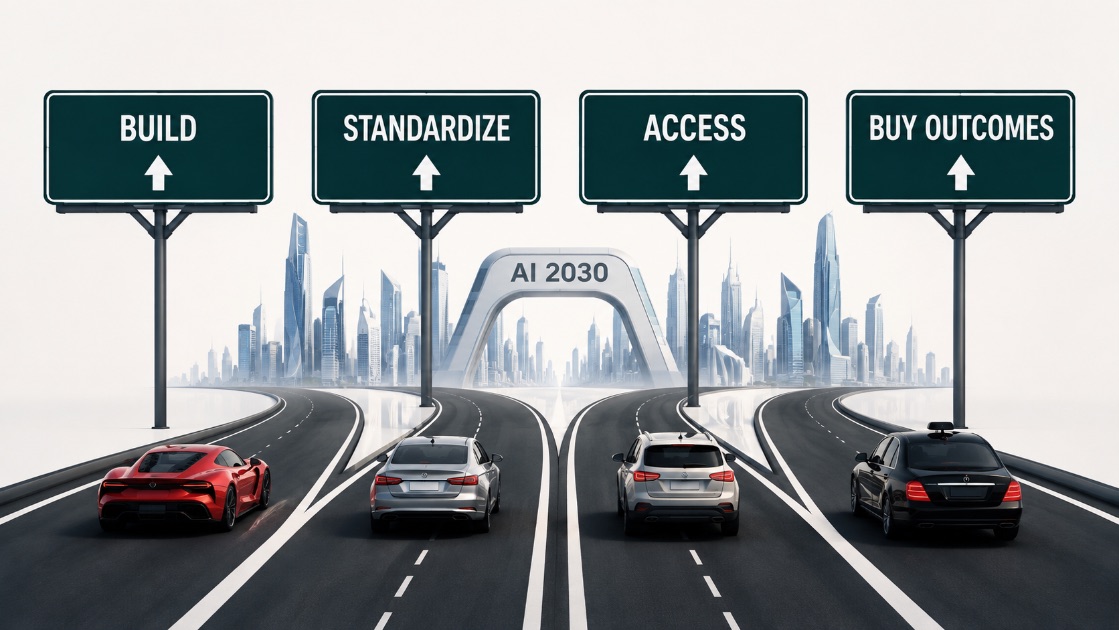
Companies are choosing the vehicle before agreeing on the journey, then placing AI in a function designed to support the business rather than reshape it
Over the past year, I have noticed the same pattern appearing in very different executive discussions about AI.
The conversation begins at the right altitude. Leaders talk about new products, scientific discovery, productivity, customer experience, and the possibility of changing how the company competes.
Then the discussion becomes more concrete.
Who should own AI? Where should the team sit? Do we need a Chief AI Officer? Which platform should become the enterprise standard?
These are legitimate questions. They often arrive before the organisation has decided what it wants AI to change.
The meeting ends with a familiar set of actions: appoint an executive sponsor, create a central team, collect use cases, define governance and prepare a technology roadmap.
The company leaves the room feeling that AI now has an owner.
This is usually the point where I become concerned.
A central team is necessary. Someone must manage security, architecture, suppliers, model risk and the growing number of experiments taking place across the organisation. The concern is what happens to everyone else once that structure is in place.
Operating leaders can begin to behave as customers of AI. They submit opportunities, wait for prioritisation and expect a specialist team to convert them into solutions.
The people who own the business outcome move one step away from the capability that may reshape it.
I recently saw this dynamic captured in a single exchange. During a discussion about a proposed AI solution, someone looked at the architecture and said:
“This looks like a Ferrari. We have the budget for a Toyota.”
It was a fair observation.
My response was:
“Perhaps today you do not need to buy either. You may need to call an Uber.”
I kept thinking about that conversation because it was not really about cost. It was about the relationship the company wanted with intelligence: whether to own it, standardise it, access it temporarily, or consume the outcome as a service.
Before examining those choices, there is a more basic organisational problem.
The intention behind a central AI function is understandable. Give AI visibility, authority and access to the centre of the organisation.
But assigning a transformative capability to a visible function can have unintended consequences. It can make that capability somebody else’s responsibility everywhere else.
We did this with digital.
We have seen this organisational move before
Companies appointed Chief Digital Officers, created digital factories and funded transformation programmes. The language was ambitious. The operating model was often conservative.
Digital became a function beside IT, marketing and innovation. Business units sent requirements; specialist teams built applications and reported adoption.
I have sat in steering meetings where the digital roadmap occupied several polished slides while commercial targets, planning decisions and capital allocation hung elsewhere. Everyone supported transformation, but the people who owned the account profit and loss could still treat digital as a service delivered to them.
What should have changed is that the company became another capability supplied to it.
AI is now moving down the same corridor.
We appoint a Chief AI Officer, establish a centre of excellence, create a model inventory and ask the business to submit use cases. The process looks controlled. It can also place AI in a second organisational layer, close to IT: important infrastructure, professionally managed and largely responsive to priorities set elsewhere.
Finance has a different position. It possesses formal rights inside the operating model. Finance influences budgets, investment gates, risk acceptance and performance reviews. Most AI offices have visibility but few comparable decision rights. They may recommend a capability without controlling the product decision, operating target or capital allocation required to turn it into value.
AI will matter when it enters those decisions with similar force.
It has to influence what the company builds, how it prices, which scientific paths it pursues, where it expands and which parts of the operating model no longer make economic sense.
A central AI office cannot produce thousands of better decisions inside research, manufacturing, supply chain and commercial operations on behalf of the people who run them. It can provide infrastructure, safeguards and direction. The value still has to be created inside the operating decisions.
There is a fair objection. Without central coordination, companies risk fragmentation, duplicated investment and weak controls. Twenty business units buying twenty incompatible tools is not a credible alternative.
But coordination is not ownership of the outcome.
If a supply-chain agent recommends a production change, the service risk still belongs somewhere. If a scientific model changes the sequence of experiments, someone must approve the decision and the evidence must be retained. If an AI-supported deviation assessment influences batch disposition, the batch record still needs a named sign-off.
The regulator will audit the evidence trail, not the confidence of the prose.
How the organisational mistake becomes an AI strategy
Once AI is positioned as a technology function, the strategy tends to follow a familiar sequence: select a platform, build governance, collect use cases, run pilots and prepare a rollout plan.
Each activity is reasonable. Together, they can produce a substantial programme without changing the products, economics or decision rights of the enterprise.
The first problem is the starting point.
The conversation begins with a model, cloud layer, vendor, or reference architecture. Teams then search for enough use cases to justify the commitment.
We choose the vehicle before agreeing on the journey.
The second problem is separation. A central AI team can turn operating teams into customers. They request capability, wait for capacity, and escalate delivery. The people who understand the business decision are separated from those who understand the technology, with documents travelling between them.
Neither side fully owns the changed outcome.
The third problem is premature standardisation. Enterprise technology has spent decades reducing fragmentation, consolidating suppliers and moving processes onto common platforms. That instinct is understandable. Applied too early to AI, it can remove the differences that make a capability valuable.
A molecule-screening capability, a customer-service assistant, a production-scheduling agent and a temporary due-diligence service have different economics and liabilities. They should not share the same ownership model merely because each contains a model.
There is also a sequencing problem. Large technology programmes assume that commitment comes first and learning follows. This is because we have been acquiring developed functionalities to address specific needs. AI works like nothing before, and organisations need to experience advanced capabilities before deciding whether the outcome justifies permanent investment.
That is why the Ferrari, Toyota and Uber analogy matters.
Buying a vehicle, leasing one and purchasing a journey represent different economic and organisational relationships. They distribute control, learning, commitment and liability differently.
These are not stages of maturity.
A sophisticated company may deliberately consume an AI-enabled service. An immature company may spend heavily building proprietary infrastructure it cannot operate. Ownership is not evidence of competence.
Four relationships with intelligence
The Ferrari: own what creates differentiation
The Ferrari represents a proprietary AI environment built around distinctive data, processes and expertise.
It makes sense when the capability changes the product, the science or the economics of the business. In life sciences, this might include target identification, decisions about clinical development, or optimization of manufacturing processes based on data and knowledge that competitors cannot reproduce.
The purchase price is only the visible part. The company also needs the garage: data engineering, specialist talent, validation, monitoring, cybersecurity and evidence management.
Models change. Data drifts. Scientific assumptions are revised. A proprietary capability remains an operating responsibility long after the launch team has moved on.
The practical test is whether the company will still want to own it when the novelty disappears, and the deviation log begins to fill.
A Ferrari is justified when learning must remain internal to the enterprise, and external dependency would weaken a strategic advantage. It is wasteful when leadership mainly wants the status associated with ownership.
The Toyota: standardise what must work every day
The Toyota is the dependable enterprise platform: a cloud AI layer, an enterprise model or capability embedded in software already used across the company.
Its value comes from repetition. Forecast enrichment, document processing, procurement support and routine planning decisions rarely require a unique model for every business unit. They need reliability, common controls and support at 02:00 when an interface fails.
A large share of enterprise AI value may come from this category, even though executive attention gravitates towards proprietary models.
Standard platforms still carry assumptions about processes, data, and decision rights. Over time, the company begins adapting itself to the platform. The architecture diagram looks cleaner while dependencies accumulate in configuration tables, workflow rules, integrations, and renewal dates.
The decision turns on whether the process is genuinely differentiating or needs to work very well.
Companies often spend Ferrari money customising work that customers, patients and shareholders will never notice.
Leasing: purchase time while the market moves
Leasing means committing to a capability for a defined period while preserving the right to change the provider, architecture or ownership model.
It suits areas where model performance, compute economics, or vendor positions are moving too quickly for a permanent commitment. It can also support a defined transition: an acquisition integration, a divestiture operating under a TSA clock, or a period in which internal capability is still developing.
Used properly, leasing is the deliberate purchase of time.
Temporary arrangements have a habit of becoming structural. Data pipelines deepen. Users build workarounds. Interfaces multiply. A one-year arrangement quietly enters its fourth year because people depend on it and nobody defined the exit conditions at the start.
A lease should specify what the organisation intends to learn, what data must remain portable, and which trigger leads to renewal, internalisation or exit.
Without those items, optionality exists mainly in the presentation.
The Uber: purchase the outcome and observe the journey
The Uber model purchases a defined outcome and a period of learning. The company does not initially own the models, workflows, or specialist capacity behind the service.
The provider may combine expert people, proprietary models, third-party tools and operational processes. The client pays for a planning recommendation, document review, scientific analysis or the resolution of a defined class of exceptions.
This works when demand is uncertain, intermittent or still poorly understood. A short ride in a Ferrari may show where higher performance materially changes the result before the company builds the vehicle, hires the drivers and constructs the garage.
The danger is that the provider learns while the client remains dependent.
Each engagement may improve the external model, workflow and playbook while the buyer receives only the answer. That is acceptable for a commodity journey. It becomes a strategic error when the problem definition, decision logic, or learning can become an internal capability.
The contract should state who owns the learning, which evidence is returned, how recommendations can be challenged, and whether the service can change provider in the future. Like for an Uber ride, you want to keep the freedom to book your return later. You want to take your time and share the destination, not why you are going there.
Otherwise, the company may outsource the understanding of the problem.
One company will need several vehicles
No enterprise should select one of these models as its universal AI strategy.
A pharmaceutical company may build a Ferrari around proprietary scientific knowledge, use a Toyota for finance and routine workflows, lease rapidly evolving infrastructure and call an Uber to test an AI-enabled planning service before industrialising it.
The choice also differs between the core and the edges, although those terms need precision.
Lot release, patient safety, financial close and production continuity demand evidence, resilience and named decision ownership. A temporary due-diligence analysis or an early commercial experiment can tolerate a more external and reversible model.
Core does not automatically mean proprietary. It means the control requirements must survive whichever ownership model is selected.
The categories can also move as the organisation learns.
An Uber may become a lease when demand becomes recurrent. A leased capability may move onto a standard platform once the market stabilises. A Toyota may deserve proprietary investment when the company discovers genuine differentiation. A Ferrari can become a commodity more quickly than its owner expects.
Architecture should support that movement.
Portable data, observable decisions, separable business rules and explicit exit conditions matter more than an elegant diagram that assumes today’s supplier landscape will remain intact until 2030.
This changes the role of architecture. Its job is not to predict one winning platform and lock the organisation around it. Its job is to preserve movement without losing control.
The investment review needs a different document
Nobody can name the winning enterprise AI platform for 2030. Capabilities that demand specialised infrastructure today may become standard features within a few years. Vendors that appear indispensable may be acquired, displaced or commoditised.
The durable investment is the organisation’s ability to learn where intelligence changes an outcome.
That learning cannot sit only inside the AI office. It must grow with the scientists deciding which hypothesis to pursue, the planner managing exceptions, the operator changing a production sequence and the commercial leader testing a different offer.
At the next investment review, ask every major AI initiative for a one-page control sheet.
It should name:
the journey and the business outcome;
the accountable business owner;
the chosen ownership model;
the evidence required before the recommendation can influence a decision;
the learning that must remain inside the company;
the trigger for migration, internalization or exit.
The platform decision should follow those answers. If the fields are blank, postpone the approval.
Ask for the page.
________________________________________________________________
Disclaimer: Views or opinions represented in this article are personal and belong solely to the article writer and do not represent those of people, institutions or organizations that the writer may or may not be associated with in professional or personal capacity, unless explicitly stated.
_________________________________________________________________
Flavio Aliberti brings with him a 25-year track record in consulting around business intelligence, change management, strategy, M&A transformation, IT and SOX auditing for high regulated domains, like Insurance, Airlines, Trade Associations, Automotive, and Pharma. He holds an MSc in Space Aeronautic Engineering from the University of Naples and an MSc in Advanced Information Technology and Business Management from the University of Wales.