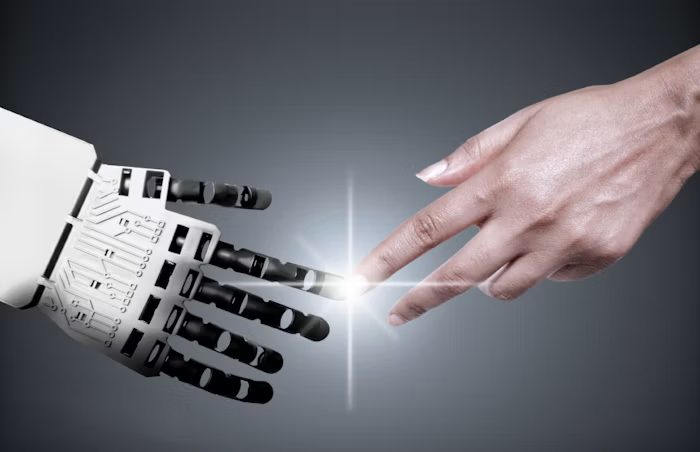
Physical AI is what happens when artificial intelligence stops living only in software and gets built directly into factory hardware — robotic arms, mobile manipulators, even four-legged sensor platforms that walk through a plant on their own. The goal is machines that can see what's in front of them, reason about it, and adjust on the fly instead of waiting for a human to step in at every stage.
A handful of companies are already proving this out. Cambrian Vision in Germany, Inbold in France, and Path Robotics in the US are running these systems on everything from flexible cable handling to autonomous welding. The numbers are hard to ignore — one deployment cut scrap rates by as much as 60% on parts worth $1,200 apiece. Dominic Meyer, who runs Looq AI, doesn't mince words about where he thinks the real advantage lies: putting intelligence into purpose-built industrial hardware, he argues, will outperform humanoid robots for decades to come.
Physical AI vs. Software-Only AI
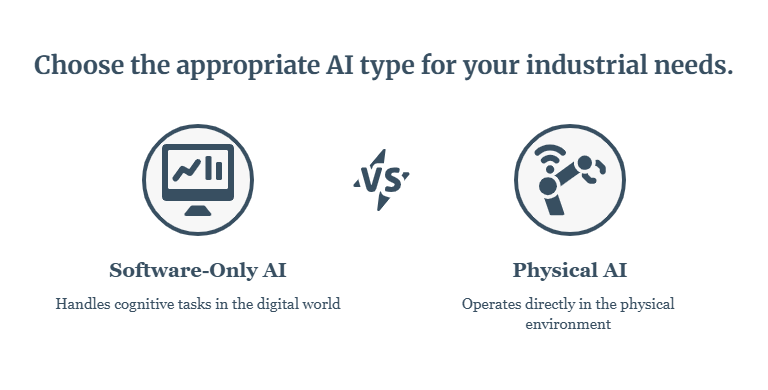
The core difference comes down to where the intelligence actually touches the work. Software-only AI crunches data in the digital world and never lays a hand on the shop floor. Physical AI is embedded right at the point where action happens.
Here's one way to think about it: if agentic AI is the "robotic arm for the mind" — handling cognitive work like root cause analysis — then physical AI is the body. It pulls together sensor data, computer vision, and machine learning inside the robot itself, so the machine can actually perceive its surroundings and respond, rather than just executing a fixed path someone programmed months ago.
A welding robot that reads part variation and adjusts mid-weld? That's physical AI. A dashboard displaying weld quality numbers after the fact? Not physical AI — it's just reporting. The line matters because it changes everything downstream: how you calculate ROI, what safety rules apply, and how the system actually gets deployed.
Where Factories Are Already Using It
Three main categories are seeing real deployment right now: inspecting hazardous areas with quadruped robots, adaptive manufacturing powered by AI vision, and computer-vision-guided assembly where a human still does the physical work.
Hazardous environment inspection. Oil and gas operators are sending robot dogs into tight, dark spaces that would put a person at real risk — capturing high-res images to spot leaks or corrosion before they become a bigger problem. At larger operators, entire fleets handle offshore inspection with barely any human oversight, feeding live data back into digital twins the whole time. It's a "zero-touch" model: the equipment gets watched constantly without anyone physically standing there.
Adaptive manufacturing. Cambrian Vision tackled a problem that's tripped up automation for years — getting robotic arms to handle flexible material like cables — using AI vision to make it work. Inbold, over in France, built mobile manipulators that adjust in real time as they move through assembly. And Path Robotics, out of Columbus, Ohio, built autonomous welding that reacts to part variation as it happens, no reprogramming required.
Operator guidance. Not every use case replaces the human. Sometimes physical AI just watches over their shoulder — using computer vision to check each step of a complex assembly as it's being built. Manufacturers using this approach have seen scrap rates drop noticeably, all while keeping a person at the center of the actual work.
Why Specialized Robots Are Beating Humanoids on the Floor
Right now, purpose-built industrial robots are winning over humanoids for a simple reason: they already meet safety standards, they solve one problem well, and they're generating measurable returns today — not someday.
Humanoid robotics gets a disproportionate share of media buzz, but the safety frameworks for running them in a dynamic industrial setting just don't exist yet. Videos of humanoid robots getting knocked over or stumbling on debris aren't just embarrassing — they're a real liability question for anyone responsible for keeping workers safe. And that's before you factor in the physical limitations that come with a two-legged design.
Meyer put it bluntly: "How many robots do you see climbing up 37-foot ladders to reach a bolt on the backside of a boiler to see what the condition of that is? Zero. And will that change in the next 30 years? I put my bets on no."
Rather than betting on humanoid tech maturing, manufacturers are putting targeted sensors and specialized robots exactly where the problem already lives. That gets systems deployed faster and delivers returns on issues that exist right now — not five years from now.
Humanoid Robots | Specialized Industrial Robots | |
|---|---|---|
Safety standards | No established industrial frameworks | Proven protocols with built-in guardrails |
Current ROI | Still in R&D/pilot stage — no proven returns | Documented productivity gains and savings |
Environment fit | Constrained by bipedal balance | Built for harsh, tight, hazardous spaces |
Task scope | General-purpose but unreliable at scale | Narrow, high-reliability per task |
Where the ROI Actually Comes From
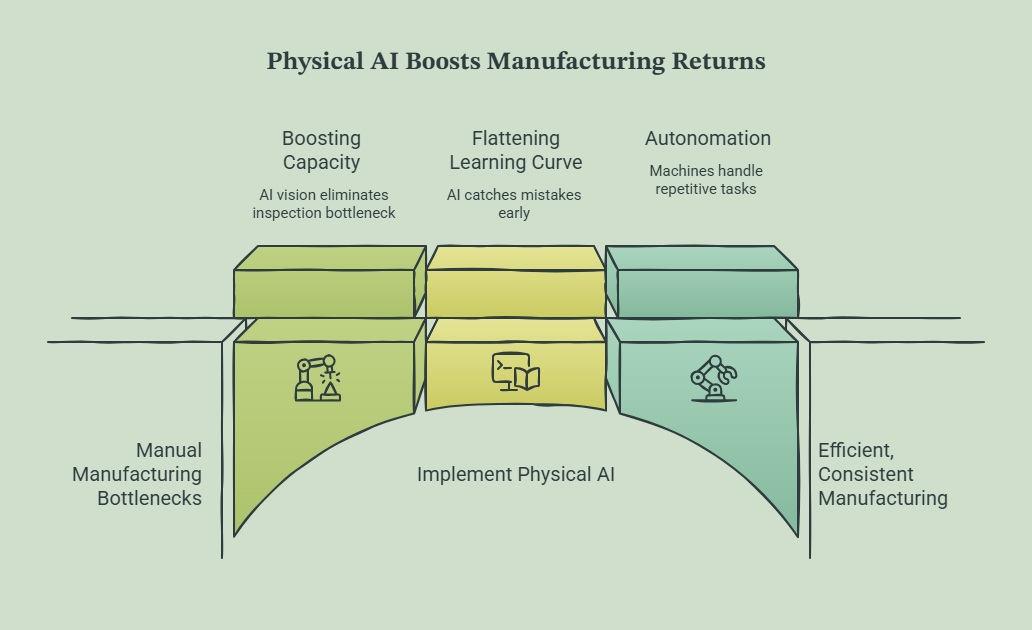
The best returns show up when Physical AI in manufacturing automation combines computer vision with robotics to take over manual work that machines simply do faster and more consistently than people.
Three patterns keep showing up:
Boosting capacity. When AI vision and robotics take over tedious inspection and assembly work, throughput goes up almost immediately — the inspection bottleneck just disappears.
Flattening the learning curve. One manufacturer used computer vision to check every step of a complex assembly in real time and cut scrap by 60% on components running $1,200 each — millions saved annually. The operator's still doing the job. The AI just catches mistakes before they turn into waste. It's not replacing the worker; it's shortening how long it takes them to get good at the job.
Autonomation. This borrows straight from the Toyota Production System: let machines handle 80-90% of repetitive physical work, and let skilled people manage the exceptions. It's not "lights-out" manufacturing — it's a deliberate split, putting machine efficiency where it belongs and human judgment where it still matters most.
The common thread: manufacturers who target physical AI at specific, well-defined problems see returns worth the investment. The ones trying to automate an entire line at once run into cost and complexity that's much harder to justify.
FAQ
What is physical AI in manufacturing?
It's AI software built directly into factory hardware — robotic arms, quadruped platforms, mobile manipulators — so machines can perceive and react to real conditions on their own. Unlike software-only AI, it operates right at the point of physical action, not just behind a screen.
How are humanoid robots different from specialized industrial robots?
Humanoids aim for general-purpose, human-like versatility. Specialized robots are built for one job — hazardous inspection, flexible material handling, autonomous welding — and right now they're the ones delivering real ROI, meeting existing safety standards, and holding up in conditions where humanoids still struggle.
How does physical AI improve manufacturing quality?
Mostly through real-time computer vision monitoring production as it happens. In one case, that approach cut scrap rates 60% on $1,200 components — the operator still does the work, the AI just catches errors before they turn into waste.
What is autonomation?
A Toyota Production System idea: machines take on 80-90% of repetitive physical work, humans handle the exceptions. Applied to physical AI, it means specialized robots and vision systems cover the predictable stuff, freeing people to focus on judgment calls machines can't reliably make.
I am Vitarag Shah, a Senior SEO Analyst at Azilen with 7+ years of experience in SEO, AI search, technical SEO, and content strategy. I write in-depth articles on AI Agents, Artificial Intelligence, Big Data, Data Engineering, Automation, enterprise software, cloud technologies, and digital transformation. My content combines research, industry trends, and practical insights to help professionals and businesses understand emerging technologies and make informed decisions.