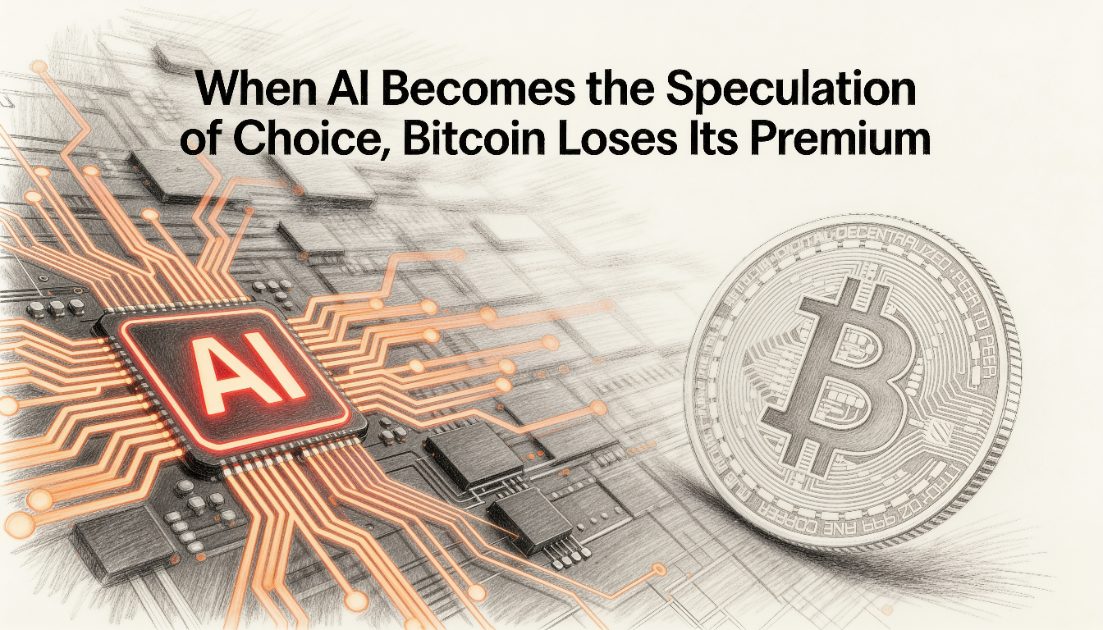
There is a particular kind of price move that should worry a Bitcoin holder far more than any single ugly day. It is not the drop below sixty thousand dollars, though that is the headline everyone repeated. It is what happened around the drop. Stocks rallied, and Bitcoin did not come along for the ride.
For years the story was simple and almost comforting. Crypto traded in line with equities. When the Nasdaq rose, Bitcoin rose with it, usually faster. When technology stocks fell, Bitcoin fell harder. It was leveraged risk, a high beta cousin of the tech trade, but at least it was a cousin. The two moved as family.
That relationship is now showing signs of strain, to borrow the careful language of the analysts. Bitcoin is down thirty two percent this year. And here is the detail that matters more than either figure: they have not recovered even when stocks have rallied. The family resemblance is gone. Bitcoin is no longer the aggressive version of the technology trade. It is something the technology trade has decided to leave behind.
This essay is about why that happened, and why it reveals something uncomfortable about what Bitcoin has actually been all along.
The premium was never about the technology
Let me make the argument plainly, because the politeness of market commentary tends to bury it. Bitcoin does not produce cash flow. It does not pay a dividend. It has no earnings to discount, no factory to depreciate, no customer to lose. Whatever you believe about its long term destiny, in the short run its price is set almost entirely by one variable: how much attention it commands relative to everything else competing for the same speculative dollar.
Call that its premium. It is the extra value an asset earns simply for being the most interesting bet in the room. For most of the past decade, Bitcoin held that premium effortlessly. It was the original disruptive trade, the asset that made early believers rich and late skeptics look foolish at dinner parties. The premium was not a line item on any balance sheet. It was a position in the culture.
The problem with a premium built on attention is that attention is the most fickle asset class in existence. It cannot be hedged. It cannot be locked in a vault. And it is strictly zero sum. Every unit of curiosity that flows toward one story flows away from another. When the most exciting speculation in the market changes, the premium does not erode gently over quarters. It transfers, often in a matter of months.
The new tenant moved in across the street
So where did the attention go. The answer is sitting on the Nasdaq listings page, in plain sight.
The market is still digesting SpaceX, which became the largest public offering in history when it listed earlier this month. It is the first of a queue. OpenAI is expected to follow. Anthropic is expected to follow. Each of these is not merely a company going public. Each is a fresh, liquid, regulated way to bet on the single most thrilling narrative in finance, which is artificial intelligence.
Consider what that does to a retail investor who, two years ago, would have parked speculative money in Bitcoin. That investor wanted three things: volatility, a story, and the feeling of being early. Artificial intelligence now offers all three, with the added comfort of a stock ticker, a prospectus, and a real business that occasionally ships a product people actually use. The speculative appetite did not disappear. It found a better restaurant.
This is the quiet violence of the IPO queue. It does not attack Bitcoin. It does not need to. It simply opens a more attractive door a few feet away, and the crowd walks through it. The oxygen that crypto needs to breathe, which is nothing more glamorous than retail enthusiasm, was finite all along. SpaceX, OpenAI, and Anthropic are inhaling it.
The tell, revisited
Now return to that opening detail, because it contains the entire argument in miniature. Bitcoin failed to recover when stocks rallied.
If Bitcoin were what its defenders claim, a form of digital gold, an uncorrelated store of value, a hedge against the slow debasement of paper money, then a technology rally would be irrelevant to it. Gold does not check what the Nasdaq did this afternoon. But Bitcoin did the opposite of gold. It did not decouple upward into safety. It decoupled downward into irrelevance. It got left out of the rally entirely, which is precisely what happens to an asset whose only durable fundamental was being interesting, at the exact moment it stopped being the most interesting thing on offer.
That is the damning part, and I do not use the word lightly. Bitcoin did not behave like a store of value under stress. It behaved like a nightclub the week a newer club opened across the street. Same building, same lights, the same thumping confidence at the door, just fewer people every night and no single dramatic event to blame for the emptiness.
But surely this is about interest rates
The convenient explanation is rates. Traders are betting the Federal Reserve will raise rates to fight inflation, higher rates punish stretched valuations, and Bitcoin is the most stretched valuation of all. This is true. It is not wrong. It is also not enough.
Rates do not explain why Bitcoin failed to bounce while equities found buyers. Rates are a tide. They lift and drop everything at once. What we are watching is not the tide. It is Bitcoin specifically being abandoned on the sand while the water rolls back in for the stocks. The macro environment set the stage.
There is a counterintuitive lesson buried here for anyone who owns narrative driven assets, which in 2026 is a larger group than most people admit. The greatest risk to such an asset is rarely a crisis. A crisis is dramatic, legible, and frequently survivable, because crises end and attention comes flooding back. The greater risk is substitution, and substitution is silent. Nobody rings a bell when a story stops being the best story available. The capital simply stops arriving. One day you look at the chart and realize the premium has quietly moved out and left no forwarding address.
The empty news cycle could not have come at a worse time
It would help crypto enormously to have a catalyst of its own right now, something dramatic enough to pull the spotlight back across the street. There is not one. The Clarity Act, the major piece of legislation that would govern digital assets in the United States, has languished in the Senate, opposed by banks and short on the bipartisan support it would need to pass. So crypto enters its least exciting season in years with no policy story, no breakthrough product story, and no new believer story, while its rival walks onto the Nasdaq under a shower of confetti.
An asset that lives on attention cannot afford a quiet news cycle. Bitcoin is having one at the worst possible moment, and there is no obvious appointment on the calendar to end it.
What this means, and what it does not
Let me be careful here, because the lazy contrarian move would be to declare Bitcoin finished, and that is not the argument. Bitcoin has been buried many times by people who mistook a loss of premium for a loss of pulse. It may well reclaim the spotlight. Narratives rotate, and the asset that is boring today can become thrilling again the moment its story finds a new chapter. Every market cycle anoints one dominant speculation, and the throne changes hands more often than its occupants would like.
The point is narrower than a eulogy and, I think, more useful. Bitcoin is not an uncorrelated store of value, and the past few weeks have demonstrated this in the clearest possible terms. It is a narrative asset whose price is a real time measurement of how compelling its own story is relative to the best alternative on the menu. For most of its life, there was no serious alternative. Now there is, and it is wearing the costume of artificial intelligence and ringing the opening bell each morning.
If you hold Bitcoin, the question to ask is no longer whether the technology is sound or the supply is truly fixed. Those questions were always a little beside the point, however much they animated the forums. The real question is whether its story can win back the attention of a market that has just discovered a newer, shinier, cash generating way to feel early. That is a harder question. It is also a more honest one.
The premium was never in the code. It was in the crowd. And the crowd just found somewhere else to be.

Finance is a thinking sport. Investing, markets, and the mental models behind the money & economics.