
A good drug can be a scientific success, a commercial success, and still be a terrible investment.
How many billion dollars must a medicine sell before we admit that buying it might have been a mistake?
Imagine a pharmaceutical company paying $12 billion for a promising late-stage asset. A few years later, the medicine receives approval, reaches patients, and eventually generates $3 billion in annual sales. Management can point to a blockbuster. The acquisition appears vindicated.
I would still want to see the return, not because it matters more than the patient, but because capital committed to one medicine cannot be committed again to the next.
Approval validates a medicine for a particular use. It does not validate the price paid to own it, and several billion in revenue cannot settle that question either. Manufacturing, commercialization, further trials, and taxes all stand between sales and cash available to repay the investment. Time makes the distance longer.
Pharma needs external innovation. Buying it can be an excellent use of capital. What interests me is the moment when the strategic need to own an asset starts replacing the economic discipline required to buy it.
Clinical success asks whether the drug works. Patient success asks whether it meaningfully changes lives and reaches the people who need it. Investment discipline asks whether the evidence available when the deal was signed justified the price and the risk. These outcomes are connected, but none proves the others.
There are four possibilities here, although the conversation too often makes room for only success or failure.
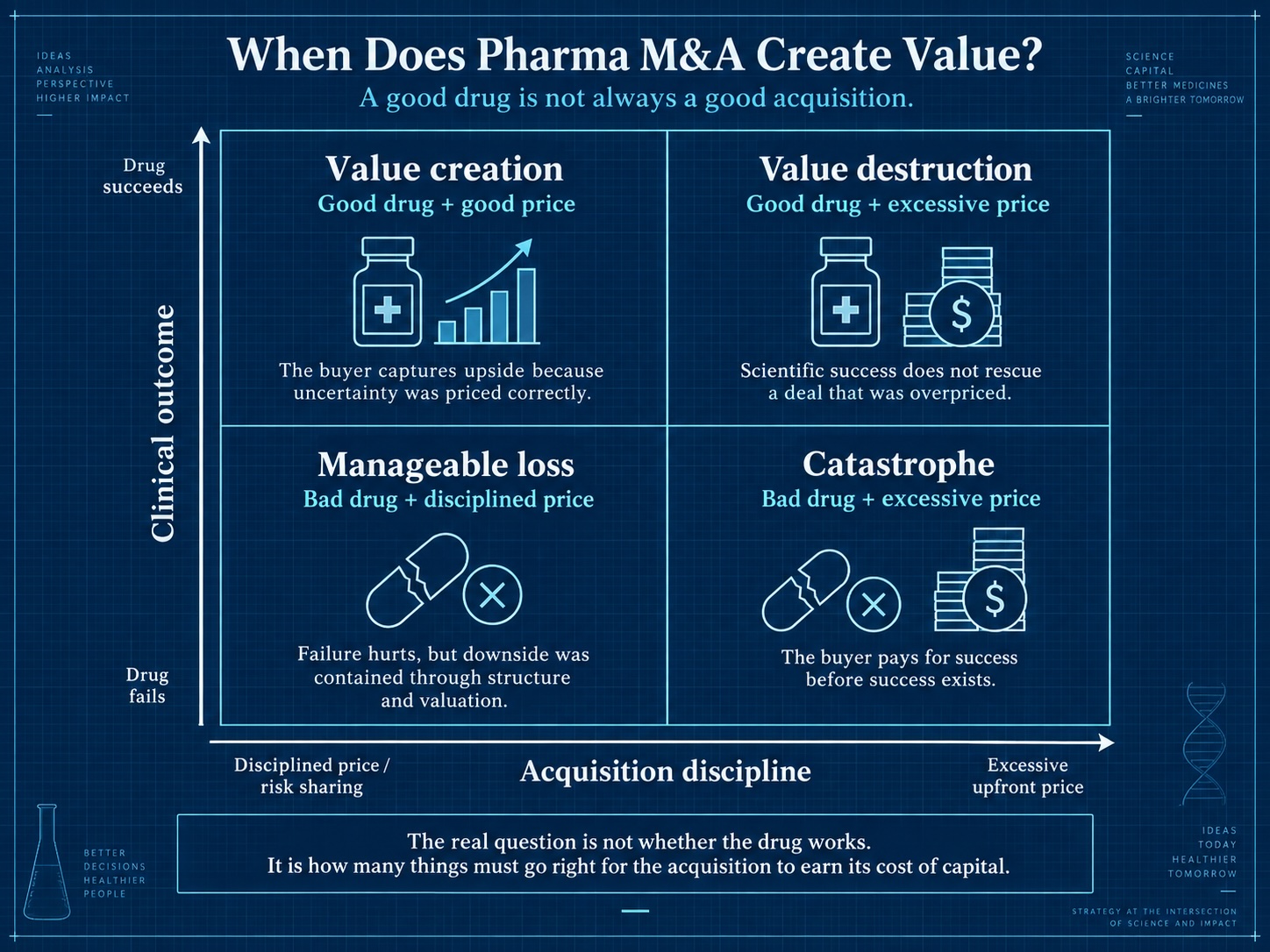
Value creation: the price leaves room for a return.
Value destruction: the medicine succeeds, but the economics disappoint.Failure
Manageable loss: the risk was priced and the exposure contained.
Catastrophe: the science fails after the buyer has committed too much.
This framework helps examine a deal, not a formula that guarantees its result. Clinical success still needs commercial execution, and a disciplined investment can lose money. What matters is separating decision quality from the outcome.
If a Phase III trial fails after a contained upfront payment, with most consideration conditional on later milestones, the transaction may have behaved exactly as intended. Failure was possible, and the buyer did not pay as though it were impossible. A portfolio of sensible investments will contain disappointments.
An expensive clinical failure is easier to judge because the loss is visible. The more uncomfortable case sits in the upper-right corner: a good drug bought at a price that leaves shareholders with an inadequate return. No failed trial to explain, and growing sales provide a persuasive defence. The medicine can help patients for years while the original investment remains poor.
That is the quadrant I would spend more time discussing.
Buying a finite amount of future
When acquiring an established business, a buyer can usually examine an operating history and existing cash flows. In late-stage biotech, much of what is purchased may still depend on events that have not happened.
The acquisition payment comes first. Meaningful cash generation may follow years later, after pivotal trials, regulatory review, manufacturing scale-up, and market access. Even then, approval does not mean physicians immediately change their practice or that the eligible population becomes a treated population.
From a supply chain perspective, this is where I become particularly interested in the valuation. A manufacturing transfer, a constrained supplier, or a delayed capacity qualification may look like an operational issue delegated to the integration team. If it delays treatment availability, it changes the economics that justified the acquisition.
The clock matters because pharma buys a finite amount of future. Patent protection and regulatory exclusivity are different mechanisms with different clocks; the FDA explicitly distinguishes them. They should not be reduced to one convenient expiry date, and an acquisition does not restart them. FDA explanation of patents and exclusivity.
A year lost after launch can burn part of the protected selling period. The commercial plan may move toward right while the competitive threat does not. Recovering that year requires more than moving a column in the spreadsheet.
What does a $3 billion blockbuster actually repay?
Take the hypothetical $12 billion acquisition. To isolate the effect of time, assume the asset generates no net cash during the first four years, then produces $3 billion in annual sales for ten years, beginning in year five.
Now assign it a generous 50% free cash flow margin, after operating costs, taxes, and ongoing investment. That means $1.5 billion a year available to the business. Assume those payments arrive at each year-end and use an illustrative 10% discount rate.
Those ten payments total $15 billion. Their value at the acquisition date is approximately $6.3 billion.
Nothing has failed clinically in this example. The product delivers $30 billion in cumulative sales, yet that cash flow stream is worth little more than half the purchase price today.
This is deliberately a simplified illustration, not a valuation of any particular medicine. It assumes an immediate jump to mature sales in year five and ignores net development and launch outflows before then. It also assigns no value to earlier positive cash flows, cash after year fourteen, other acquired assets, or additional indications. A real valuation must include all of those where justified, alongside the probability of reaching them.
The point is that “$3 billion blockbuster” tells us very little until we know when the cash arrives, how much survives as free cash flow, and how long it lasts.
At a sufficiently high acquisition price, success becomes the minimum condition required to avoid a serious loss.
The wrong comparison can weaken the right criticism.
One response is to compare the acquisition price with the cost of developing a drug. If development costs around $3 billion, why pay $12 billion?
I understand the objection, but I would not build the argument on that ratio. There is no universal $3 billion development cost. The sample, the treatment of failed programmes, and the cost of capital influence the estimate. The Congressional Budget Office’s review explains why the cost per successful medicine includes much more than the expenditure on that medicine alone. CBO review of pharmaceutical R&D.
A late-stage asset has survived uncertainties that an early research programme has not. Buying it can save time and avoid years of unsuccessful development. That has value, sometimes considerable value. Historical development spending, however, is neither a ceiling nor a floor for what the asset is worth.
The better question is how much uncertainty has genuinely disappeared, and what the remaining opportunity is worth after allowing for everything that can still go wrong.
Evidence supporting approval does not automatically establish reimbursement, physician adoption, or success in another indication. Paying a premium for clinical progress can be rational. Treating that progress as if it had resolved the entire commercial future is much harder to defend.
How many assumptions are hiding inside the price?
A large acquisition price can depend on a surprisingly long chain of acceptable assumptions. The pivotal trial succeeds, the label supports the intended population, reimbursement arrives promptly, and physicians adopt the treatment. Manufacturing keeps pace. A competitor does not materially alter the market before the buyer has recovered its investment.
None of those assumptions has to look absurd on its own. The difficulty is needing enough of them to hold together.
As a simple mathematical illustration, five independent events with an 80% probability each have only about a 33% probability of all occurring. That is not an estimate for a drug acquisition. It shows why confidence in each single step cannot simply make the success probability of the whole sequence.
In reality, the dependencies are more complicated. A weaker clinical result may narrow the label and weaken the reimbursement case. A manufacturing delay may give a competitor time to establish prescribing habits. Separate teams can end up forecasting risks that share the same underlying cause.
This is why I would challenge peak sales so closely. It compresses a complicated future into one number that is easy to remember and defend. But a $5 billion peak reached late, dependent on further indications and followed by rapid erosion can be worth less than a $2 billion peak reached sooner with more durable cash generation.
Peak sales tells me how high the mountain is. It says almost nothing about how much time I have left once I reach the top.
I would want the investment committee to examine the years before and after that peak with at least as much attention as the number itself.
Who is being paid for the uncertainty?
Milestone payments, contingent value rights and staged transactions allow part of the consideration to follow the evidence. They can make the price depend on approval, commercial performance or another event that materially changes the asset’s value.
There is no reason every acquisition should use them. Sellers value certainty, auctions can limit flexibility, and contingent terms can create difficult incentives. A fully upfront acquisition can also be disciplined if the price adequately reflects the remaining risk.
But where the valuation is aggressive and major uncertainties remain, structure becomes revealing. How much is the buyer paying for what is known, and how much for what everybody hopes will happen?
An impressive maximum deal value spread across demanding milestones is economically different from the same amount paid at closing. Equally, adding a small contingent payment does little to protect a buyer who has already paid away most of the plausible upside.
The useful question is whether the buyer retains enough return to justify carrying the unresolved risk.
Large pharma has reasons to stretch. An approaching patent cliff makes the revenue gap tangible. A promising acquisition offers a name, a development timetable and a growth story that can be communicated to shareholders. The urgency is understandable.
It can also change the decision. “This is a strategically important area” becomes “we need an asset here,” which becomes “this is the best available asset.” By the time the discussion reaches “we should buy it,” the price can feel like an obstacle to executing the strategy rather than a condition of whether the strategy makes sense.
The buyer may have real advantages: an existing commercial presence, manufacturing capabilities, or expertise that can accelerate development. Those advantages belong in the valuation, with their costs and delivery requirements. They do not justify an unlimited premium, especially if the seller captures their entire value at signing.
What are we actually trying to maximize?
By design, I have been careful not to turn this argument into a retrospective scorecard for CEOs.
Pharma acquisitions usually attract their sharpest criticism when failure becomes visible: a Phase III trial misses its endpoint, a launch disappoints, an impairment enters the accounts and eventually reaches the headlines. By then, the verdict benefits from information nobody had when the transaction was signed. A poor outcome does not automatically prove that the decision was reckless, just as an approval does not prove that the price was disciplined. The fair test is what was known at the time, what alternatives existed, and how much the buyer paid for the remaining uncertainty.
There is also a deeper limitation to looking at these transactions only through financial return. A medicine that gives someone more time, prevents disability, keeps a patient out of hospital, or offers a family an option where none existed has created real value, even if the acquisition never earns its original valuation. That is not a soft exception to the economics. It is the reason the industry exists.
But patient benefit cannot become the retrospective justification for any price. The $12 billion committed to one asset is no longer available for another molecule, another clinical trial, the manufacturing capacity needed to make a treatment available, or broader access. A company can help patients with a successful medicine and still have overpaid for it. The opportunity cost appears elsewhere, often among patients whose medicine was never funded and whose absence will never make a headline.
So what are we actually trying to maximize?
I would go for the amount of meaningful patient benefit a company can keep creating with finite capital and finite time. The word keep matters. A company that maximizes financial return without improving lives has misunderstood its purpose. A company that ignores financial discipline may eventually lose the means to pursue it.
The question before signing
That leaves me with two questions before approving a deal: How many things must go right for this acquisition merely to earn its cost of capital? And if they do go right, what meaningful patient outcome are we actually funding?
The answer needs more than counting assumptions. I want to know which ones carry the valuation, how much delay the economics can absorb, what happens if the label is narrower or adoption is slower than expected, and whether the investment still makes sense without every indication expansion succeeding. A deal that survives a plausible disappointment is fundamentally different from one that requires every line of the forecast to be delivered.
If the return depends on flawless clinical execution, rapid approval, immediate uptake, further indications and an almost uninterrupted exclusivity window, the buyer may already have paid the seller for most of the future it still has to create. The acquisition may still produce an extraordinary medicine, but there is very little investment upside left and even less room for reality to intervene.
Taking scientific risk is not the problem. Important medicines exist because somebody was willing to fund an uncertain idea, and, when one of those medicines gives a patient more time or offers a family an option where none existed, that value is real even if no spreadsheet can fully capture it. But capital is finite: what is paid for one asset cannot fund the next trial, additional capacity, wider access, or the next medicine. Financial discipline is therefore not in conflict with patient impact. It is what allows a company to keep creating it.
The distinction between investing and gambling is not whether the outcome is uncertain, because every investment contains uncertainty. It is whether the price leaves enough value to justify carrying that uncertainty and enough capital to invest again. When a company pays today for almost every success that still needs to happen tomorrow, the science may be extraordinary and the strategy convincing: but the economics look remarkably similar to a bet.
________________________________________________________________
Disclaimer: Views or opinions represented in this article are personal and belong solely to the article writer and do not represent those of people, institutions or organizations that the writer may or may not be associated with in professional or personal capacity, unless explicitly stated.
_________________________________________________________________
Frequently Asked Questions
When is a pharmaceutical acquisition a bad investment despite commercial success?
A pharma acquisition can be a poor investment even when the drug is approved, reaches patients, and generates billions in sales if the price paid was too high relative to the actual returns. The author argues that clinical success and strong sales don't necessarily validate the acquisition price or prove the investment made financial sense.
What are the four possible outcomes of a pharma M&A deal?
The four outcomes are: value creation (price leaves room for return), value destruction (medicine succeeds but economics disappoint), manageable loss (risk was priced and exposure contained), and catastrophe (science fails after buyer commits too much). These distinctions help evaluate deal quality beyond just labeling it a success or failure.
Why does approval of a drug not validate the acquisition price?
FDA approval validates that a medicine works for a particular use, but it does not confirm that the price paid to acquire it was economically sound. Manufacturing, commercialization, further trials, and taxes all reduce the cash available to repay the investment, potentially leaving inadequate returns despite commercial success.
What is the most uncomfortable pharma M&A scenario according to this article?
The most uncomfortable scenario is when a good drug is bought at such a high price that shareholders get inadequate returns, even though sales grow and the medicine helps patients for years. Unlike clinical failures, there's no failed trial to explain the poor investment outcome.
How should pharma companies balance the need for external innovation with investment discipline?
While buying external innovation can be excellent for pharma companies, the strategic need to own an asset should not replace economic discipline in evaluating the deal. Companies must ensure the price and risk were justified by evidence available at the time of acquisition, not just by later commercial success.
Why is investment discipline separate from clinical and commercial success in pharma deals?
Clinical success shows whether a drug works, and patient success shows whether it meaningfully helps people, but investment discipline asks whether the price paid at the time of acquisition was justified by available evidence. These outcomes are connected but none proves the others—a drug can succeed clinically and commercially while still representing poor capital allocation.
Flavio Aliberti brings with him a 25-year track record in consulting around business intelligence, change management, strategy, M&A transformation, IT and SOX auditing for high regulated domains, like Insurance, Airlines, Trade Associations, Automotive, and Pharma. He holds an MSc in Space Aeronautic Engineering from the University of Naples and an MSc in Advanced Information Technology and Business Management from the University of Wales.