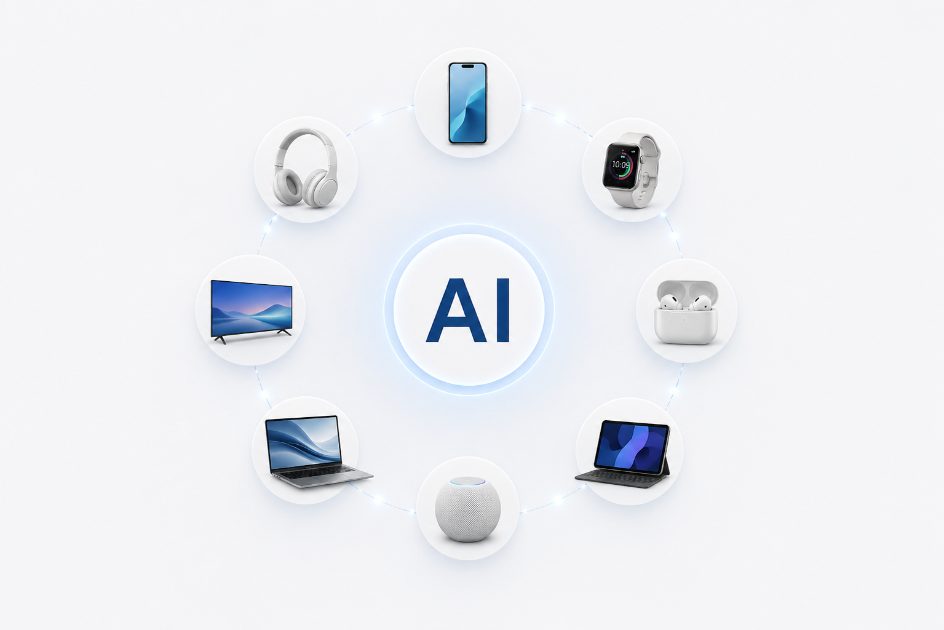
Few years ago, buying a new smartphone or laptop was all about the specifications. People compared processor speed, RAM, battery life, storage, camera quality and display. Every new device promised faster performance and better hardware, making upgrades feel worthwhile.
Today, things are different.
Instead of asking, "How fast is the processor?" many people are asking, "Does it have an AI assistant?" "Can it summarize my notifications?" "Will it edit my photos automatically?" or "Can it translate conversations in real time?"
This shift shows how quickly consumer technology is evolving. Artificial intelligence is no longer just a feature, it's becoming the brain behind our everyday devices. According to McKinsey, generative AI could add trillions of dollars to the global economy each year, encouraging companies to bring AI into everything from smartphones and laptops to earbuds, smartwatches and even home appliances.
The next generation of consumer devices won't just be faster, they'll be smarter, more helpful and designed to understand us better. That's the real upgrade.
Consumer Technology Is Moving Beyond Hardware
The reality underlying this transformation is simple: hardware innovation has hitting a performance plateau. Over the past few decades, chip manufacturers relied heavily on Moore's Law to deliver massive speed boosts every two years. Today, those jumps are shrinking. Faster processors now yield incremental, barely noticeable real-world improvements for the average user. Smartphone cameras have become consistently excellent across almost all price tiers, battery breakthroughs have slowed to a crawl and displays have reached a point of peak visual refinement.
Because of this, consumers are keeping their devices longer. A market study by International Data Corporation (IDC) underscores that smartphone upgrade cycles have steadily lengthened as hardware changes feel less revolutionary. Consumers simply don't upgrade for an extra fraction of a gigahertz anymore.
Instead, the features driving excitement are powered by artificial intelligence. Elements like AI-driven computational photography, live voice transcription, intelligent search and proactive battery optimization are what make a device feel "new." Silicon Valley has realized that software intelligence is the ultimate competitive advantage. As a result, industry analysts note that the next big upgrade isn't better hardware: it's better AI, pushing manufacturers to pivot from raw horsepower to cognitive capabilities.
AI Is Becoming the New User Experience
AI is no longer just a standalone application or a novelty website you visit in a browser tab. Instead, it is transforming into the invisible fabric connecting every single user interaction.
Historically, interacting with a device required a high degree of manual input. If you wanted to schedule a meeting, book a flight and notify a colleague, you had to jump across three or four separate applications, copying and pasting data along the way. Modern operating systems are completely redesigning this workflow by embedding AI directly into the core user interface.
Instead of opening a series of isolated apps, the device's underlying intelligence operates at the system level. It handles repetitive tasks automatically: organizing scattered notes, drafting contextual email replies, summarizing multi-hour calendar gaps and recommending actions before you even type a command. According to design research from firms like Gartner, the future of user interfaces is moving away from complex menus toward natural, conversational interactions. You don't "use" AI, you simply interact with your device naturally and the AI coordinates the backend work.
Every Consumer Device Is Becoming Smarter
This wave of intelligence is hitting every major category of consumer electronics simultaneously, entirely reshaping what these devices are capable of doing.
Smartphones
The smartphone is evolving from a basic communication portal into a highly personalized cognitive partner. Beyond simple call routing, smartphones now leverage on-device generative AI to offer writing assistance, advanced object removal in video editing, real-time call screening summaries and deeply contextual recommendations based on your daily habits.
Laptops
Laptops have graduated from basic productivity tools into creative AI workstations. With specialized Neural Processing Units (NPUs) now standard in modern chip chipsets, laptops can handle complex code generation, instantaneous document drafting and localized intelligent search across thousands of files without needing a constant cloud connection.
Earbuds
Once viewed as mere audio accessories for music and calls, earbuds are turning into sophisticated communication tools. Utilizing localized Edge AI, modern earbuds process real-time dual-language translation directly into your ear, isolate your voice from chaotic city noise and read out time-sensitive, contextual notifications based on your physical location.
Smartwatches
Smartwatches have broken out of the basic step-counter category to become comprehensive health companions. By integrating advanced machine learning models with biometric sensors, they track minor fluctuations in skin temperature, blood oxygen and heart rate variability to deliver deep sleep insights and predictive recovery coaching. This evolution highlights how tiny healthcare sensors are powering the future of healthcare by moving wellness from reactive treatment to proactive daily insights.
Smart Glasses
Smart glasses represent the vanguard of context-aware assistants, overlaying navigation cues, live foreign-text translations and real-time visual recognition directly onto the user's field of view. However, packing this immense computational power into a lightweight frame presents massive engineering hurdles, which explains why smart glasses still struggle with battery life as engineers work to balance intensive AI processing with tight thermal and physical size limits.
From Smart Devices to Intelligent Devices
To understand this paradigm shift, we have to draw a clear line between the "smart" gadgets of the last decade and the truly "intelligent" devices hitting the market today.
Traditional smart devices are fundamentally rooted in simple automation. They are purely reactive, waiting for explicit user inputs or executing rigid, pre-programmed rules. They operate within isolated apps or data silos, unable to communicate meaningfully with the rest of your life. A classic example of this is a smart plug that turns off the living room lights at exactly 10:00 PM because you scheduled it to do so. It is functional, but it is entirely rigid.
Modern AI devices, by contrast, swap basic automation for genuine intelligence. Instead of waiting for a command, they are continuously proactive, observing environmental and behavioral patterns to learn your preferences and adapt over time. Crucially, they synthesize data across your entire digital ecosystem rather than staying locked inside a single app.
Consider a practical scenario: Imagine you finish a grueling work project late at night. An old smart device simply sits there, waiting for you to manually open your phone and set an alarm. A modern AI device, however, reviews your wearable data, notices your unusually high fatigue levels, checks tomorrow's calendar, analyzes local weather forecasts and factors in real-time morning travel times. Instead of waiting for you to ask, it quietly suggests pushing back an internal morning meeting by thirty minutes so you can get adequate rest. That is the fundamental jump from basic automation to genuine intelligence.
Why Consumers Will Benefit
The rapid rise of AI consumer devices isn't just a marketing gimmick orchestrated by tech conglomerates it delivers concrete, measurable value to everyday life. By delegating cognitive friction to our devices, we experience a massive drop in digital clutter.
Time Reclamation: AI filters out the digital noise by automatically managing spam, sorting essential alerts and handling mundane scheduling.
Enhanced Accessibility: Natural language processing allows individuals with physical or cognitive challenges to command complex software using simple, spoken sentences.
Proactive Well-being: Instead of waiting for a doctor's visit, users get real-time flags regarding irregular heart rhythms or sudden drops in sleep quality, catching issues early.
Ultimately, artificial intelligence reduces the friction of the digital world. Technology is becoming vastly more helpful without demanding more of our finite attention spans.
The Challenges Behind AI-Powered Consumer Devices
Despite the obvious benefits, this rapid transition introduces complex challenges that product managers, developers and consumers must navigate together.
The Privacy Paradox: For a device to become deeply personal and predictive, it requires access to vast amounts of highly personal data, including your location history, conversations, biometric markers and private messages.
Ensuring this data is protected is paramount. This has sparked a major industry push toward Edge AI, where data is processed directly on the device’s physical silicon rather than being transmitted to a vulnerable cloud server.
Furthermore, companies face a steep battle in maintaining user trust. AI systems must remain transparent about why they make certain recommendations and they must drastically reduce accuracy errors like "hallucinations" in text or search. Consumers must always feel like they are firmly in control of major decisions, rather than being driven blindly by an algorithm.
The Future Belongs to Intelligent Ecosystems
Looking ahead, the ultimate destination of this trend extends far beyond individual gadgets. The future isn't just about a smarter phone or a more capable laptop operating in a vacuum. Instead, the next evolution involves multiple AI-powered devices communicating fluidly through a unified, cross-device intelligence layer.
In this environment, you don’t manually hand off tasks from your phone to your laptop or your car. The intelligence layer follows you seamlessly. Your earbuds pass contextual data to your smart glasses, your watch updates your laptop's productivity dashboard, your home environment adapts to your biometric stress levels.
This seamless integration represents the realization of a long-standing tech dream: the rise of ambient computing and what it means for users. Technology fades completely into the background of our physical spaces, operating quietly, intelligently and omnipresently to support our lives.
Conclusion
Consumer technology has spent decades competing on physical metrics, thinner frames, brighter screens and faster clock speeds. But the hardware race as we knew it has reached its maturity. The next decade will be defined completely by cognitive value.
Moving forward, consumer electronics companies will no longer win market share based on specifications alone. Instead, the market will reward companies whose devices most effectively understand their users, accurately anticipate their unique needs and quietly remove friction from their daily lives. The future isn't about owning more technology, it's about our technology finally becoming intelligent enough to work for us. The most valuable consumer devices of tomorrow won't be the ones with the fastest processors they'll be the ones that understand us best.
Frequently Asked Questions
Why are consumers no longer focused on processor speed and RAM when buying devices?
Hardware innovation has hit a performance plateau, with processor improvements now yielding only incremental, barely noticeable real-world improvements. Consumers are keeping devices longer because faster specs no longer feel revolutionary enough to justify upgrades.
What features are now driving consumer excitement in new devices?
AI-powered features like computational photography, live voice transcription, intelligent search, and proactive battery optimization are what make devices feel new and desirable to consumers today.
How is artificial intelligence being integrated into consumer devices?
AI is transforming from standalone applications into the invisible fabric connecting every user interaction, becoming the brain behind everyday devices from smartphones and laptops to smartwatches and home appliances.
Why are tech companies prioritizing AI over hardware improvements?
Silicon Valley has realized that software intelligence is the ultimate competitive advantage, pushing manufacturers to pivot from raw horsepower to cognitive capabilities as the next major competitive differentiator.
What economic impact is generative AI expected to have?
According to McKinsey, generative AI could add trillions of dollars to the global economy each year, encouraging companies to bring AI into consumer devices across all categories.
How long are consumers keeping their devices now compared to before?
According to an IDC market study, smartphone upgrade cycles have steadily lengthened as hardware changes feel less revolutionary and consumers see less reason to upgrade for incremental performance improvements.

I am a technical writer and technology enthusiast focused on making complex innovations easy to understand. I write about Artificial Intelligence, consumer technology, developer tools, software engineering and the future of digital products. My work explores how AI is transforming everyday devices, modern software development and the way people interact with technology. Through practical insights, research-driven analysis and real-world examples, I aim to help developers, tech professionals and curious readers stay ahead in a rapidly evolving technology landscape.