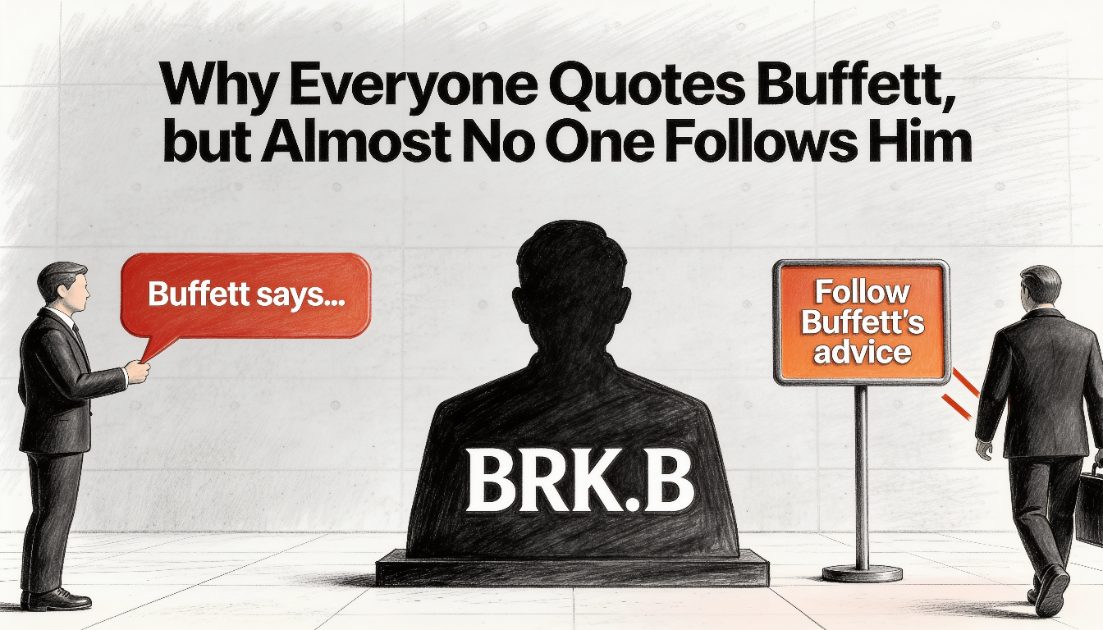
There is a strange ritual that plays out every quarter in fund letters, LinkedIn posts, and pitch decks around the world. Someone reaches for a Warren Buffett line, drops it into the second paragraph, and moves on. Be fearful when others are greedy. Price is what you pay, value is what you get. Our favorite holding period is forever.
Then, having invoked the saint, the writer goes back to doing the exact opposite.
This is not hypocrisy in the ordinary sense. Most of the people quoting Buffett genuinely admire him and genuinely believe what they are quoting. That is what makes the gap so interesting. We are not looking at a case of people saying one thing and secretly believing another. We are looking at people who believe a thing sincerely and still cannot bring themselves to act on it.
The question worth asking is not why investors ignore good advice. It is why this particular advice, which is simple, free, endlessly repeated, and delivered by the most credible practitioner in the history of the field, has such a spectacularly low conversion rate from belief to behavior.
Quotes are cheap because they cost nothing to hold
An aphorism is a strange sort of asset. It has enormous social value and almost zero carrying cost. Quoting Buffett signals patience, discipline, and long term thinking without requiring you to be patient, disciplined, or long term about anything. You get the reputational return immediately and pay the behavioral price never.
Actually following Buffett works the other way around. You pay first, in the currency of looking foolish, and you collect much later, if at all. In the late 1990s, disciplined investors watched shares they had refused to buy climb week after week. Vodafone traded on a price to earnings multiple of around 60. Anyone who declined that trade on valuation grounds spent years being publicly wrong before being privately right. The share price today still sits at a fraction of where it stood then, which is vindication of a sort, arriving roughly two decades after the humiliation.
That asymmetry is the whole story. The quote pays now. The behavior pays later. Human beings are not built to accept that trade, and no amount of admiration for the man saying the words changes the arithmetic of our impatience.
The first rule is not a rule, it is a constraint
Consider the most famous line of all. The first rule of investing is not to lose money. The second rule is not to forget the first rule.
Read as a slogan, it is pleasant and slightly tautological. Everyone would prefer not to lose money. Read as an operating constraint, it is brutal. It means you must decline the majority of interesting opportunities that cross your desk. It means whole years pass in which the correct action is no action. It means your performance will look mediocre precisely during the periods when everyone around you is doing well, because the environments that produce spectacular gains for the reckless are the same environments that produce nothing at all for the careful.
An investor who genuinely applies that constraint will underperform for stretches long enough to end most careers. This is where the copying breaks down. It is not that people fail to understand the rule. It is that the rule is incompatible with the institutional life most investors actually live.
Buffett had a balance sheet, not just a philosophy
Here is the part that gets left out of the quote graphics.
Buffett and Charlie Munger built Berkshire Hathaway on insurance float, which is other people's money that arrives before it needs to be paid out and can be invested in the meantime. It is capital that does not run away when markets fall. Nobody redeems it in a panic. No investment committee reviews it monthly. No client calls in March asking why the strategy is not working.
Almost every professional investor quoting Buffett operates under the exact opposite conditions. They manage capital that can leave, report to people who measure them quarterly, and compete against peers whose numbers are published. Under those conditions, being wrong alongside everyone else is survivable, and being right alone is often fatal especially when there is irrational exuberance in the market. The structural incentive is to hug the crowd, and no philosophy defeats an incentive that determines whether you still have a job in eighteen months.
Retail investors are not exempt. Their capital cannot be redeemed by a committee, but it can be redeemed by their own anxiety at two in the morning, which turns out to be a similarly unreliable form of permanent capital.
So the honest version of the observation is this. Buffett's results came from a philosophy plus a capital structure plus a temperament. The philosophy is the only one of those three that fits in a tweet, so the philosophy is the only one that gets copied. It is a bit like admiring a mountaineer's technique while ignoring that he brought oxygen.
Buffett did not follow Buffett either
Now for the genuinely counterintuitive part.
The man himself abandoned his own doctrine. Buffett was trained by Benjamin Graham in the 1950s, and Graham's method was to buy statistically cheap companies trading below the value of what sat on their balance sheets. Buffett later described his early practice with a wonderfully unglamorous image, comparing it to picking up discarded cigar ends off the street for one last free puff. It worked beautifully, and then it stopped working, because the bargains ran out and the world changed.
So he changed. He absorbed the influence of growth thinking, moved toward paying reasonable prices for genuinely superior businesses, and spent the following decades doing something Graham never taught him. The disciple outgrew the master, which is the highest compliment a method can receive.
The people quoting Buffett today have frozen him at whichever moment they find most quotable. They treat a body of thought that visibly evolved across seventy years as a fixed catechism. Following Buffett properly would mean doing what he did, which was to notice when a method stopped working and to have the nerve to update it publicly. Instead we get the sentences preserved in amber, cited as eternal truths by people who would be embarrassed to admit their process has changed since 2019.
Every measure becomes a target, including the sayings
The history of stock valuation is essentially this principle applied repeatedly. Investors valued companies on dividend yields, until dividends stopped being the point. They valued them on book value, until asset heavy businesses became structurally unattractive and cheap balance sheets turned into value traps. They valued them on earnings, at which point executives discovered a wide menu of accounting choices that made earnings look better without any additional cash arriving.
Enron was the master class. Then came discounted cash flow models, which allowed anyone with a spreadsheet to extend last year's growth rate forward forever and generate whatever number their gut had already decided on. Then return on invested capital, which quietly assumed that highly profitable businesses could reinvest at the same rate indefinitely, an assumption luxury and software investors have recently been reminded is optional.
Each measure was a real insight before it became a target. Each was gamed within a decade of becoming fashionable.
The Buffett quotes have suffered the same fate. They started as descriptions of behavior and became targets for signaling. Once "long term" became a thing to be seen saying, it stopped reliably indicating anyone was actually long term. The measure was corrupted by being aimed at.
What following him would actually look like
Strip away the aphorisms and the underlying question is embarrassingly plain. Will the price you pay today be justified by the cash the business eventually produces, or by what its assets would fetch if sold? Everything else is decoration.
Answering that honestly requires three things that no quote can supply. It requires knowing the business well enough to have an opinion independent of the market's opinion. It requires a capital arrangement, professional or personal, that lets you be wrong for two years without being forced to sell. And it requires accepting that you will spend meaningful periods watching other people get rich in ways you have declined to participate in.
Recent history keeps supplying the test. Investors who bought into SpaceX paid something in the region of 100 times sales, a multiple that would have caused any traditional valuer to check their spreadsheet for errors. Buyers were subsequently down around 30% in one month which means they now need 42% gain simply to return to where they started. That arithmetic, the cruel asymmetry of recovering from losses, is precisely what the first rule was protecting against. It was widely known. It was widely quoted. It was not followed.
The uncomfortable conclusion
Buffett is not underfollowed because his ideas are complicated. He is underfollowed because his ideas are simple and his conditions are rare. The sentences travel freely across the internet. The temperament, the time horizon, and the capital base do not travel at all.
Which leaves each of us with a more useful question than "what would Buffett do." The better question is what would you do if nobody could see your portfolio for five years, and nobody could take your money away during that period, and nobody would ever tell you what your neighbors earned.
Whatever answer comes to mind, that is your actual investment philosophy. Everything else is quotation.

Finance is a thinking sport. Investing, markets, and the mental models behind the money & economics.