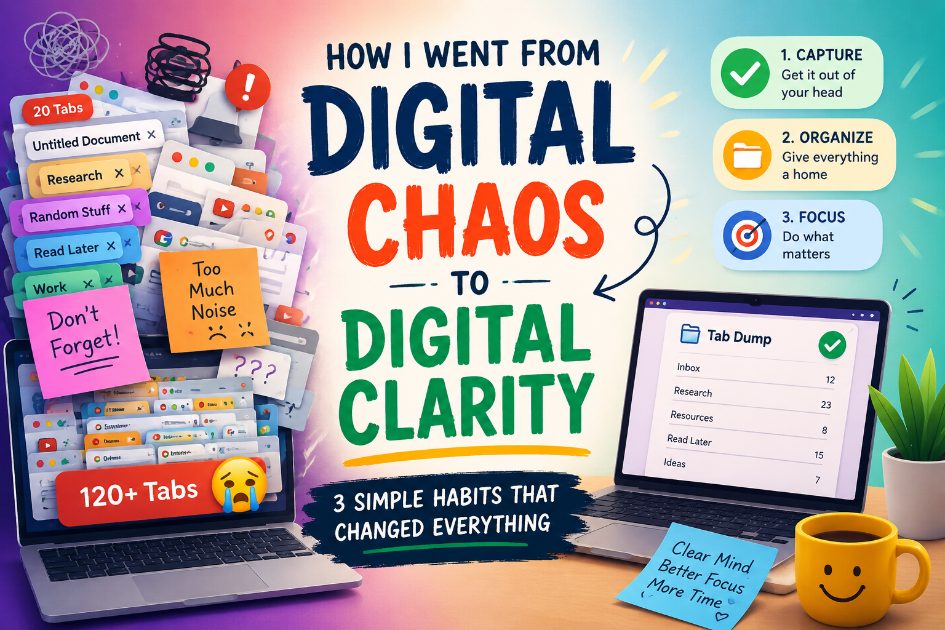
For a long time, I thought having dozens of browser tabs open meant I was being productive. Every tab represented something I wanted to read, learn, or finish later. But "later" rarely came. Instead, my browser became a digital storage room filled with articles, YouTube videos, documentation, and random ideas that I was afraid to lose.
Eventually, I realized the problem wasn't my memory—it was my habit of using browser tabs as bookmarks.
Every time I opened my laptop, I was greeted by a wall of unfinished work. Before I even started my actual task, I had already become distracted by everything waiting for my attention.
That was when I decided to change the way I managed information. These three simple habits completely changed my digital workflow.
Habit 1: The 1-Click Read Later System
The biggest mistake I made was believing that keeping a tab open meant I would eventually come back to it.
In reality, those tabs stayed open for days or even weeks without being touched.
Now, whenever I find an article, video, tutorial, or website I want to keep, I save it to a simple Notion Inbox with a single click. As soon as it's saved, I close the tab immediately.
This small habit keeps my browser clean while giving me confidence that I haven't lost anything important.
Instead of searching through dozens of open tabs, I know exactly where every saved resource lives.
Habit 2: The "Delete Tomorrow" Rule
One thing I noticed was that most of the links I saved were never actually useful.
Some looked interesting at the moment, but after a day or two they no longer mattered.
So I created a simple rule.
If a saved link isn't connected to a long-term project, I give myself one day to read it.
The next day, I make a decision.
Read it and remove it from my list.
Or delete it completely.
No "maybe later."
This rule keeps my reading list from becoming another collection of forgotten links. It also forces me to focus on information that actually adds value instead of collecting content I will never use.
Habit 3: Close Your Browser Every Night
This habit felt uncomfortable at first.
I used to leave every tab open because I worried I would forget something important.
Once I started saving everything into my system, I realized I didn't need to keep my browser open anymore.
Now, before I finish work each day, I close every single browser tab.
The next morning I open my browser and see one clean tab instead of fifty unfinished tasks waiting for me.
It sounds like a small change, but it completely changes how I start my day.
Instead of deciding which old tab deserves my attention, I begin with today's priorities.
That simple routine helps me focus faster and removes the mental clutter that used to follow me every morning.
What Changed?
These habits didn't magically make me more productive overnight.
What they did was remove hundreds of tiny decisions that were draining my attention every day.
Instead of asking myself:
"Where did I save that article?"
"Should I leave this tab open?"
"I'll read this later, right?"
I already had a system that answered those questions for me.
Today, my browser is a workspace—not a storage room.
Key Takeaways
Save useful links instead of leaving them open.
Review temporary links the next day.
Delete anything you no longer need.
Close every browser tab before ending your workday.
Start every morning with a clean browser and a clear mind.
Digital clutter builds slowly, but so do good habits.
I didn't realize how much time and mental energy I was spending managing browser tabs until I stopped depending on them. These three habits didn't just organize my browser—they made my workday calmer, simpler, and far more intentional.
"Most people use AI to write lazy emails. I reverse-engineer it to build surgical editing workflows. I write about the exact math, prompt architecture, and automation systems required to make AI do the boring parts of content creation so creators don't have to."