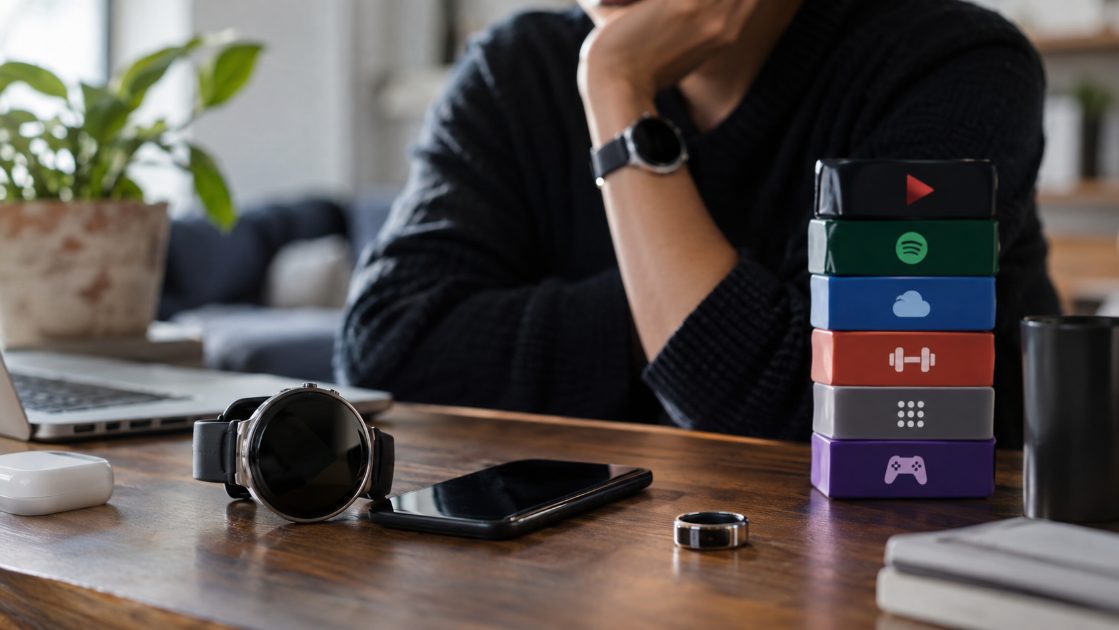
Buying a wearable used to be a fairly simple transaction. You paid for the device, charged it, paired it with your phone and started using it.
That relationship is becoming a little more complicated.
Many consumer wearables now combine hardware with software services that continue long after the initial purchase. A smartwatch or smart ring may track sleep, activity, heart rate and other measurements without much effort from the user, while deeper analysis, longer-term trends or other software features can be tied to a recurring membership.
For wearable companies, this can create a steady source of revenue. For consumers, it adds another question to the buying decision: how much is the device really going to cost over time?
That question matters because buying a wearable is only the first step. People also have to keep wearing it, keep using its app and keep believing that the information it provides is useful.
A 2019 systematic review of 463 studies on wearable activity trackers found that research around these devices already covered acceptance, adoption and abandonment, along with data, technology, behavior change and privacy.
As subscriptions become a bigger part of the consumer wearable business, the question of value could become just as important as the question of features.
Subscription Fatigue Isn't Just About Price
Subscription fatigue is not merely a complaint about rising costs. It represents a broader exhaustion with managing multiple recurring payments, forgetting what you are subscribed to and constantly having to evaluate whether a service is still worth keeping. Most importantly, it involves the frustration of feeling that a product you already purchased is somehow incomplete without an ongoing financial commitment.
While streaming media operates in a fundamentally different space than consumer wearables, it provides a highly relevant proxy for consumer behavior. According to Deloitte’s 2025 Digital Media Trends research, nearly half of consumers reported frustration with the sheer volume of their subscriptions, while 47% felt they were paying too much for the digital services they currently use.
The Subscription Is Small. The Subscription Stack Isn't.
The psychology of pricing plays a massive role here. A fee of $5 or $7 for one health service does not sound like a huge burden. Adding another $10 for a different app also seems manageable. However, consumers do not evaluate these costs in isolation. They evaluate their total monthly subscription stack. When a new wearable attempts to add itself to that stack, it faces an uphill psychological battle.
A Wearable Subscription Has One Big Difference
The fundamental issue for the wearables market is that a device subscription feels distinct from other digital services. A streaming platform sells ongoing, newly produced content. A wearable subscription, on the other hand, is firmly attached to a physical product that the consumer already owns.
You bought the hardware outright. It sits on your finger or your wrist and it gathers data directly from your own body. Because of this, the financial model inherently creates an ownership-versus-access tension. The physical hardware feels permanently owned, while the intelligence and analytics built around it feel temporarily rented.
"I Already Paid for the Device"
This dynamic triggers an obvious consumer reaction. If a user paid $300 upfront for a piece of hardware, they inevitably wonder why they need to pay a monthly fee to understand the very data it collected. Not every wearable company utilizes this model, but those that do must navigate a delicate balance. When a consumer feels they are being charged twice, once for the sensors and once to read what the sensors found, the perceived value of the entire ecosystem drops.
For Wearable Companies, the Subscription Makes Perfect Sense
To understand where the market is heading, we have to look at the business reality. From a corporate perspective, the subscription model is incredibly attractive and often necessary to sustain modern innovation.
Hardware sales are notoriously irregular. A customer might buy a smartwatch and hold onto it for three to four years, leaving the manufacturer with no ongoing income from that user. Subscriptions instantly solve this by converting a single transaction into predictable, recurring revenue. Furthermore, modern wearables rely heavily on continuous cloud infrastructure, artificial intelligence processing and ongoing software development. Analyzing massive physiological datasets requires expensive server maintenance and continuous engineering support. Finally, for companies answering to investors, a customer who continues paying $6 a month for several years represents a vastly higher lifetime value than a customer who simply buys the device once and never spends another dime.
Oura Shows Why the Model Is So Attractive
The financial power of this model is clearly visible in current market data. Health tech company Oura provides a prime example of why companies push for recurring revenue. According to Oura's 2026 S-1 SEC filing, the company's financials illustrate just how lucrative the shift to software can be.
Oura reported having roughly 5 million paid members by mid-2026, with an astounding 94% of device activations successfully converting to paid memberships. Additionally, the company maintained a 12-month weighted average member retention rate of approximately 85%. The most striking figure for investors, however, is profitability: Oura's membership gross margin sits at a staggering 89%.
These numbers explain exactly why wearable companies have a strong financial incentive to build recurring revenue into their products. However, a model that works perfectly on a corporate balance sheet still has to work psychologically for the customer.
The Real Battle Is Perceived Value
Ultimately, a subscription only survives if consumers can clearly see what they are receiving every month. A monthly fee becomes much easier to justify when it unlocks actionable, high-quality features. In the wearables space, this value typically comes from deeper sleep analysis, AI-generated readiness scores, personalized training recommendations and historical health trend tracking.
But there is a critical distinction to make: more data does not automatically equate to more perceived value. If a user wakes up feeling exhausted, an app charging them a monthly fee simply to confirm they slept poorly will quickly feel redundant.
More Data Doesn't Always Mean More Value
The broader academic literature on wearable technology heavily supports the idea that perceived usefulness dictates long-term adoption. A comprehensive 2024 ACM Computing Surveys paper reviewed 236 studies focusing specifically on the utility, privacy and security of wearable activity trackers. The research consistently points to a simple truth: if users do not understand how the extra information materially changes their daily behavior, adding another monthly payment becomes nearly impossible to justify.
The More Interesting Question Is What Happens After Cancellation
When discussing subscription fatigue, the conversation often stops at the point of cancellation. But the more interesting question for the wearable market is what actually remains once a user stops paying.
Depending on the specific device, a canceled subscription can lead to vastly different user experiences. Some platforms allow users to retain access to basic health metrics, daily tracking and core hardware functionality. Others strip away nearly all historical data and restrict the app to bare-bones functionality. A subscription model becomes incredibly hard to accept when consumers fear that cancellation will instantly turn an expensive piece of hardware into a severely downgraded, less useful version of itself.
The Bigger Risk Isn't Cancellation. It's Not Buying in the First Place
While churn rates matter, the more pressing risk of subscription fatigue is its impact on initial adoption. We cannot solely focus on existing users deciding to cancel. We must consider the consumer who is debating buying their very first advanced health wearable.
If a buyer looks at the market and sees that the total cost equals the price of the device plus a mandatory subscription over a three-year replacement cycle, their purchasing calculation fundamentally changes.
The Price on the Box Isn't Always the Real Price
The concept of total cost of ownership is taking root in the consumer mindset. A $300 wearable with a $6 monthly subscription is not actually a $300 product for someone intending to use its premium insights for three years. It is a $500 product disguised by a lower entry fee. When consumers factor in that long-term reality, they often pause.
Cost Was Already a Problem Before Subscription Fatigue
It is vital to remember that these subscription costs are not being introduced into a frictionless market. A 2025 systematic review in Frontiers in Medicine examining barriers to wearable technology adoption identified cost, long-term sustainability and accessibility as primary hurdles.
The review specifically noted that commercial wearables are often perceived as prohibitively expensive when users factor in continuous updates, replacement parts and mandatory subscriptions. Users already have to deal with hardware degradation, battery life limits, privacy concerns and general usability issues. Adding another recurring financial burden simply introduces one more potent reason to hesitate.
A Wearable Doesn't Help If It Ends Up in a Drawer
Beyond cost, the wearables market continues to battle its oldest enemy: abandonment. A person can purchase an incredibly sophisticated device packed with accurate sensors, wear it diligently for a few months and then simply stop putting it on.
People abandon their wearables for a multitude of reasons, ranging from physical discomfort and annoying charging requirements to data overload and a lack of genuinely useful insights. A major 2019 Journal of Biomedical Informatics systematic review analyzed 463 independent studies and identified device abandonment and long-term adoption as some of the most critical themes in health technology.
From an investment standpoint, the subscription problem amplifies this issue. If a user loses interest and stops wearing the device, the recurring fee attached to it becomes the very first thing they cancel. The hardware's limited engagement lifespan makes securing long-term subscription revenue highly volatile.
Not Every Wearable Will Feel the Same Subscription Pressure
Subscription fatigue will not impact all segments of the wearable market equally. The market is fragmented and consumer expectations vary wildly depending on the form factor.
For smartwatches, users are somewhat conditioned to expect app ecosystems, seamless cloud syncing and continuous software updates, making some recurring models slightly more palatable. Fitness trackers, on the other hand, face immense pressure from cheap, highly capable alternatives that charge nothing beyond the initial purchase. Smart rings present a particularly interesting battleground. Because they are marketed primarily as continuous, passive health monitors, the debate between Subscription vs Subscription-Free Smart Rings heavily dictates consumer choice in that specific vertical.
AI Might Make Wearables More Useful and More Expensive
Artificial intelligence is rapidly shifting the value proposition of wearables. Devices are moving away from simply stating, "Here are your numbers," toward actively suggesting, "Here is what your numbers mean for your day." Modern AI models can correlate sleep depth, heart rate variability, training load and nutrition to offer highly personalized, predictive coaching.
However, AI integration brings massive ongoing computational costs. Hardware sensors collect the raw physiological data, but complex AI processing is required to turn that data into a cohesive narrative. This reality gives companies a legitimate operational reason to charge for software, but it simultaneously forces consumers to decide if they are willing to pay a monthly AI tax for a device they already bought.
"Why Can't I Just Buy the Data?"
As the subscription stack grows, consumers will likely begin pushing back, asking a fundamental question: "Why can't I pay once and own the software?"
The market is already splintering into different business models to address this tension. Some companies strictly sell the hardware, providing all core tracking features without any recurring fees. Others offer a hybrid model where the hardware and basic tracking are un-gated, but premium coaching insights require a subscription. A third model heavily subsidizes the hardware upfront but effectively renders the device useless without an ongoing membership. Finally, some brands are experimenting with larger upfront lifetime purchases, granting permanent access to all software features. While no single model has achieved total dominance, each fundamentally alters the long-term relationship between the brand and the buyer.
The Answer May Not Be "No Subscription"
Ultimately, the solution to subscription fatigue is not necessarily the complete elimination of subscriptions. Recurring revenue is likely here to stay. The bigger issue is ensuring the payment continually feels justified.
A subscription becomes acceptable when the physical device remains inherently useful even without it, when the premium features are clearly distinct from basic tracking and when pricing remains predictable. If the service legitimately saves the user time, effort or money and the insights actually lead to positive behavioral changes, consumers will pay.
For Investors, Recurring Revenue Isn't the Whole Story
For data-driven investors evaluating the wearable sector, seeing a subscription tier on a company's product page is no longer enough to guarantee long-term health. The metrics that define success require deeper scrutiny.
Investors must evaluate the true customer acquisition cost compared to hardware margins. They need to monitor what percentage of device buyers actually convert to paying subscribers and more importantly, how many of those subscribers are retained past the critical 12- and 24-month marks. Churn rates reveal the reality of perceived value, while hardware replacement cycles indicate true brand loyalty. Ultimately, investors must determine if the subscription model meaningfully increases the lifetime value of the customer or if it simply alienates potential buyers and restricts overall market growth.
The Most Important Number May Be "Value Per Month"
While it is not a traditional accounting term, the most important metric moving forward might simply be "value per month." The core question defining the future of wearable tech is whether the customer feels that the product gives them more actionable, tangible value each month than the subscription costs them.
If the answer is yes, the subscription seamlessly integrates into the product experience. If the answer is no, it immediately becomes just another annoying bill to manage. That shift in perception is precisely where subscription fatigue transforms from a minor consumer complaint into a serious, structural business problem.
The Wearable Can't Become Another Subscription We Forget About
A consumer wearable is profoundly different from a streaming platform because it physically sits on the user's body every single day. A consumer can cancel a media service and simply switch to another network to watch a show. But if they invest $300 into a smart ring or a high-end health watch, they have made a deliberate physical and financial commitment.
Because of this inherent friction, the attached subscription has to justify itself on an entirely different level. The future of wearable recurring revenue will not depend on how many features companies can successfully lock behind a paywall. It will depend entirely on whether users can look at their monthly credit card statement, see the recurring charge and still feel completely confident that the device on their wrist is worth having.
Frequently Asked Questions
What is subscription fatigue and how does it affect wearables?
Subscription fatigue represents exhaustion with managing multiple recurring payments and evaluating whether services are still worth keeping. For wearables, it's particularly problematic because consumers feel their already-purchased hardware is incomplete without ongoing financial commitments, making them question the true total cost of ownership.
Why are wearable companies adding subscription services to their products?
Subscription services create a steady source of recurring revenue for wearable companies beyond the initial hardware purchase. These subscriptions typically unlock deeper analysis, longer-term trend tracking, and additional software features beyond basic functionality like sleep and activity tracking.
How does subscription fatigue differ between wearables and streaming services?
While streaming services sell newly produced content that justifies ongoing payments, wearable subscriptions attach to physical hardware consumers already own, making the recurring fee feel like an incomplete product rather than a new service. This makes consumers more frustrated about wearable subscriptions compared to other digital services.
What percentage of consumers report frustration with their subscription costs?
According to Deloitte's 2025 Digital Media Trends research, nearly half of consumers reported frustration with the volume of their subscriptions, while 47% felt they were paying too much for their digital services.
Does the price of individual wearable subscriptions matter as much as the total subscription stack?
No—while a $5-7 wearable subscription may seem reasonable in isolation, consumers evaluate their total monthly subscription costs together. A new wearable subscription faces an uphill psychological battle when added to consumers' existing subscription stack of multiple services.
What factors influence whether people continue using their wearables?
According to research reviewed in a 2019 systematic study, wearable adoption depends on acceptance, ongoing use of the device and its app, belief in the usefulness of the information provided, and data privacy concerns, all of which affect long-term retention.

I am a technical writer and technology enthusiast focused on making complex innovations easy to understand. I write about Artificial Intelligence, consumer technology, developer tools, software engineering and the future of digital products. My work explores how AI is transforming everyday devices, modern software development and the way people interact with technology. Through practical insights, research-driven analysis and real-world examples, I aim to help developers, tech professionals and curious readers stay ahead in a rapidly evolving technology landscape.