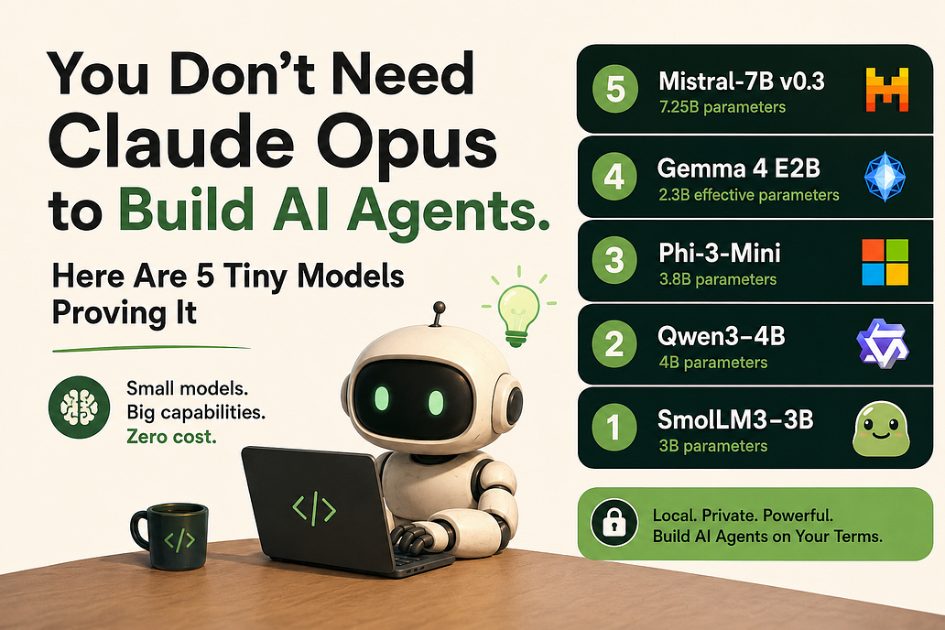
You Don’t Need Claude Opus to Build AI Agents. Here Are 5 Tiny Models Proving It

Big isn’t always better.
Everyone told you the same thing, and everyone is lying.
“You need the best model.”
“Use Claude Opus; it’s the best.”
“Don’t cut corners on AI.”
You heard it daily, don’t you?
So you also started to buy the subscription. You dealt with the latency. You watched the API bills grow day after day.
Basically, you built your AI agent on top of a cloud-based giant and told yourself it was worth it.
But what if I told you that some local models with 2 billion parameters can now call tools, run workflows, and help to build an AI agent?
It’s local, so it costs you ZERO.
The Quiet Revolution You Missed
Nowadays, everyone is obsessed with Claude, GPT-5, and Gemini Ultra; they forget to see what is happening in the background.
Small open-weight models learned one of the most important skills of agentic AI, i.e., tool calling.
Tool calling sounds like something important that only big models are capable of, right?
It’s not.
It simply means that AI can look at your request, choose which function to run, and fill in which inputs to get the result.
This makes AI feel like an agent rather than a chatbot.
Before choosing the big models, just try these 5 small models and see what they are capable of doing.
5. Mistral-7B v0.3
With 7.25 billion parameters. Released in May 2024.
If you are looking for the safest model, choose this one.
I have been using Mistral-7B for almost a year, and it’s actually good.
It’s the recent version 0.3 that added function calling through dedicated tokens — they are TOOL_CALLS, AVAILABLE_TOOLS, and TOOL_RESULTS.
You can run it via Ollama or vLLM. Right now, it has a 32K context window.
You just went through the biggest model in this list, but it’s still small enough to run locally with a decent GPU.
4. Gemma 4 E2B
With 2.3B effective parameters. Released April 2026.
This one is genuinely crazy.
With 2.3 billion effective parameters, you can run this under 1.5 GB of memory with quantization.
It can also handle text, images, audio (up to 30 seconds), and video. Also supports 35+ languages natively.
This model uses a new architectural trick called Per-Layer Embeddings (PLE) that lets the model work far beyond its actual size.
The good part here is that it can run on IoT devices. It can run on mobile.
It does native function calling for your agentic AI workflows.
For edge AI, this is the most exciting model on this entire list.
3. Phi-3-Mini
With 3.8 billion parameters. Released April 2024.
When Phi-3-Mini launched, people didn’t believe the benchmark scores.
This model was competing with GPT-3.5 on math and logic tasks.
Similar to Gemma 4 E2B, it is built to run on devices, including smartphones.
There is one thing that I hate: it’s coming up with a 4k context window.
One more thing: it’s the oldest model in my list too.
It’s MIT-licensed so that you can use it commercially.
2. Qwen3–4B
With 4 billion parameters. Updated August 2025.
The one that shocked many developers.
It supports tool calling and handles 100+ languages. Has a context window of 262,000 tokens — that’s roughly 200,000 words in one prompt.
There is no chain of thought, no slow thinking loops. You ask, it answers, and it calls the tool. As fast as you think.
If you are building customer support bots or something like tool-heavy agents where speed matters more than deep reasoning, make sure to try this model.
1. SmolLM3–3B
With 3 billion parameters. Released July 2025.
It was trained on over 11 trillion tokens, which is more than most humans could read in a thousand lifetimes.
It supports 6 languages and has a 64K context window.
The best part here is that you can switch between “thinking mode” and “fast answer mode” depending on what you need.
For tool calling, it gives you two options:
JSON-style calls
Python-style function calls.
Pick what fits your pipeline.
This model is completely open-source, which means the weights, the datasets, and the training code — everything — is available to study. You can even modify it according to your own needs.
What Does This Mean for You?
It means the excuse is gone.
You no longer need an expensive API subscription.
You no longer need a GPU to build something real.
You can run these models locally, fine-tune them on your own data, and ship products without worrying about rate limits or privacy.
Frequently Asked Questions
Do I really need Claude Opus to build an AI agent?
No, you don't need Claude Opus or other large models. Small open-weight models with as few as 2 billion parameters can now perform tool calling and build effective AI agents locally at zero cost.
What is tool calling in AI agents?
Tool calling means an AI can understand your request, choose which function to run, and fill in the necessary inputs to get results. This capability makes AI behave like an agent rather than just a chatbot.
What are the best small AI models for building agents?
The article highlights five models worth trying: Mistral-7B v0.3, Gemma 4 E2B, Phi-3-Mini, Qwen3-4B, and one unnamed model. These range from 2.3 to 7.25 billion parameters and all support tool calling.
Can small AI models run on mobile or edge devices?
Yes, models like Gemma 4 E2B and Phi-3-Mini are specifically designed to run on IoT devices and smartphones, making them ideal for edge AI applications.
How much GPU memory do small models require?
Gemma 4 E2B with 2.3 billion effective parameters can run under 1.5 GB of memory with quantization, while Mistral-7B requires a decent GPU but can still run locally.
Can I use small open-weight models commercially?
Yes, some models like Phi-3-Mini are MIT-licensed, allowing commercial use. You should check the specific license of whichever model you choose.
What's the advantage of small models over large cloud-based ones?
Small models run locally for zero cost, eliminate latency issues, and avoid growing API bills associated with cloud-based giants like Claude Opus while still supporting tool calling for agentic AI.
Hi, I'm Suraj Jha, a 22-year-old writer passionate about Data, SEO, and Self-Improvement, exploring the intersections of tech and personal growth.