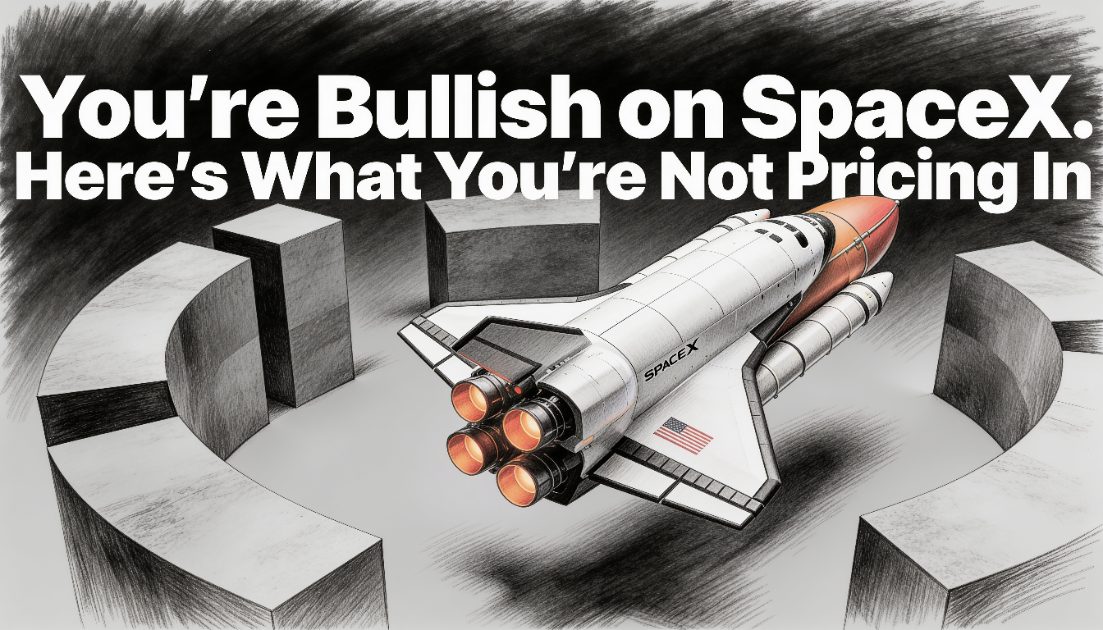
Markets have gotten very good at shrugging off catastrophe. That skill is quietly turning into a liability.
Every valuation is a story about the future wearing a number as a disguise. When you buy into the SpaceX thesis, you are buying a particular story. Launch costs keep falling. Starlink becomes the connective tissue of the planet. The company graduates from rockets into infrastructure the way Amazon graduated from selling books into selling everything. It is a good story, and the numbers that dress it up are plausible. Analysts at large banks keep publishing bullish notes. Institutional money keeps arriving.
But there is a variable in that story almost nobody models, because it refuses to sit politely inside a discounted cash flow. It is the possibility that someone, deliberately, decides to break the satellites.
Last week the Financial Times columnist Gillian Tett pointed at a piece of reporting that most investors filed under interesting but not actionable. A yearlong investigation by Der Spiegel, Insider, and Le Monde described a discreet working group of Russian and Chinese officials meeting repeatedly to develop ways to disable American satellites, Starlink included. None of the three governments have confirmed it. It may be exaggerated. It may be theater. But it rhymes with earlier assessments from British and American analysts, and the logic behind it is not science fiction. If your adversary depends on a constellation of low orbit satellites for battlefield communications, the satellites become a target. That is not a plot. That is just strategy.
The uncomfortable part is not the espionage. It is what the story reveals about how markets now digest danger. Because the honest reaction of most investors to this news was not fear. It was a shrug.
The shrug is the strategy
For most of financial history, tail risk moved prices. A rumor of war, a bank run, a missile test, and portfolios repriced by lunchtime. Fear was the reflex. Today the reflex has changed. Investors read about a plan to weaponize orbit and calmly keep buying the single stock most exposed to it.
Tett gives this instinct a name: investor fatalism. The label is precise. It is not that investors fail to see the risks. It is that they have concluded, somewhere below the level of speech, that worrying does not pay.
Look at the record that trained them. In under two decades, markets have swallowed the 2008 financial crisis, a global pandemic, a full invasion of Ukraine, a tariff regime that rewrote global trade, and an American strike on Iran. Every one of those events arrived dressed as the end of the world. Every time, the investor who sold in a panic did worse than the investor who did nothing at all. Markets did not merely survive. They compounded. Live through enough disasters and you stop respecting them.
Nouriel Roubini, an economist nobody has ever accused of cheerfulness, noted that oil shocks are no longer so shocking. He has a point. The machinery of the global economy really has grown more resilient. Demand adjusts, stockpiles cushion the blow, supply finds new routes. So the fatalism is not pure delusion. It is pattern recognition. And that is precisely what makes it treacherous, because pattern recognition works beautifully until the pattern breaks.
The bug zapper
There is a second force under the shrug, and it is more embarrassing to say out loud. It is fear of missing out, wearing an institutional suit.
Michael Cembalest of JPMorgan described the fate of investors who avoided American tech over the past decade as a kind of bug zapper. Step away from the light and you are punished by underperformance severe enough to end a career. The fund manager who sat out the handful of giant tech names did not receive a medal for prudence. He received redemptions and a tense meeting with his investment committee. So the rational move, measured at the level of one person's career, is to keep buying whatever is rising and to treat geopolitical tail risk as a problem for another department.
Here is the counterintuitive knot at the center of it. The behavior that looks like greed is actually a defensive crouch. Nobody is loading up on SpaceX exposure because they have carefully concluded that Russia and China will behave themselves in orbit. They are loading up because the cost of being wrong and out is vivid and immediate, while the cost of being wrong is abstract and shared. When everyone is exposed to the same catastrophe, no single manager gets blamed for it. Ruin, spread widely enough, stops feeling like risk and starts feeling like weather.
You are pricing the wrong risk
Notice what the skittish investors actually worry about. The ones who have trimmed their SpaceX enthusiasm lately are mostly nervous that the gargantuan capital spending will not be matched by future revenue. That is a financial worry, a spreadsheet worry, a will the money come back worry. It is a perfectly reasonable question. It is also not the question the satellite story is asking.
The bull case does not leave out risk. It leaves out a specific category of risk, and then quietly reclassifies it from priceable to unthinkable. Unthinkable risks are the most dangerous kind, because they do not show up in the price at all. A risk you argue about at least gets a number. A risk you refuse to contemplate gets a zero.
Starlink is a useful example precisely because it is not a toy. Mykhailo Fedorov, until recently Ukraine's defense minister, called it the lifeblood of his country's wartime communications. Satellites quietly underpin navigation, payments, shipping, and the timing signals that financial markets themselves depend on to function. We got a faint preview of how fragile this is back in 1962, when a single high altitude American nuclear test damaged satellites that merely happened to be in the neighborhood. The infrastructure is far more critical today, and in some ways far more exposed.
The venture firm Andreessen Horowitz, not a house known for gloom, told investors bluntly that orbits are now battlefields. You can read that as marketing for their defense portfolio, or you can read it as a group with real money at stake saying the quiet part in public. Either way, it is a peculiar situation when the venture capitalists are more willing to name the danger than the people building the equity model.
Why the calm might be justified, and still wrong
To be fair to the fatalists, they have a real argument, and it deserves to be stated at its strongest. Many investors who do know about the threat assume it is neutralized by mutually assured destruction. So the reasoning goes: nobody will actually pull the trigger, because everybody loses.
That logic is comforting and possibly correct. But mutually assured destruction only holds when both sides value what they would lose about equally, and when both sides happen to be behaving rationally on the same afternoon. Neither condition is guaranteed. Deterrence is a psychological state, not a law of physics, and psychological states have a habit of failing at the worst possible moment.
Tett closes her column with a metaphor worth stealing. Most investing runs on Newtonian physics. Draw a straight line from the past, extend it into the future, adjust for a few known forces. It works gorgeously right up until it does not. She points instead to a speech by Ravi Menon, a former top Singaporean regulator, who argues that geoeconomics behaves more like quantum mechanics. Contradictory conditions coexist. Distant events turn out to be entangled. Uncertainty is not a flaw to be engineered away. It is the fabric of the thing.
Applied to your position, the lesson is not sell. That would just be straight line thinking pointed downhill. The lesson is that a valuation which silently assumes a peaceful orbit where treaties hold is placing a bet, not running a calculation. The bet may well pay. But you should at least know that you are making it.
The footnote that becomes the headline
A warning sign appears, nothing bad follows, so the warning gets downgraded to background noise. Repeat until the thing everybody tolerated becomes the thing that ends the mission. That is how the Space Shuttle Challenger was lost. It is also, arguably, how most portfolios that blow up actually blow up. Not because the risk was hidden, but because it stayed visible for so long without consequence that it stopped registering as a risk at all.
The reported Russian and Chinese working group is said to be meeting again later this year, in St Petersburg. Today it reads like a footnote. It will keep reading like a footnote right up until the afternoon it does not. That is the honest nature of the trade you are in.
None of this is a case for abandoning the bull thesis. Resilience is genuine. The economy really does absorb shocks better than the permanent doom crowd will ever admit, and staying frightened forever is a well documented way to underperform for decades. But there is a difference between resilience and amnesia, and the gap between the two is exactly where the next surprise likes to live.
The bulls are not wrong to be calm. They are wrong about why they are calm. And in markets, being right for the wrong reason is simply a loss that has not shown up yet.
Finance is a thinking sport. Investing, markets, and the mental models behind the money & economics.