
Reprogramming our Genetics (GNR part 2)
As a fellow believer of the acceleration of technology and fanboy of esteemed futurist Ray Kurzweil, I will be writing a 4-part series on his predictions on GNR (Genetics, Nanotechnology, and Robotics) and how they stand today. This is part 2 of 4, enjoy!
GNR Part 1 (Link & Intro):
Intro to GNR (Genetics, Nanotechnology, and Robotics):
3 Technological Revolutions that will Accelerate Us Into the Future
This transcendence into the future will be powered by 3 technological revolutions grouped by 1 acronym, GNR.
medium.com
The singularity is near! We are getting closer to the time when our biology will become outdated and we will transcend into the next stage of evolution. This transcendence into the future will be powered by 3 technological revolutions grouped by 1 acronym, GNR. Ray Kurzweil believes GNR will be a set of overlapping revolutions that will define the future of the human race.
GNR Part 2 (Full Article):
“Every time you understand something, religion becomes less likely. Only with the discovery of the double helix and the ensuing genetic revolution have we had grounds for thinking that the powers held traditionally to be the exclusive property of the gods might one day be ours.” ― James D. Watson
We are in the fragile beginnings of the genetic revolution, in which we will reprogram our own biology. Reprogramming ourselves at the molecular level is a large complex problem that starts at a small place, DNA(Deoxyribose Nucleic Acid). DNA is considered to be the blueprint of life, the instruction manual for our cells that stores all the information of our heredity.
As we are beginning to understand the information process underlying life, we are starting to learn how to alter DNA. This will help us:
- Reverse Degenerative Disease
- Overcome Cancer
- Reverse Aging
- Enable Human Cloning
- Solve World Hunger
Every day in biotech, new knowledge is discovered which promotes more advancements. A win in this field is a win for all of humanity.
Genome Sequencing, Analyzing our 3 Billion Reasons
 Provided by Getty Images[/caption]
Genome sequencing is a low-level (micro) analysis of DNA. DNA is comprised of 4 chemical building blocks, A, C, G, and T, that are called the bases. The human genome (the entire set of genes in an organism) is comprised of 3 billion base pairs which constitute the rules of creating and maintaining a human being. Genome sequencing can allow researchers to determine how DNA building blocks can be paired to get a particular output. When we get to a point that we understand how to rearrange these pairs in any way we want, we could reset, the preset instructions that make us human.
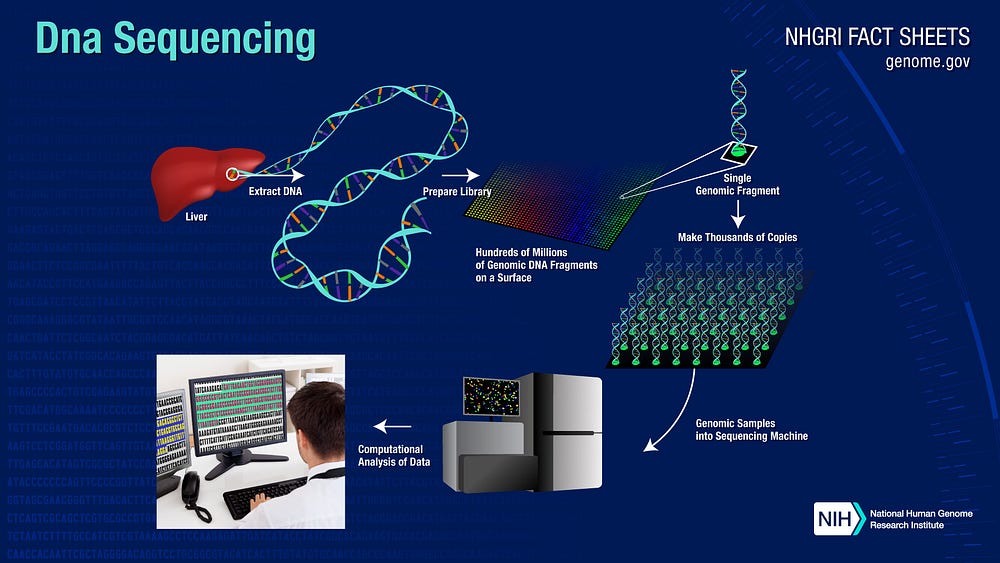 https://www.genome.gov/about-genomics/fact-sheets/DNA-Sequencing-Fact-Sheet[/caption]
Breakthroughs in genome sequencing can speed the process in which we find cures to a genetic disease or even press pause on the effects of aging. One of the leading companies in this space is Illumina. Illumina utilizes powerful gene sequencing tools, that enable researchers to explore DNA at an entirely new scale. The progress they have made is astonishing. In 2006, their DNA sequence tool could sequence one human genome for about $300,000, by 2017 they could do that for only $1,000.
According to Fior Markets, the biotech market is expected to grow to nearly 900 billion by 2027.
Other top dogs in this space are:
- Thermo Fisher Scientific, a world leader in serving science, with annual revenue exceeding $25 billion.
- BGI Genomics, a company aiming to bring down the cost of genome sequencing to $100.
- Agilent Technologies, provides laboratories worldwide with instruments, services, consumables, applications, and expertise, enabling customers to gain the insights they seek.
I mean we could on and on but you get it, this space is blowing up.
The field of biotech is already immense and we will see a lot more expansion this decade as achievements in gene sequencing will be utilized through gene editing.
Gene Editing, Rearranging those 3 Billion Reasons
Gene editing is the precise manipulation of DNA. Using an array of technologies, scientists can add, remove, or alter the 3 billion base pairs within an organism’s genome. In the 1970s, gene editing finally took off. Molecular biologist Hamilton Smith from Johns Hopkins University School of Medicine utilized the process of gene engineering to purify enzymes in bacteria. Enzymes are chemicals in plants and animals that hasten biochemical reactions by building or breaking down other molecules.
Discoveries in the 1990s would prove gene editing to be necessary. However, it wasn’t until 2017 that the FDA approved the first gene therapy experiment. They approved Kymriah (tisagenlecleucel), a genetically modified immunotherapy, for certain pediatric and young adult patients with a form of acute lymphoblastic leukemia (ALL). So far, FDA has only approved gene-editing for rare cased diseases but we’re getting close to commercialization with more common disorders. Several gene-editing technologies have been developed but one is taking the world by storm, CRISPR.
CRISPR-Cas9 (you don’t even want me to start), a biotechnologist’s dream and law maker’s nightmare, is where we start to see exponential growth in the field of genetics. CRISPR technology is a powerful tool that is a specialized extension of DNA that acts as a pair of molecular scissors that can cut strands of DNA. CRISPR has taken some time to be publically adopted but we have finally reached organizational acceptance.
In 2020 2 researchers, Emmanuelle Charpentier, Director at the Max Planck Institute for Infection Biology in Berlin, and Jennifer Doudna, a director at the Doudna Lab won the Nobel Prize in Chemistry for their groundbreaking CRISPR gene-editing tool. They are recognized as the first to propose that CRISPR could be used to cut any desired DNA sequence. A solution to modify base pairs of DNA.
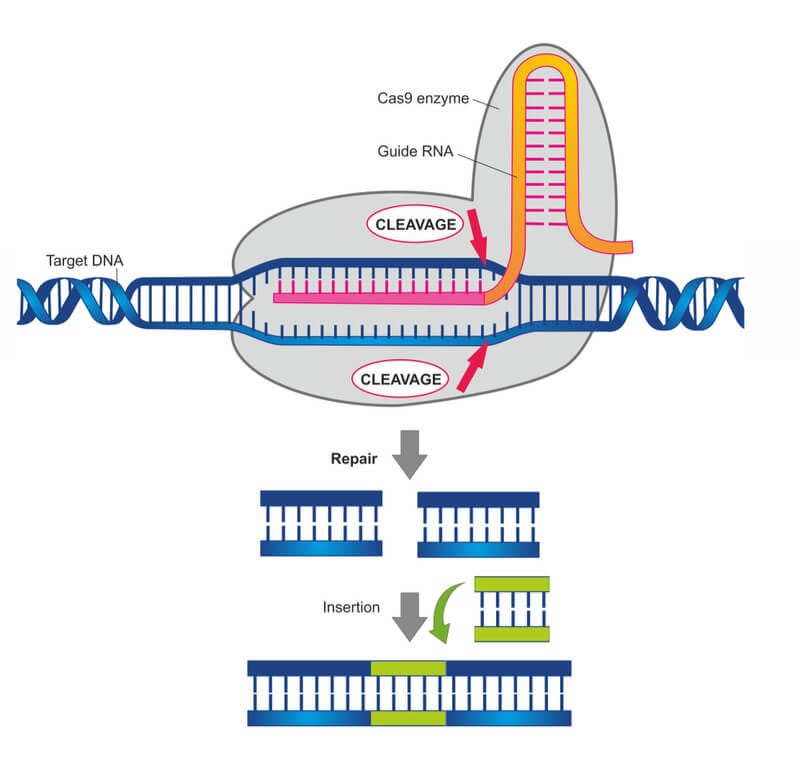 https://www.labiotech.eu/in-depth/crispr-cas9-review-gene-editing-tool/[/caption]
There are other DNA editing tools like TALEN and ZFN, but neither has shown to be as efficient as CRISPR. In theory, CRISPR could be used to modify virtually any type of DNA. Just this month, researchers from Rice University unveiled a new CRISPER tool that can target the histones in our genome, the proteins that keep our DNA in order. This could lead to new therapies for cancer and other diseases. Yet we still haven’t really seen the potential impact that tools like CRISPR can make on common diseases in the public.
The practice of genome editing has gone under a lot of scrutinies in medical practice, but from the mix of accomplishments in the space & resources allocated to study viruses due to the pandemic, we may start to see a lot more approval for this practice in clinics. This milestone in biotechnology could be what takes into the age of personalized medicine.
The Next Step in Biotech
Complications of treatment with medicine are that it’s not a one-for-all solution. We are all uniquely made creatures, even if just by 1 little teensy weensy difference.
Imagine trying to find a solution for 7.6 billion people that each has 3 billion possible combinations of DNA.
That’s where Personalized Medicine comes in.
Personalized medicine is the tailoring of medical treatment to the individual characteristics of each patient. We have witnessed this as doctors use gene therapies to treat specific types of breast cancer cells. That’s why I still believe we are in the early stages of genetics. If genetic engineering was a person, it would be a teenager starting to undertake puberty.
2 mind-blowing developments I’ve seen that provide hope in the field of genetic engineering are:
- Todd Rider an MIT-trained bioengineer that had developed (in the first half of last decade) a radical idea for killing viruses with his gene therapy named DRACO. It died from the lack of funding but apparently was able to kill 15 human viruses and 2 in mice. BRING BACK DRACO!
- A group of people that we’re given an assortment of drugs for a year aged backward. Their epigenetic clock was extended by at least 2.5 years through bio-hacking.
We’re seeing the developments all around us. The speed at which Moderna and Pfizer were able to develop vaccines for COVID-19 shows how far we have gone. It’s not too crazy to think that the limited length of our mortality could be solved.
Can We Really Live Forever?
[caption id="attachment_24503" align="aligncenter" width="497"] https://chrisherd.medium.com/why-immortality-is-already-within-our-grasp-and-how-we-could-achieve-it-853984fce530[/caption]
Theoretically, it seems possible. We know how to change our genome, the system of instructions that gives us our existence in the unique way we are assembled. Couldn’t we just keep refining that system till we end aging? At least for a much longer time than we can now?
Serial Entrepreneur, Cannafacturer CEO, and lifelong friend Jackson Jesionowksi is one of the many people I know working to fight off the grim reaper. He’s even built a whole doctrine around it called Existim, a community dedicated to the persistence and expansion of consciousness.
And he is not alone.
There is a substantial movement of very wealthy people investing in companies dedicated to combating mortality such as Jeff Bezos (CEO of Amazon), Peter Theil (Co-Founder of PayPal), Larry Ellison (Co-Founder of Oracle), etc. Some of the top anti-aging companies in the US are:
- Agenus
- Frequency Therapeutics
- Geron
- Athersys
- Unity Biotechnology
- Lineage Cell Therapeutics
- CohBar
- Proteostasis
We expect to see the market exceed 100 billion late this decade.
Scientist & anti-aging pioneer Aubrey de Grey explains this out very well by using the metaphor of maintaining a house,
“How long does a house last? The answer obviously depends on how well you take care of it. If you do nothing, the roof will spring a leak before long, water and the elements will invade, and eventually, the house disintegrate. If you proactively take care of the structure, repair all damage, confront all dangers, and rebuild or renovate parts from time to time using new materials, the life of the house can be extended without limit.”
If we treat our body and brain like Dr.Grey talks about the house, then it is possible!
A few methods futurist believe life extension of this magnitude will be possible by 2050 through:
- Renewing body parts with 3D printers that can print yourself better than your parents did at birth.
- Preserving your consciousness, robotically.
- Or upload yourself to VR/AR.
Either way, the biotech revolution or transcendence of biology by the birth of super-intelligence will introduce us to the light of immortality.
The pace of innovation in genetics has grown dramatically this past decade. Unfortunately, some believe no matter how much we fine-tune our lives we will always be “second-class robots.” Begging the question, will progress in genetics be inconsequential once nanotechnology steps in and becomes commercialized?
Find out in part 3 of 4 of the GNR series, where we will demystify Nanotechnology. Infinitesimally small robots that will allow us to manipulate matter at the molecular level.
If you have reached this far, could you please? take this quick 5-second survey on how I can make my writing better for you in the future! (Link Here)

Andrew was born in Kenya and moved to the US when he was 3. He graduated in the class of 2020 from the University of Arizona with a B.S. in Systems Engineering and a minor in ECE (Electrical & Computer Engineering). His entrepreneurial endeavors began senior year of college when he and some classmates founded Facade Technologies to sponsor their own Senior Design Project. They built a desktop application named Facile that can compile APIs to automate other applications. Right now, he is the CTO of Sencha Credit, an early stage fintech company, where they are working hard to develop the debit card that builds credit. Their mission is to empower everyone to build credit effortlessly and reach new financial heights! He loves to share his enthusiasm for the acceleration of technology on his blog, as he encourages entrepreneurship while exhibiting his passion for deeptech. Andrew understands that the speed of innovation is exponential, but he’s worried it takes too long for organizations to utilize new innovation, so his mission is to teach & demystify the complexity of deeptech to everyone. “Humans beings are evolving. Some believe we’re transcending into a new paradigm of evolution, and I want people to embrace that future.”