
I Become President For A Day To Apply Modern Monetary Theory (MMT) To The US Economy
Politicians and academics are making dramatic claims about MMT. I apply it to the 2018 US economy and learn that debt isn’t always debt.
Modern Monetary Theory (MMT) sounds dull and morose, but it’s creating quite a stir:- Warren Mosler, a leading MMT thinker, apparently fills stadia in Italy. (Well, definitely meeting halls!)
- Professor Stephanie Kelton, an MMT evangelist, was mobbed in Japan.
- Alexandria Ocasio-Cortez (NY Rep), who justifies policy using MMT, is the centre of controversy.
 The Whitehouse (Will Murphy © 2014)[/caption]
Rather than bore you with a mash-up of MMT musings, I thought I’d get radical. The best way to understand theory is to apply it, so I became a fake US President (FakePrez) for a day. As FakePrez, I tried to understand how MMT would have worked on the 2018 US Economy.
I learned that debt isn’t always debt, and that big government isn’t really that big. Did MMT work for me?
Read on.
The Whitehouse (Will Murphy © 2014)[/caption]
Rather than bore you with a mash-up of MMT musings, I thought I’d get radical. The best way to understand theory is to apply it, so I became a fake US President (FakePrez) for a day. As FakePrez, I tried to understand how MMT would have worked on the 2018 US Economy.
I learned that debt isn’t always debt, and that big government isn’t really that big. Did MMT work for me?
Read on.
I need to get my head around MMT
A crisis in Italy inspired Warren Mosler. He was a Wall Street trader when Italy got into financial trouble in the 1990s. The accepted wisdom was that Italy would default on its loans. Mosler disagreed, because Italy controlled its currency, and bet big. Italy did not default, and Mosler made US$100 million. He published a paper in 1993, “Soft Currency Economics”, expounding the idea that a government with a monopoly on a fiat currency cannot run out of money. It is just a number on a computer, and if you need more, change the number. Why do we use fiat currencies? Because the world economy is too big to be constrained by something physical, such as gold or silver. In 2017, the purchasing power of the world economy was US$127.8 trillion according to the CIA World Fact-book. All the gold ever minted is worth about US$7.5tr. Let that sink in. The number on the computer is the truth, not physical notes or coins. Understand that and MMT makes more sense. If a government wants to inject money into an economy, it edits a database record and starts spending. (It feels like cheating!) If the government wants to slow the economy, it raises taxes (not interest rates) and removes money. A government with fiat currency superpowers can theoretically do amazing things:- Clear a national debt in a single bound (if it’s in its own currency).
- Pay everyone who needs it a living wage. No one will be left behind.
- Build new national infrastructure to meet, say, a Green agenda.
I need to understand the US economy.
As FakePrez working on imaginary policies, I should understand the American economy. After some thought, I decided to balance the US’s liabilities and its income streams. Economists often compare national debt with GDP, so I’ll do that. I’m going to use waterfall diagrams, each with increasing granularity. [caption id="attachment_16974" align="aligncenter" width="620"] 2018 US Economy (Will Murphy)[/caption]
Tax revenues and government spending seem insignificant compared to the national debt. Luckily, we have the size of the US economy (GDP net inflation) to put things in perspective.
Even so, if the US economy were a company, it would be insolvent. Yet the US economy is the strongest in the world, so it can’t be that bad. I need to look more closely.
2018 US Economy (Will Murphy)[/caption]
Tax revenues and government spending seem insignificant compared to the national debt. Luckily, we have the size of the US economy (GDP net inflation) to put things in perspective.
Even so, if the US economy were a company, it would be insolvent. Yet the US economy is the strongest in the world, so it can’t be that bad. I need to look more closely.
There are many types of debt.
[caption id="attachment_16973" align="aligncenter" width="620"] Expanded National Debt (Will Murphy)[/caption]
Look at the leftmost side of the new chart:
Expanded National Debt (Will Murphy)[/caption]
Look at the leftmost side of the new chart:
- Debt owed to US creditors (US$9.9tr)
- Debt owed to foreign creditors (US$6.2tr)
- Debt owed by the US treasury to other departments (US$5.87tr)
 No Intra-government debt (Will Murphy)[/caption]
That looks better. Even if MMT advocates are completely wrong about fiat currencies, the US’s debt is not anything like the issue I first thought.
No Intra-government debt (Will Murphy)[/caption]
That looks better. Even if MMT advocates are completely wrong about fiat currencies, the US’s debt is not anything like the issue I first thought.
How about the spending?
Do I need to create growth? The economy is slowing in 2018, so the answer is yes. I need to think about creating money if I follow MMT. Is there an inflation issue? The rate is 2.49%, which is okay but on the high side. If I create money, I need to improve economic productivity. What am I spending money on? How much more do I need to do? From a budgeting side of things, US$2.5tr of my US$3.3tr spend is mandatory (eg Medicare), and US$325b is a debt interest payment. I only have US$1.3b to play with. The military is getting US$900b of that. How much of the economy will that help? I’m not feeling confident.Deconstructing 2018 GDP.
[caption id="attachment_16976" align="aligncenter" width="620"]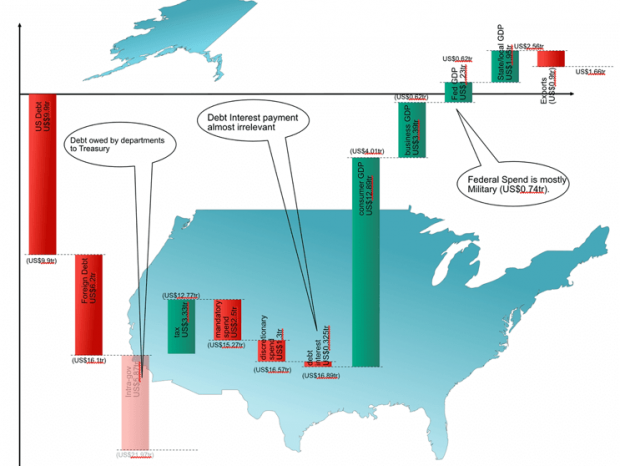 Expanded GDP (Will Murphy)[/caption]
US GDP in 2018 was US$20.5tr or US$18.6tr adjusted for inflation, which is amazing. Only the EU comes close by combining the economies of 27 countries. How is my deficit of US$795b supposed to make an economy of that size grow significantly? I need a multiplier effect on steroids.
I better unpack that GDP figure.
The star is consumer spending at US$12.89tr with business spending a distant second at US$3.39tr. Oh dear, the government's impact on GDP is only US$3.18tr.
Hang on, it’s worse than that. US$3.18tr includes State level and local spending. I don’t control that. Federal Government’s GDP contribution is only US$1.23tr.
I’m going to have to create quite a lot of money. I’m aghast.
Expanded GDP (Will Murphy)[/caption]
US GDP in 2018 was US$20.5tr or US$18.6tr adjusted for inflation, which is amazing. Only the EU comes close by combining the economies of 27 countries. How is my deficit of US$795b supposed to make an economy of that size grow significantly? I need a multiplier effect on steroids.
I better unpack that GDP figure.
The star is consumer spending at US$12.89tr with business spending a distant second at US$3.39tr. Oh dear, the government's impact on GDP is only US$3.18tr.
Hang on, it’s worse than that. US$3.18tr includes State level and local spending. I don’t control that. Federal Government’s GDP contribution is only US$1.23tr.
I’m going to have to create quite a lot of money. I’m aghast.
Bet big on infrastructure?
What can I do? Consumer spending is just under two-thirds of GDP. I have to do something that affects 127 million households.]Tax cuts sound like the best way to do that, but that means that I lose my only weapon against inflation. I will get results relatively fast though, and it will be popular. I need to be certain that American productivity continues to grow. What are my options? Big infrastructure projects sound good. Here are five big ones:- Dulles Transit Extension (cost US$6.2b; 8 years).
- Otay Mesa East (US$715m; awaiting okay).
- O’Hare Modernisation (US$8.8b; 8 years).
- Crescent Corridor Expansion (US$2.5b; 2030).
- Alaskan Way Viaduct (US$3.1b; ?).
MMT is nice in theory.
MMT is praised for its academic rigour, and it is elegant. There are real insights into how money works in a modern economy. Government can treat debt differently to the way an individual or a company treats debt. It has flaws, because it assumes: - That a central government knows enough about a complex economy to second-guess the market. - That that government has enough influence over an economy to meaningfully change it quickly. - That improved economic capacity aligns with economic stimulus. Those assumptions are unrealistic, because the US economy is too large and complex to manipulate centrally. The largest component of US GDP is consumer spend, which admittedly is easy to stimulate with tax cuts. People see money in their accounts, and consumerism does its magic. The investment spending needed to meet that new demand is almost totally out of my control. I can build bridges and improve roads, but the benefits won’t appear for years. In the meantime, I either reverse my tax cuts or start increasing interest rates. I wish MMT were as simple as it sounds.
I've been in the technology industry for 30 years. I began my career writing code to emulate IBM cluster controllers in the twilight of mainframes. In the early 2000s, I designed provisioning software for British Telecom's national MPLS network, before moving into IP network design. In the last ten years my outlook has become more commercial. My academic training started with a. first in Computer Science, and I received my MBA from Durham. I'm a keen runner and play piano.
More in Economics & Macro
Carbon Taxes Go Global: How the EU's Climate Tariffs Are Sparking an Economic Revolution
Swagoto Chatterjee·6 min
The Populist Perestroika: What Lies Behind and What Lies Ahead
Olegs Jemeljanovs, PhD, CFA·13 min
2025: The Year of Post-Surrealism and the Populist Perestroika
Olegs Jemeljanovs, PhD, CFA·3 min