
The healthcare logistics market is booming.
On July 15, healthcare logistics powerhouse Marken announced three acquisitions. Austria-based HETO, Hungary-based Der Kurier, and Italy-based HRTL all agreed to sell. Marken, in turn, was previously acquired by UPS, in an effort to create a life sciences supply chain leader.
The resulting company will cover 51 locations, 10 clinical storage depots, and worldwide reach. In addition, Marken will be able to deliver 7,000 clinical trial shipments every month.
Why is a parcel company pursuing a strategy in life sciences?
The answer is that UPS is just one of many companies that recognizes the opportunity in health care logistics. Also this year, we’ve seen a flurry of additional deals, including
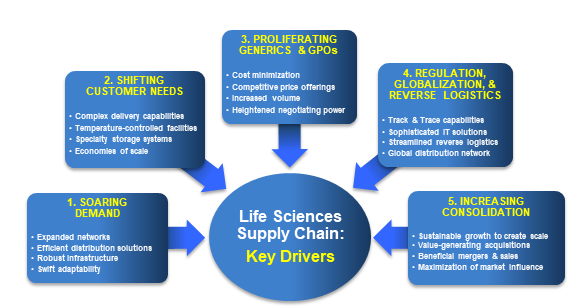 trends driving change in life sciences logistics[/caption]
 As a result, supply chains will have to learn to adapt to distributing to more locations, including residential homes, retirement homes and community centers. This was one catalyst for the Cardinal-Medically Home Group deal. Finding more economical ways to access local settings is key, and creating economies of scale is essential to ensure that numerous locations can be reached with ease.
 Source: Manatt, Phelps & Phillips[/caption]
Industry analysts see this M&A wave continuing. Further, according to a Definitive Healthcare survey just released, industry consolidation was listed as the most important trend of the year, leading the way with 25.2% of the votes.
A key driver is the consolidation wave led by the Big Three in drug distribution, as mentioned above — Cardinal Health, McKesson, and AmerisourceBergen.
Astute companies in the life sciences supply chain are thus recognizing that value-generating mergers and acquisitions are a must. As distributors strive to achieve greater capacity, adapt to a market dominated by GPO-coordinated generic pharmaceutical purchases, and keep pace with escalating regulation and rapid globalization — all the while cutting costs and offering competitive prices — even more transactions are set to materialize in the next 12 months.
Source: Manatt, Phelps & Phillips[/caption]
Industry analysts see this M&A wave continuing. Further, according to a Definitive Healthcare survey just released, industry consolidation was listed as the most important trend of the year, leading the way with 25.2% of the votes.
A key driver is the consolidation wave led by the Big Three in drug distribution, as mentioned above — Cardinal Health, McKesson, and AmerisourceBergen.
Astute companies in the life sciences supply chain are thus recognizing that value-generating mergers and acquisitions are a must. As distributors strive to achieve greater capacity, adapt to a market dominated by GPO-coordinated generic pharmaceutical purchases, and keep pace with escalating regulation and rapid globalization — all the while cutting costs and offering competitive prices — even more transactions are set to materialize in the next 12 months.
- Pharmaceutical distribution leader McKesson’s acquisition of healthcare distributor Medical Specialties Distributors for $800 million
- Dental distribution giant Henry Schein’s acquisitions of Hayes Handpiece Franchises, Cliniclands, and Elite Computer Italia
- Healthcare distributor Cardinal Health’s acquisition of mscripts for SaaS-based mobile-based pharmacy solutions, along with its investment in the virtual hospital Medically Home Group
trends driving change in life sciences logistics[/caption]
Five trends driving change in life sciences logistics
-
Soaring Demand
-
Shifting Customer Needs
As a result, supply chains will have to learn to adapt to distributing to more locations, including residential homes, retirement homes and community centers. This was one catalyst for the Cardinal-Medically Home Group deal. Finding more economical ways to access local settings is key, and creating economies of scale is essential to ensure that numerous locations can be reached with ease.
-
Proliferating Generics and GPOs
-
Regulation, Globalization & Rise of Reverse Logistics
-
Increasing Consolidation
Source: Manatt, Phelps & Phillips[/caption]
Industry analysts see this M&A wave continuing. Further, according to a Definitive Healthcare survey just released, industry consolidation was listed as the most important trend of the year, leading the way with 25.2% of the votes.
A key driver is the consolidation wave led by the Big Three in drug distribution, as mentioned above — Cardinal Health, McKesson, and AmerisourceBergen.
Astute companies in the life sciences supply chain are thus recognizing that value-generating mergers and acquisitions are a must. As distributors strive to achieve greater capacity, adapt to a market dominated by GPO-coordinated generic pharmaceutical purchases, and keep pace with escalating regulation and rapid globalization — all the while cutting costs and offering competitive prices — even more transactions are set to materialize in the next 12 months.
The Road Ahead: Challenge or Opportunity?
In light of the new burdens imposed on distributors by these five industry changes, we see three options available to companies in this sector:- Establish critical capabilities through acquisitions, with a growth strategy to extend your network and enhance your competitive edge.
- Take advantage of favorable capital markets and record deal levels by pursuing a sale or utilizing additional equity to invest in the innovative technologies and modernized facilities necessitated by the transformation.
- Do nothing. However, consolidators like Medline, VWR, and others are swiftly pursuing acquisition-led growth, and you may find your competitive edge eroding in the face of more aggressive competitors.
Benjamin Gordon is an entrepreneur, advisor, and investor for companies in transportation, logistics, and supply chain technology. He is the CEO of Cambridge Capital and BGSA. He is a published author at Fortune, Supply Chain 24/7, Modern Distribution Management, and SupplyChainBrain. He has been interviewed on CNBC and ABC. He hosts BGSA Supply Chain, the industry-only CEO-level conference for all areas of the supply chain. Benjamin graduated from Harvard Business School and Yale College.