5 Unexpected Payment Trends That Could Take 2025 by Storm
Dmytro Spilka·4 min


 And more recently, MAS & Singapore Exchange (SGX) announced the development of an automated method of settlement for tokenized assets. The system was developed by leveraging the open sourced software developed in the Phase 2 of the Project Ubin. It is dubbed as Delivery versus Payment - DvP (securities settlement) mechanism which employs smart contracts to settle transactions on different blockchain platforms. Blockchain startup Anquan, Deloitte & Nasdaq were the technology partners in this recent endeavor where the successful automation has resulted in an increased efficiency, reduced settlement risks while demonstrating interoperability and investor protection. Future phases of the Project include the implementation of the Payment versus Payment - PvP (Cross-border settlement system) before targeting the operating model to streamline processes & assess policy impact. Final phase would be the implementation of a comprehensive Cross-border settlement of payments & securities - DvPvP.
 The phases of 'Jasper' were pretty similar to its contemporary 'Ubin' wherein the first phase consisted of building a DLT platform on the Ethereum platform with the proof of concept mechanism. The second phase of the project saw the transferring of the prototype from Phase I to R3's Corda platform to see how it functions in a centralized structure. The first two phases were completed in 2017. Phase III explored ways to integrate the platform with integrating the digital assets on the platform with foreign exchanges & securities while maintaining the privacy of the market participants which is a unique feature of Jasper. Findings of the third phase were published recently. In addition to this, Bank of Canada has also partnered with Bank of England (BoE) & Monetary Authority of Singapore (MAS) on developing a faster & cost-effective cross-border payments settlement system. A preliminary report has been published by BoC, MAS, BoE & HSBC, with contributions from Toronto-Dominion Bank, the Overseas-Chinese Banking Corporation, the United Overseas Bank, KPMG and Payments Canada which outlines the role of the emerging technology of DLT in this Digital Transformation. The report basically marks the fourth phase of Project Jasper. Both Canada's Jasper & Singapore's Ubin are working hand in hand achieve a cross-border settlement system based on DLT.
 The first phase entailed a study whether the liquidity-saving mechanism of the current Real Time Gross Settlement (RTGS) could be executed in the DLT system. The experiment was conducted with the replication of the real world scenarios in IBM's HyperLedger Fabric framework. Efficiency of the system was measured based on the latency of the system. Safety features were also tested in scenarios of one or more nodes failing or data being sent in an incorrect format. Phase II tested the settlement of securities against cash in a DLT environment. The project found that cash & securities transactions can be executed within the same ledger (single ledger DvP) or on separate ones (cross-ledger DvP - figure above), however the complexity would be greater in the latter. BoJ & ECB continue to experiment with different platforms, software & setups. The practical aspects like the integration with the current systems, partnership considerations or monetary policy implications have not been considered as yet.

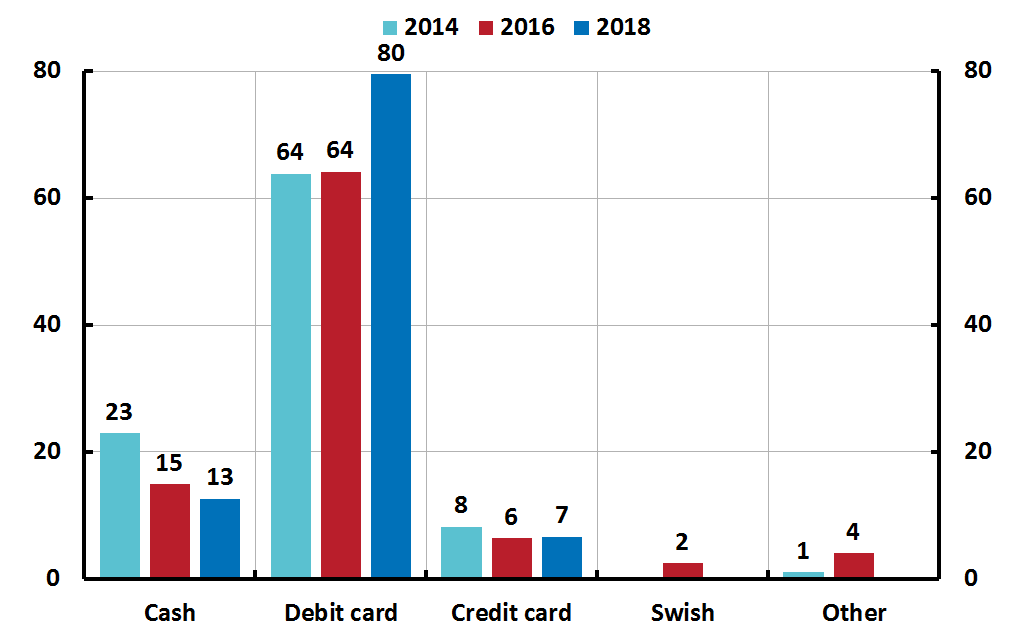 The project was initiated based on some sound statistics on the massive of decline of Cash as a form of payment in the country. According to a 2018 survey of Riksbank only 13% of people are using cash for their purchases falling from 23% just four years ago. If the trend continues Sweden may find itself in a spot where no one is willing to accept Cash as a form of payment. It is obvious the State wants to have an active role in the monetary system and it is not willing to hand it over to third parties which are in nobody's control. Looking at the numbers alone, I am pretty sure Riksbank is going to implement the e-krona system.
Another example of a state issuing a fully digital currency is Petro of Venezuela. Although it has not been a complete success since the government control over it gives a lack of credibility & people in Venezuela are much more comfortable using decentralized Cryptocurrencies like Bitcoin & Dash, which are way more popular than the official digital currency. So far the move by the Venezuelan government to issue Petro to circumvent the economic sanctions & back it with Oil hasn't proved worthwhile. Working on somewhat similar lines, Iran has recently announced its intention of launching 'Crypto-Rial'- digital alternative to its Fiat currency. This is on the back of SWIFT kicking Iran out of the International banking payment system after economic sanctions were placed on the country. Central Bank of Iran has said that the launch of the digital currency goes beyond maneuvering the economic sanctions - they are looking into tapping the immense potential of the blockchain technology to streamline & revolutionize the financial system at the interbank & retail level. And finally, Russia announced the launch of 'Crypto Ruble' more recently. Initially, the Russian stable coin would be exchangeable with an equivalent of its fiat money. It was also announced once the blockchain gains traction & occupies a bigger role in Russia's economy, the Crypto Ruble would completely replace the Fiat Ruble.
International Monetary Fund Chair Christine Lagarde recently cozied up to the idea of Central banks issuing their own digital currency. This is a 180-degree turn from what the monetary authorities have been thinking & saying about digital currencies recently, nevertheless, a welcome development. I believe the financial authorities are finally realizing the potential of Blockchain & Cryptos. The change is coming...
The project was initiated based on some sound statistics on the massive of decline of Cash as a form of payment in the country. According to a 2018 survey of Riksbank only 13% of people are using cash for their purchases falling from 23% just four years ago. If the trend continues Sweden may find itself in a spot where no one is willing to accept Cash as a form of payment. It is obvious the State wants to have an active role in the monetary system and it is not willing to hand it over to third parties which are in nobody's control. Looking at the numbers alone, I am pretty sure Riksbank is going to implement the e-krona system.
Another example of a state issuing a fully digital currency is Petro of Venezuela. Although it has not been a complete success since the government control over it gives a lack of credibility & people in Venezuela are much more comfortable using decentralized Cryptocurrencies like Bitcoin & Dash, which are way more popular than the official digital currency. So far the move by the Venezuelan government to issue Petro to circumvent the economic sanctions & back it with Oil hasn't proved worthwhile. Working on somewhat similar lines, Iran has recently announced its intention of launching 'Crypto-Rial'- digital alternative to its Fiat currency. This is on the back of SWIFT kicking Iran out of the International banking payment system after economic sanctions were placed on the country. Central Bank of Iran has said that the launch of the digital currency goes beyond maneuvering the economic sanctions - they are looking into tapping the immense potential of the blockchain technology to streamline & revolutionize the financial system at the interbank & retail level. And finally, Russia announced the launch of 'Crypto Ruble' more recently. Initially, the Russian stable coin would be exchangeable with an equivalent of its fiat money. It was also announced once the blockchain gains traction & occupies a bigger role in Russia's economy, the Crypto Ruble would completely replace the Fiat Ruble.
International Monetary Fund Chair Christine Lagarde recently cozied up to the idea of Central banks issuing their own digital currency. This is a 180-degree turn from what the monetary authorities have been thinking & saying about digital currencies recently, nevertheless, a welcome development. I believe the financial authorities are finally realizing the potential of Blockchain & Cryptos. The change is coming...
Stay in touch: Twitter | LinkedIn | Tradealike | StockTwits | Telegram
Faisal is based in Canada with a background in Finance/Economics & Computers. He has been actively trading FOREX for the past 11 years. Faisal is also an active Stocks trader with a passion for everything Crypto. His enthusiasm & interest in learning new technologies has turned him into an avid Crypto/Blockchain & Fintech enthusiast. Currently working for a Mobile platform called Tradelike as the Senior Technical Analyst. His interest for writing has stayed with him all his life ever since started the first Internet magazine of Pakistan in 1998. He blogs regularly on Financial markets, trading strategies & Cryptocurrencies. Loves to travel.