When Work Floods: How to Find Scarcity After AGI
Flavio Aliberti·9 min

 We will soon be so outclassed by artificial intelligent machines and robots to create the basic goods we need that we will become a hindrance to productivity. To optimize productivity, we will automate the whole supply chain. The transformation has already started. Our role in the economy will shift towards only consumption. The reason we have supply chains is to ensure we efficiently transform natural resources into consumable goods.
Over the next 20-30 years, automation will affect every sector, including creative ones. AI will accomplish all tasks we usually pay a human being to do. This doesn’t mean humans won’t work for money anymore. There will always be a demand for services rendered by actual human beings, and where there is demand, offers and competition can occur in a free market. In a perfect future economy, people will offer services not because they need to do so to survive, but because they enjoy it. If people enjoy doing certain tasks to fulfill a demand, no one will get in the way, I’m sure. Hence, work will become an option, not a necessity.
We will soon be so outclassed by artificial intelligent machines and robots to create the basic goods we need that we will become a hindrance to productivity. To optimize productivity, we will automate the whole supply chain. The transformation has already started. Our role in the economy will shift towards only consumption. The reason we have supply chains is to ensure we efficiently transform natural resources into consumable goods.
Over the next 20-30 years, automation will affect every sector, including creative ones. AI will accomplish all tasks we usually pay a human being to do. This doesn’t mean humans won’t work for money anymore. There will always be a demand for services rendered by actual human beings, and where there is demand, offers and competition can occur in a free market. In a perfect future economy, people will offer services not because they need to do so to survive, but because they enjoy it. If people enjoy doing certain tasks to fulfill a demand, no one will get in the way, I’m sure. Hence, work will become an option, not a necessity.
 We can imagine companies and the government will own the automated supply chains we depend on. They will ask for compensation for the products and services they provide and the infrastructure they built to make it all work. Again, how can we buy anything if we aren’t earning money? If we aren’t spending, why would companies build automated supply chains in the first place?
To solve the chicken and the egg dilemma, we need to ask a more fundamental question: Why do we think work is the only path towards having money to trade?
We don’t. However, to maintain balance and fairness, money can still be a valuable tool. But how do we get money to buy things?
The simplest answer is anything but work.
Thankfully, there are other ways to have cash-flow in the economy. What we need to decide now is how do we distribute the produced goods fairly. Companies will want compensation, even though they may not have employees anymore. The owners want to see profits and they want to spend whatever money they received as a reward for making our lives easier.
We can imagine companies and the government will own the automated supply chains we depend on. They will ask for compensation for the products and services they provide and the infrastructure they built to make it all work. Again, how can we buy anything if we aren’t earning money? If we aren’t spending, why would companies build automated supply chains in the first place?
To solve the chicken and the egg dilemma, we need to ask a more fundamental question: Why do we think work is the only path towards having money to trade?
We don’t. However, to maintain balance and fairness, money can still be a valuable tool. But how do we get money to buy things?
The simplest answer is anything but work.
Thankfully, there are other ways to have cash-flow in the economy. What we need to decide now is how do we distribute the produced goods fairly. Companies will want compensation, even though they may not have employees anymore. The owners want to see profits and they want to spend whatever money they received as a reward for making our lives easier.
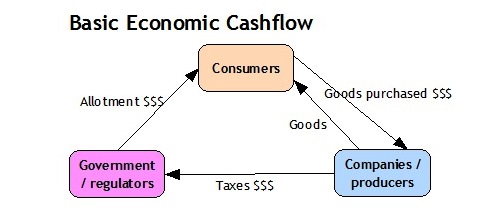 If the population can have money to spend, they will spend it and the money will flow through the economy just like it is now. If we have a population that has money to spend, only then can they buy what they need.
 An alternative idea is to declare the nation’s population collective owners of all the nation’s land. Here, individuals and companies would need to rent the land from the population (managed by a governmental division) and receive lease money as an income to spend back into the economy. Personally, I like the second choice because it allows the population to have a voice on what companies and individuals do with the land, therefore regulating what is a good use or not.
Whatever model we end up choosing, people would naturally buy what they need first with whatever amount they have, and then buy luxuries with whatever remains. We can also agree as a collective on just how much of our natural resources we want to consume while keeping our environment healthy.
If people want to offer services to make more money to buy more stuff, they can still do that and play the offer and demand game just like we’re doing today. That would be pure trade on top of the main cash-flow system. The extra money from one person paid to another for human services rendered. This would be another layer of trade beyond the main supply chains and integrated with it too.
It would be a simple task to integrate a free basic healthcare and education system for all into this model along with optional private services for the population.
What we need to do is to decide what is most important. Work for the sake of work? Or is the most important thing making sure the population has basic needs met, all of us without exception, and make sure the economy supports that?
We could eliminate homelessness, poverty and forced work. It requires restructuring, encouraging automation and changing the criteria giving a human being the right to survive.
I think most of us will agree we want everyone to have basic needs met.
The challenge is to have a consensus on what to do next before the employment-centric economy collapses because of automation disruption. I’m ready to do my part. Are you?
An alternative idea is to declare the nation’s population collective owners of all the nation’s land. Here, individuals and companies would need to rent the land from the population (managed by a governmental division) and receive lease money as an income to spend back into the economy. Personally, I like the second choice because it allows the population to have a voice on what companies and individuals do with the land, therefore regulating what is a good use or not.
Whatever model we end up choosing, people would naturally buy what they need first with whatever amount they have, and then buy luxuries with whatever remains. We can also agree as a collective on just how much of our natural resources we want to consume while keeping our environment healthy.
If people want to offer services to make more money to buy more stuff, they can still do that and play the offer and demand game just like we’re doing today. That would be pure trade on top of the main cash-flow system. The extra money from one person paid to another for human services rendered. This would be another layer of trade beyond the main supply chains and integrated with it too.
It would be a simple task to integrate a free basic healthcare and education system for all into this model along with optional private services for the population.
What we need to do is to decide what is most important. Work for the sake of work? Or is the most important thing making sure the population has basic needs met, all of us without exception, and make sure the economy supports that?
We could eliminate homelessness, poverty and forced work. It requires restructuring, encouraging automation and changing the criteria giving a human being the right to survive.
I think most of us will agree we want everyone to have basic needs met.
The challenge is to have a consensus on what to do next before the employment-centric economy collapses because of automation disruption. I’m ready to do my part. Are you?Sylvain is an international keynote speaker, futurist, entrepreneur and author of the non-fiction book "Engineering Paradise: Are You Ready?". As an entrepreneur, he supports and runs entertainment technology, digital media and international infrastructure funding businesses with multiple partners from around the world. He has a bachelors degree in biochemistry, chemical engineering and education from the University of Ottawa, Canada, has taught from high school to university for over 20 years and has been public speaking for over 12 years. In addition, he currently is a delegate of the World Future Society, a principle at the Canadian Institute of Mass Communication and is a Certified Master Entrepreneur Facilitator & Coach. His passion is now writing and speaking about how artificial intelligence will completely change our society and our economy through articles, other publications and other media formats like video and podcasts.