Something strange is happening to the economics of software. A small team can now build in weeks what might have taken months a few years ago. AI coding assistants generate boilerplate, cloud platforms remove much of the infrastructure setup, open-source libraries provide mature building blocks, and low-code tools can turn an idea into a working product remarkably quickly.
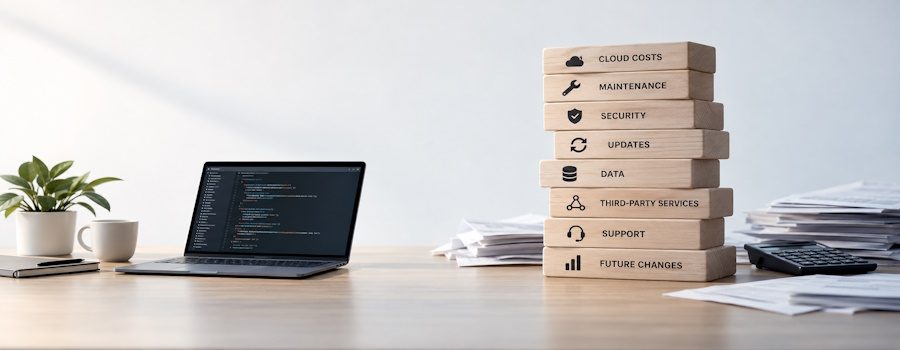
Yet when I look at what businesses actually spend on software over time, I do not see ownership becoming equally cheap. The first version may cost less. The prototype certainly can. But five years of running, changing, securing, supporting, and adapting that software still creates a substantial bill.
This creates a gap that business leaders need to understand. The cost of producing software is falling faster than the cost of owning software. And the more attention companies give to the falling build cost, the easier it becomes to underestimate everything that comes next.
We Keep Measuring the Cheapest Part of the Lifecycle
Software budgets tend to begin with a question: “How much will it cost to build?”
That is understandable because the initial project is visible. There is a team, a timeline, a scope, and a price. Once the product launches, spending becomes fragmented across cloud bills, developers, support contracts, security work, monitoring tools, third-party APIs, database services, upgrades, testing, and small changes requested by the business.
Those costs rarely appear together on one invoice.
This fragmentation can make the original development bill look more important than it really is. A $100,000 application followed by several years of infrastructure, maintenance, support, licensing, security work, and feature changes may be a very different investment from the number approved at project kickoff.
This is why total cost of ownership is a better lens than build cost alone.
The same issue is becoming visible in AI projects. A recent WeblineIndia breakdown of AI software development costs in 2026 separates the initial build from later spending on compute, monitoring, model work, governance, and ongoing product support. The exact mix varies by project, but the larger lesson applies well beyond AI: delivery is one phase of a much longer economic life.
AI Makes Creation Cheaper, Not Responsibility Cheaper
AI coding tools are changing how quickly software can be produced. They can draft functions, generate tests, explain unfamiliar code, create documentation, and help developers move through routine work faster.
That does not mean the software becomes self-sustaining. Every generated feature still creates something that someone must understand, review, test, monitor, secure, and eventually change. The cost may move away from typing code, but it does not disappear.
This is where the economics get interesting. Suppose AI helps a team produce 30 percent more functionality in the same period. The organization now owns 30 percent more behavior that may need future support. If the additional output creates more dependencies, more edge cases, more user expectations, and more infrastructure usage, faster creation can actually enlarge the future maintenance surface.
I explored a related problem in a previous DataDrivenInvestor piece on context debt in AI-assisted software development. Faster code generation can leave teams with more software than shared understanding. That gap becomes expensive later, when people need to modify code whose original reasoning has been lost.
So the financial question is not simply, “How much faster can AI help us build?”
It is, “What are we creating that we will still be paying to understand five years from now?”
Cloud Turned Infrastructure Into a Meter
Before cloud computing, infrastructure spending was painfully visible. Companies bought servers, storage, network equipment, licenses, and data-center capacity. The upfront bill made infrastructure difficult to ignore.
Cloud changed the model. Instead of buying capacity in advance, teams could consume infrastructure as they needed it. That was enormously useful, but it also turned infrastructure into a continuously running meter.
Gartner projected worldwide public-cloud end-user spending at $723.4 billion for 2025, up from $595.7 billion in 2024. It also expected infrastructure-as-a-service spending alone to grow 24.8 percent that year.
The FinOps Foundation’s 2025 survey tells an equally useful story. Its respondents represented companies responsible for more than $69 billion in cloud spending, and workload cost reduction remained their top current priority. Managing AI and machine-learning spending was also moving rapidly up the agenda.
These numbers do not mean cloud is a bad deal. They show something more important: once software is running, infrastructure becomes an operating discipline rather than a purchase decision.
Every user request can trigger compute. Every uploaded file needs storage. Every backup occupies capacity. Every log entry has a home. Every AI request may carry a model cost. Every third-party service can have its own usage-based pricing.
Building the application may become cheaper while using it becomes more expensive.
Every Feature Comes With a Small Annuity
Product teams naturally think about what a new feature will cost to create. They rarely ask what the same feature will cost to own for the next seven years.
Imagine adding document uploads to a business application. The visible work may look straightforward. Users need a button, an upload screen, some storage, and a way to retrieve files. Ownership expands the picture.
Who checks files for malicious content? How long are they retained? What happens when storage grows from 100 GB to 20 TB? Do customers need data-residency controls? Are backups required? Can a user permanently delete a document? What happens if a storage provider changes its pricing? Do old mobile clients still support the feature?
One feature has quietly created storage cost, security work, support cases, privacy questions, compatibility requirements, and future migration work. Multiply that across hundreds of features and you begin to see why mature software costs money even when a team is not building anything dramatic.
This is the part of software economics that feature-roadmap discussions often miss. A feature is not a one-time expense. It is a small recurring liability attached to the product.
Technical Debt Is Really Future Labor
Technical debt is often described as bad code, but that definition is too narrow. The economic meaning is more useful: technical debt is work that makes future change cost more than it otherwise would.
A rushed database design can make reporting harder. A tightly coupled service can make one small product change require changes in five places. Poor documentation can force a new developer to spend days reconstructing decisions. An old library can eventually make a security update far more complicated than expected.
None of these problems need to break the application today. They simply make tomorrow more expensive.
This is why technical debt should not always be treated as something that must be eliminated. Some debt is perfectly rational. A startup may knowingly choose a shortcut because getting to market matters more than creating the cleanest long-term structure.
The mistake is pretending that the shortcut was free. A useful business question is: What future cost did we accept in exchange for moving faster now?
That turns technical debt from an engineering complaint into a capital-allocation decision.
Security Has No “Finished” State
A product can reach feature completeness. Security cannot. Operating systems change. Browsers change. Libraries discover vulnerabilities. Authentication expectations change. Attack methods change. Regulations change. Employees join and leave. Credentials need rotation. Old APIs lose support.
A software product that receives no new features can still require meaningful technical work simply to remain safe and usable. This creates a cost category that AI-assisted development does little to remove.
AI may help developers identify issues or produce fixes faster, but the business still needs processes for patching, access control, testing, monitoring, incident response, backups, dependency updates, and security review.
The better software becomes at serving the business, the greater the potential cost if it fails. That changes the ownership equation. A small internal application used by ten employees carries one level of operating responsibility. A platform processing payments, customer records, contracts, or health data carries another.
The code may be similar in size. The cost of responsibility is not.
Success Itself Makes Software More Expensive
One of the least discussed parts of software economics is that successful products accumulate obligations.
More customers mean more data. More markets mean more legal and localization requirements. Larger customers ask for audit logs, access controls, single sign-on, reporting, data-retention policies, uptime commitments, and security reviews.
Older customers expect old workflows to keep working while new customers request new ones. As a result, product success can increase the number of promises embedded inside the software.
This is one reason I am skeptical of evaluating software productivity only by how much code or how many features a team can ship. Shipping creates commitments.
A previous DDI article argued that AI agents are only as good as the workflows around them. Software economics follows a similar pattern. The cost is rarely located in one piece of technology. It comes from the system of dependencies, processes, users, people, and promises surrounding it.
The Better Metric Is Cost of Change
If I had to pick one number that businesses should pay more attention to, it would not be cost per line of code, developer hourly rate, or even initial project cost.
It would be cost of change.
How expensive is it to safely change the product once it exists?
Can a new developer understand it quickly?
Can one service be replaced without rebuilding half the system?
Can cloud spending be traced to specific products or customers?
Can a feature be removed without breaking three others?
Can the company change vendors without losing operational knowledge?
Can a security patch be shipped in hours rather than weeks?
These questions reveal whether software is becoming an asset that remains adaptable or an asset that becomes harder to move every year.
A system that costs $500,000 to create but remains easy to change may be cheaper over its lifetime than a $150,000 system where every future request becomes a mini-project.
The initial invoice alone cannot tell you which investment was better.
Cheaper Code Changes What Companies Should Value
If AI keeps reducing the effort required to produce software, the scarce resource in software development will move elsewhere. Code generation will matter less as a differentiator. Clear architecture, product knowledge, reliable data, security discipline, maintainability, testing, and the ability to change a live system without disrupting the business will matter more.
That shift has consequences for buyers too. Choosing the lowest-cost development option may become less meaningful if the majority of the product’s economic life sits after the first release. Businesses should pay closer attention to who can maintain the system, who understands the domain, how easily knowledge transfers, how costs behave as usage grows, and what happens when technology choices need to change.
This is not an argument for spending more on every software project. It is an argument for measuring the right thing.
The Build Price Is Becoming the Least Interesting Number
Software creation is going through a genuine cost reset. AI can reduce repetitive development work. Managed cloud services make sophisticated infrastructure accessible to small teams. Open-source ecosystems remove years of foundational work. A founder with the right tools can build something in a weekend that once required a funded team.
That is real progress. But ownership follows a different curve. Software has to live inside changing businesses, changing regulations, changing infrastructure, changing security threats, changing customer expectations, and changing technology. Every successful year adds history to the system, and history has a cost.
The companies that understand this will stop treating software primarily as something they buy or build. They will treat it as something they must be able to change economically for as long as it matters to the business. And in that world, cheaper software creation is only the beginning of the story.
Frequently Asked Questions
Why is software getting cheaper to build but not cheaper to own?
While AI coding assistants, cloud platforms, and open-source libraries have made initial development faster and cheaper, the long-term costs of running, maintaining, securing, and updating software remain substantial. The cost of production is falling faster than the cost of ownership across the entire software lifecycle.
What costs are included in software ownership beyond the initial build?
Software ownership costs include cloud infrastructure bills, developer salaries, support contracts, security work, monitoring tools, third-party APIs, database services, upgrades, testing, and ongoing feature changes. These costs are often fragmented across different invoices and vendors, making them harder to track than the initial development cost.
Why do businesses underestimate the true cost of software?
Companies tend to focus on the visible initial build cost with a clear team, timeline, and scope, while ongoing ownership costs are fragmented across many departments and vendors. This makes the original development bill appear more significant than it actually is relative to total cost of ownership over several years.
How does AI coding assistance affect long-term software costs?
AI coding tools make initial development faster by automating routine work, but they don't reduce the need to understand, review, test, monitor, and secure the generated code. Every feature created still requires someone to maintain and manage it throughout its lifetime.
What is total cost of ownership and why does it matter for software projects?
Total cost of ownership measures the complete cost of building, running, and maintaining software over its entire lifetime, not just the initial development bill. Understanding TCO is crucial because a software project approved based on build costs alone may represent a much larger investment once maintenance, infrastructure, and support are included.
How are AI project costs different from traditional software development costs?
AI projects separate costs into initial build and later spending on compute, monitoring, model work, governance, and ongoing product support. This breakdown illustrates the broader principle that delivery is only one phase of a much longer economic lifecycle for any software project.

As a writer at WeblineIndia, I bridge the gap between complex tech concepts and everyday understanding, making innovation accessible to all. With a background rooted in custom software development, I dive deep into trends, breakthroughs, and emerging technologies, translating them into enlightening articles.