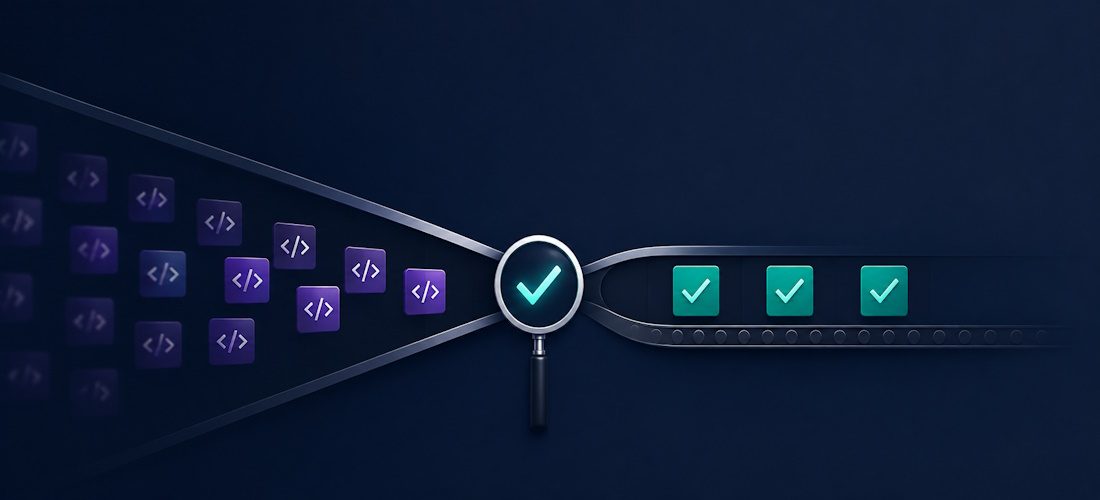
A developer asks an AI coding assistant to add an export feature to an internal reporting tool. Within minutes, there is an endpoint, validation logic, database changes, tests, and a polished pull request. Producing the change was fast, but deciding whether that change is safe to ship is still a very human job.
Someone has to check how the query behaves on a large dataset, whether authorization rules cover every path, what happens if the export fails halfway through, and whether the generated tests reflect the actual requirement. AI has made producing plausible code much cheaper, but it has not reduced the cost of proving that code correct at the same rate.
That difference may become one of the defining engineering problems of AI-assisted development. As code generation gets faster, review, testing, security checks, architectural judgment, and production validation have to absorb more output. The bottleneck is beginning to move from writing software to verifying what has been written.
Code generation is scaling faster than developer confidence
The adoption curve for AI coding tools is already ahead of developer trust. Stack Overflow's 2025 Developer Survey found that 84% of respondents were using or planning to use AI tools in their development process. Yet more developers reported distrusting AI accuracy than trusting it.
That gap matters because developers are not simply handing responsibility to the tool. They are generating code faster while remaining responsible for determining whether the output is correct. AI can shorten the time needed to reach a plausible solution, but every generated solution still enters an engineering system that needs to understand and verify it.
This is one reason the issue goes beyond whether AI writes "good code." As discussed in DataDrivenInvestor's context debt in AI-assisted software development, teams can accumulate software faster than they accumulate understanding of why that software works the way it does. Verification adds another layer to the same capacity problem.
The code may arrive at machine-assisted speed, but trust still has to be earned through review, testing, and evidence.
Why is "almost right" code such an expensive problem?
Obviously broken code is usually easy to reject. It fails to compile, crashes a test, calls something that does not exist, or produces a visible error. Code that is almost correct is much harder because finding the mistake requires understanding the surrounding business and technical context.
Stack Overflow's survey found that 66% of developers identified AI solutions that are "almost right, but not quite" as a frustration. Forty-five percent also reported that debugging AI-generated code can take more time. Those numbers point directly toward the verification problem rather than the generation problem.
Consider an AI-generated refund function. The calculation works for current monthly and annual plans, and the generated tests all pass. What the assistant does not know is that thousands of older customers remain on a discontinued pricing plan with a different refund rule. Nothing in the syntax exposes the mistake. Someone needs historical product knowledge to recognize it.
The same problem appears in infrastructure. An AI-generated database migration can work perfectly against development data while causing table locking under production traffic. The generated code is not obviously poor. Its weakness only becomes visible when somebody verifies it against conditions that were missing from the assistant's context.
Code review was built for a slower production rate
Traditional code review developed around a simple constraint: producing a meaningful software change took time. A developer might spend hours understanding the requirement, inspecting existing code, writing the change, debugging it, and preparing a pull request. That effort naturally limited how much code reached reviewers.
AI changes the production side of that equation. A developer can now generate an initial solution, refactor surrounding code, produce tests, add documentation, and explore alternative approaches within a fraction of the previous time. The reviewer does not receive the same multiplier.
Reading 800 changed lines is still reading 800 changed lines. Understanding how those lines interact with a mature system still requires attention. This creates an uncomfortable mismatch where the cost of producing a pull request falls much faster than the cost of reviewing one properly.
A reviewer now needs to look beyond whether the code appears clean. The useful questions become:
Does the behavior match the actual requirement?
Which assumptions did the coding assistant make?
What happens with old or unusual data?
What happens when an external service fails?
Are authorization and permission rules preserved?
Do the tests prove the requirement or simply mirror the generated code?
These questions are harder to automate because they depend on context. AI is particularly capable of producing code that looks conventional, which makes surface-level review less useful precisely when generated output becomes more common.
Why can generated tests create false confidence?
AI coding assistants are very capable test generators. They can create fixtures, propose edge cases, mock dependencies, build regression tests, and cover repetitive test scenarios much faster than a developer writing everything manually.
The problem appears when the same reasoning produces both the feature and the evidence that supposedly verifies it. If an assistant misunderstands a requirement and then generates tests based on that same interpretation, every test can pass while the software still behaves incorrectly.
Imagine a requirement that allows customers to change a delivery date until 24 hours before dispatch. The assistant interprets "dispatch" as the shipment date stored on the order. The actual business rule refers to the warehouse pickup time, which may occur hours earlier. It then writes both the feature and tests around the wrong timestamp.
The test suite has verified consistency between two artifacts based on the same assumption. It has not verified the real business rule.
That is why AI-generated tests should not become the only evidence for AI-generated code. Acceptance criteria should come from an independent source, such as product requirements, domain experts, production incidents, security policies, or manually defined examples. Generated tests are useful, but test intent still needs human ownership.
Security turns verification into a bigger engineering concern
Security makes the verification gap harder to ignore because secure code is not simply code without obvious bugs. A generated API endpoint can be well structured while returning more customer data than a user should see. A dependency can solve the technical problem while introducing a package the organization does not want in production.
AI did not create these risks. What changes is the amount of software a team can produce before somebody with enough security or architectural knowledge examines it. Faster generation can increase the surface area that needs checking even when the average quality of individual suggestions improves.
Some verification work can and should be automated. Teams can use:
Static analysis for known unsafe patterns
Dependency and vulnerability scanning
Secret detection before commits reach the repository
Automated policy checks
Security-focused test suites
Runtime monitoring for unexpected behavior
These controls scale better than relying entirely on manual review. Yet they cannot answer every question. A scanner may identify a vulnerable package, but it may not know whether a particular endpoint violates a customer's contractual data-access rules. Automated checks increase verification capacity, but they do not remove the need for engineering judgment.
Is production becoming part of the verification process?
Some software behavior cannot be fully proven before release. Real traffic, unusual customer data, third-party outages, concurrency, network conditions, and long-running processes expose situations that development and staging environments cannot reproduce perfectly.
That means verification increasingly continues after deployment. Teams need enough observability to determine whether a new change behaves as expected, whether error rates move, whether latency increases, and whether customers encounter failures that the test suite never anticipated.
This is similar to the broader systems problem discussed in AI Agents Are Only as Good as the Workflows Around Them. AI capability alone does not determine the result. The surrounding process determines whether the capability can be used safely and consistently.
Coding assistants face the same constraint. A powerful AI coding tool inside a weak review, testing, deployment, and monitoring process does not automatically create a faster engineering organization. It can simply move unfinished reasoning further downstream.
Should verification capacity become an engineering metric?
Software organizations have spent years measuring how quickly work moves through development. Lead time, deployment frequency, cycle time, pull request throughput, and completed tickets all provide useful signals. AI can make some of these metrics harder to interpret.
Suppose a team adopts coding assistants and produces 30% more pull requests. That appears positive until review queues grow, average change size increases, senior developers spend more time checking generated output, and post-release rework rises. The organization produced more code, but it may not have produced more trustworthy software.
Instead of looking only at generation or delivery volume, teams can watch a smaller set of verification signals:
Review wait time: How long does finished code wait for meaningful human review?
Change failure rate: How often does a deployed change require a fix, rollback, or urgent follow-up?
Rework after merge: How much supposedly completed work needs correction shortly after approval?
Escaped defects: How often do problems survive testing and reach customers?
Time to diagnose: How quickly can engineers understand why a newly shipped change failed?
Pull request size: Is AI increasing the amount of code reviewers must understand in each review?
These measures do not need to become another collection of targets for developers to chase. Their value is diagnostic. If code output increases while verification queues and rework rise with it, the team has probably moved the bottleneck rather than removed it.
DataDrivenInvestor's discussion of why companies need AI in workflows rather than just products applies equally well inside engineering. A coding assistant changes one activity. Capturing its full value requires changing the workflow around that activity.
Smaller AI-generated changes may be more valuable than bigger ones
One practical response to faster code generation is surprisingly simple: keep changes small. AI makes it tempting to ask for an entire feature, refactor, test suite, error-handling layer, and documentation update in one pass because generating all of it costs very little extra time.
The reviewer pays for that convenience. A large generated pull request asks somebody to understand many assumptions simultaneously. Smaller changes create clearer verification boundaries and make it easier to compare behavior with the original requirement.
A useful AI-assisted development workflow can therefore favor:
One clearly defined behavior per change where practical
Explicit acceptance criteria before code generation begins
Human-written explanations for unusual architectural decisions
Independent test cases for business-critical behavior
Extra review for authorization, data access, payments, and migrations
Production monitoring tied to higher-risk releases
This approach may appear to give away some of AI's speed, but generating code quickly is not the final objective. The objective is to deliver software the organization can understand, operate, and change safely.
This is also why a mature software development process still matters when teams adopt AI coding tools. Requirements, architecture, review, testing, deployment, and maintenance remain connected stages of delivery even when AI compresses the coding portion of the work.
Can AI help solve the verification bottleneck it creates?
AI can also increase verification capacity. A second AI pass can inspect a pull request, propose edge cases, search for risky assumptions, compare code with acceptance criteria, identify missing tests, or explain unfamiliar changes before a human reviewer begins.
The useful distinction is that the verifier should be asked to challenge the generated solution rather than merely describe it. If the same assumptions are supplied to both generation and verification, the second pass can reproduce the first mistake with equal confidence.
Teams can make AI-assisted verification more useful by giving it adversarial tasks:
Find ways this change could fail in production.
Identify assumptions that are not represented in the tests.
Compare the code against the acceptance criteria rather than the original prompt.
Look for permission, privacy, and data-access risks.
Identify existing behavior that this change could accidentally alter.
Suggest production signals that would reveal an incorrect assumption.
Human reviewers benefit from the same mindset. The value of a second reviewer is not simply that another person reads the syntax. The value is that another perspective challenges the reasoning behind the change.
When code becomes abundant, judgment becomes scarce
Software organizations have historically treated coding capacity as a major constraint. Better frameworks, cloud platforms, open-source libraries, and developer tooling gradually reduced the amount of work required to build software. AI coding assistants are pushing that trend much further.
What they do not make abundant is engineering judgment. Knowing which requirement matters, which failure mode deserves attention, which architectural compromise is acceptable, which test proves the right behavior, and which production signal indicates trouble still depends heavily on context.
The next phase of AI-assisted software development may therefore be less about how much code a team can generate and more about how much generated code the team can confidently absorb. Organizations that increase generation without increasing verification capacity may simply create larger review queues, more rework, and software that fewer people fully understand.
AI is changing the economics of writing software. The teams that benefit most will not necessarily be the ones generating the largest amount of code. They will be the ones that become better at deciding which code deserves to ship.
When creation becomes cheap, verification becomes valuable. And when software can be produced faster than a team can review, test, secure, understand, and observe it, coding is no longer the real bottleneck. Trust is.
Frequently Asked Questions
What is the main bottleneck in AI-assisted software development?
The bottleneck is shifting from writing code to verifying it. As AI code generation becomes faster, the time and effort required for review, testing, security checks, and validation has not decreased proportionally, making verification the critical constraint in AI-assisted development.
Why is AI-generated code that is 'almost right' so problematic?
Almost-correct code is expensive to fix because finding the mistake requires deep understanding of business and technical context, unlike obviously broken code that fails immediately. According to Stack Overflow's survey, 45% of developers report that debugging AI-generated code takes more time than expected.
Do developers trust AI coding tools?
While 84% of developers are using or planning to use AI tools, more developers reported distrusting AI accuracy than trusting it, creating a gap between adoption rate and confidence level. Developers remain responsible for verifying that AI-generated code is correct before shipping it.
What specific aspects of code need human verification when using AI assistants?
Developers must verify query performance on large datasets, whether authorization rules cover every code path, error handling for failures, whether tests match actual requirements, and architectural soundness. These verifications cannot yet be automated at the same speed as code generation.
How does AI code generation relate to context debt?
Teams can accumulate software faster than they accumulate understanding of why that software works, creating context debt. Verification adds another layer to this capacity problem, as faster code generation requires teams to maintain thorough understanding across more code.
What percentage of developers struggle with AI-generated code quality?
According to Stack Overflow's 2025 Developer Survey, 66% of developers identified AI solutions that are 'almost right, but not quite' as a frustration, indicating widespread concerns about subtle bugs in AI-generated code.

As a writer at WeblineIndia, I bridge the gap between complex tech concepts and everyday understanding, making innovation accessible to all. With a background rooted in custom software development, I dive deep into trends, breakthroughs, and emerging technologies, translating them into enlightening articles.