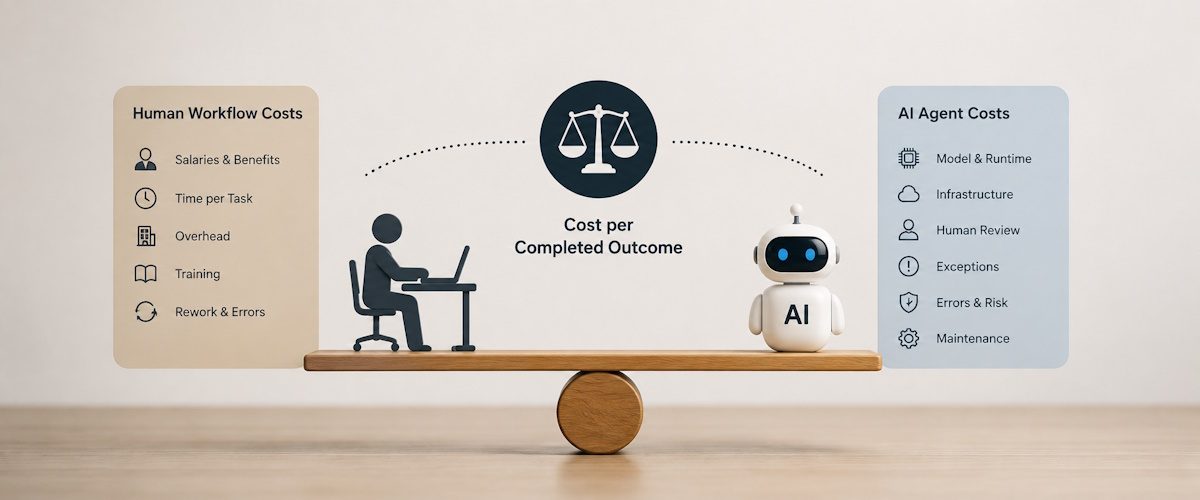
An AI agent that costs a few cents to run can still be more expensive than a person. The model bill tells only a small part of the story if 30% of outputs need review, 8% fall into an exception queue, and one bad action creates hours of cleanup. The useful comparison is not machine minutes against human wages. It is the total cost of reaching an acceptable business outcome.
That distinction matters because many AI business cases still start with the wrong denominator. Teams compare API spend with payroll, see a large gap, and assume the agent has already won. In practice, an agent becomes cheaper only when its runtime cost, review cost, exception cost, expected failure cost, and share of fixed operating cost remain below the fully loaded cost of the human workflow it is replacing or reshaping.
This is also why workflow design matters more than the demo. DataDrivenInvestor has already covered how AI agents depend on the workflows around them, because the agent inherits the rules, data quality, handoffs, and approval paths of the process it enters. The same logic applies to economics: weak workflows make cheap models expensive.
Start With Cost per Completed Outcome
The cleanest unit of comparison is cost per completed task that meets the required quality bar. For a human workflow, that usually begins with loaded labor cost multiplied by the time needed to finish the task, then adds rework, supervision, software, and overhead where they materially affect the result. For an agent, the base model call is only one line in a wider cost stack.
A useful first-pass formula is:
Human cost per task = loaded hourly labor cost × task time in hours + rework + process overhead
Agent cost per task = runtime + human review + exception handling + expected failure loss + allocated fixed cost
The formula is simple on purpose. It forces the team to compare the same outcome on both sides instead of comparing salary with tokens. It also makes the break-even point visible, because every variable can be changed and stress-tested before a large rollout.
Human Work Costs More Than the Wage Line
A company does not pay only the number that appears on a worker's paycheck. In March 2026, the U.S. Bureau of Labor Statistics reported that private-industry employer compensation averaged $46.60 per hour, including wages and benefits. The figure varies sharply by occupation, region, seniority, and company size, so it should not be treated as a universal benchmark.
Still, it is useful for showing why hourly wage alone can distort an automation case. If a repetitive task takes 12 minutes and the relevant loaded labor cost is $46.60 per hour, the direct labor component is about $9.32 per completed task. A company should replace that figure with its own finance data, but the method is more useful than a generic claim that AI is cheaper than people.
The human baseline can also move after AI enters the process. An NBER study of 5,179 customer-support agents found that access to a generative AI assistant increased issues resolved per hour by about 14% on average, with much larger gains among less experienced workers. A March 2026 NBER study based on a survey of nearly 750 corporate executives also found positive but varied productivity gains across firms and sectors. That means the right comparison is sometimes not “agent versus human,” but “autonomous agent versus AI-assisted human.”
The Agent Has a Cost Stack Too
The first layer is runtime. That includes model inference, tool calls, search, retrieval, vector storage, third-party APIs, and the compute needed to coordinate multi-step tasks. A single request may look cheap, but an agent that plans, retries, calls several tools, checks its work, and writes back to business systems can consume far more resources than a one-shot prompt.
The second layer is human review. Review cost depends on how often people check the agent and how long each check takes. A workflow that needs a three-minute review on every task may still save money, but the economics can look very different from a workflow where only 10% of cases need a person.
The third layer is exceptions. Real business processes contain missing fields, ambiguous requests, policy conflicts, stale records, unusual customers, and actions that need approval. Every time the agent stops and sends work back to a person, part of the labor cost returns.
The fourth layer is expected failure loss. This is the number most pilots ignore because it rarely appears in the model invoice. If an incorrect action can cause a refund error, compliance issue, customer loss, duplicate payment, or hours of recovery work, the expected cost belongs in the unit economics.
The fifth layer is fixed operating cost. Building connectors, setting permissions, logging actions, testing prompts, maintaining retrieval data, monitoring behavior, and keeping fallback paths available all cost money before the next task starts. A recent WeblineIndia breakdown of generative AI development costs makes the same broader point: build cost and recurring run cost need to be considered together rather than treated as separate business cases.
A Simple Break-Even Example
Consider a back-office task that takes a person 12 minutes. Using the $46.60 loaded hourly cost above, direct labor is about $9.32 per task. Now assume an agent is introduced for the same workflow, with the numbers below used only as an illustrative model rather than an industry benchmark.
Cost component | Illustrative agent cost per task |
|---|---|
Runtime and tool calls | $0.30 |
Allocated fixed operating cost | $0.30 |
Human review: 20% of tasks, 3 minutes each | $0.47 |
Human exception handling: 8% of tasks, 12 minutes each | $0.75 |
Correction work: 2% of tasks, 10 minutes each | $0.16 |
Expected failure loss: 0.5% × $150 | $0.75 |
Total | $2.72 |
Under those assumptions, the agent workflow costs roughly 71% less per completed task than the human-only version. That sounds decisive, but the model is sensitive to variables that are often guessed during a pilot. If the average loss from a harmful error rises to $1,000, a 1% harmful failure rate alone adds $10 per task and wipes out the labor advantage.
That is the break-even insight. A cheap model does not rescue an expensive error profile. The higher the consequence of a bad action, the lower the failure rate must be before autonomy makes financial sense.
Exception Rate Is Often the Hidden Variable
Teams tend to focus on model quality because it is easy to benchmark. Workflow economics are often decided by the percentage of cases that fall outside the clean path. An agent that handles 92% of routine cases cheaply can still create a poor business result if the remaining 8% are slow, difficult, and costly to resolve.
Good agent candidates usually share a few traits:
The task repeats often enough to spread fixed cost across meaningful volume.
Inputs and success criteria are clear.
Most actions are reversible or low consequence.
Exceptions can be identified early and routed cleanly.
The business can measure task completion, rework, and failure cost.
The opposite profile should make leaders cautious. Low-volume work, vague judgment, high financial consequence, relationship-heavy decisions, or messy data can leave too much cost in the exception path. In those cases, AI may still help a person work faster without being the cheaper autonomous option.
Human Review Has Its Own Break-Even Point
Human review is sometimes treated as a temporary step that will disappear once the agent becomes better. That assumption can create misleading forecasts because some workflows should keep review for economic reasons, not just trust reasons. A three-minute check can be cheap insurance when a wrong action carries a large expected loss.
The question is how much review buys enough risk reduction. If every case gets reviewed, the company may remove little labor from the process. If almost nothing gets reviewed, expected failure loss can rise faster than the savings created by autonomy.
This is where the broader AI ROI conversation becomes more useful. DataDrivenInvestor has argued that AI return cannot be reduced to a simple cost-versus-output calculation, because the technology changes decisions and the structure of work. For agent economics, review is part of that structure, and it should be priced explicitly rather than hidden inside a management assumption.
Autonomy Should Be Priced as Risk
There is a major economic difference between an agent that drafts an email and an agent that sends it, between an agent that flags an invoice and one that releases payment, and between an agent that recommends a refund and one that issues it. The model may be identical in each pair. The cost of being wrong is not.
This is why autonomy should be treated as a financial variable. As authority grows, the expected loss per bad action can grow with it, which means the acceptable failure rate has to fall. A task can be technically automatable long before it becomes economically sensible to automate without approval.
That framing also changes how teams think about permissions. Limiting an agent to reversible actions may reduce the amount of labor removed, but it can sharply reduce expected failure loss. Controlled autonomy can beat full autonomy on unit economics even when the fully autonomous demo looks more impressive.
Volume Can Make or Break the Case
Fixed cost is easy to ignore when a pilot processes a small set of test tasks. Once the system moves into production, the company has to maintain connectors, access controls, evaluation sets, logs, model changes, fallback paths, and operational ownership. Those costs need to be divided by the number of useful tasks the system completes.
Assume the fixed operating cost is $3,000 per month. At 10,000 completed tasks, that is $0.30 per task. At 500 tasks, it becomes $6 per task before model calls, review, exceptions, or failures are added.
This is one reason the best first agent is often attached to a boring, repetitive workflow rather than an occasional executive decision. High volume gives fixed cost room to fall, while repetitive structure makes exceptions easier to understand. DataDrivenInvestor's earlier case for putting AI into workflows rather than product features fits the economics here as well: the measurable value sits in completed work, not in the presence of an AI button.
The Hybrid Model Often Wins First
There are really three operating models to compare: human-only work, AI-assisted human work, and agent-led work with human exceptions. Companies often jump from the first to the third because full autonomy makes the savings case look larger. The middle model can be the better economic choice when judgment remains expensive to automate.
AI assistance reduces the time a person spends on search, drafting, classification, or context gathering while leaving final control with the worker. That can capture part of the labor benefit without exposing the business to the full expected loss of autonomous action. The NBER customer-support study is useful here because it shows measurable productivity gains even when the person remains responsible for the conversation.
Agent-led work becomes more attractive as the process becomes bounded, measurable, high-volume, and low in costly exceptions. That is not a permanent hierarchy. A workflow can move from assistance to partial autonomy as evidence accumulates and the exception path becomes better understood.
Build the Business Case Around Sensitivity, Not One Forecast
A single ROI estimate creates false confidence because agent economics can change quickly when one assumption moves. The better approach is to model several cases before deciding that a workflow should become autonomous. Leaders should know what happens if review rises from 10% to 30%, exception rates double, runtime cost falls by half, or the average failure loss is five times higher than expected.
The most useful variables to stress-test are human minutes per task, loaded labor cost, monthly task volume, agent runtime cost, review rate, review time, exception rate, exception handling time, harmful failure rate, average loss per harmful failure, and fixed monthly operating cost. These numbers create a break-even range rather than a single headline estimate. They also expose which assumption the business case depends on most.
If the economics collapse when one variable changes slightly, the workflow is not ready for aggressive autonomy. If the agent remains cheaper across a wide range of plausible conditions, the case is much stronger.
The Break-Even Point Is a Workflow Number
An AI agent becomes cheaper than a human workflow when the total expected cost of producing an acceptable outcome falls below the human alternative at the required quality and risk level. That calculation has to include review, exceptions, failure loss, fixed operating cost, and the human work that remains around the agent. Token price is part of the equation, but it is rarely the whole equation.
The best candidates are not simply tasks that an AI agent can perform. They are tasks where the economics survive real-world friction. Clear rules, meaningful volume, measurable outcomes, bounded consequences, and a manageable exception path give the agent room to create financial value.
For business leaders, the next question should not be “How much does the model cost?” It should be “What does one completed, acceptable outcome cost after every human, machine, exception, and failure is counted?” That number tells you when the agent is actually cheaper.
Frequently Asked Questions
How should a company calculate the cost of an AI agent per task?
Start with runtime and tool costs, then add the cost of human review, exception handling, expected losses from failures, and a share of fixed monthly operating costs. Divide the total by completed tasks that meet the required quality bar. Comparing only API spend with wages will usually overstate the savings.
Is a fully autonomous AI agent always cheaper than AI-assisted staff?
No. Full autonomy can lower direct labor while raising the expected cost of errors, exception handling, and recovery. For many workflows, AI-assisted staff can deliver a better cost profile because people remain at the points where judgment or accountability is expensive to automate.
Which workflows are most likely to reach break-even first?
High-volume, repetitive workflows with clear inputs, measurable outcomes, low-cost failures, and clean exception routes are usually stronger candidates. Low-volume work with ambiguous judgment or costly irreversible actions is harder to justify on unit economics alone. The workflow should be measured before autonomy is treated as the goal.
What is the most overlooked cost in AI agent ROI?
Expected failure loss is often the missing line. Teams usually estimate model cost and labor saved, but a small failure rate can dominate the economics when each bad action is expensive. The right calculation multiplies the probability of a harmful failure by its average business cost and includes that amount in every task's expected cost.

As a writer at WeblineIndia, I bridge the gap between complex tech concepts and everyday understanding, making innovation accessible to all. With a background rooted in custom software development, I dive deep into trends, breakthroughs, and emerging technologies, translating them into enlightening articles.